Marsilio Ficino died on 1 October 1499, just outside Florence. He was 65, a priest and a scholar who had spent his working life turning ancient Greek philosophy into Latin. Four days earlier he had made his will and asked for a very simple funeral.
A story grew up around that morning. Years before, he and an old friend had talked for hours about whether the soul lives on after the body dies. At the end they shook on a promise: whoever died first would come back, if he could, and tell the other what the next world was like.
The rider in white
Early one morning, the friend sat at his books. He heard a horse galloping down the street. It stopped at his door, and he heard Ficino’s voice: “O Michael! O Michael! those things are true.”
He got up and looked out of the window. There was Ficino’s back, dressed in white, riding away on a white horse. The friend called after him and watched until the rider was gone. Later came the news that Ficino had died at that same hour. From then on the friend gave up worldly study for theology.
The friend was Michele Mercati, a humanist from San Miniato who exchanged letters on philosophy with Ficino. The tale came down through his family. His grandson, also named Michele, became a physician and kept the Vatican’s botanical garden. The grandson passed the story to Cardinal Cesare Baronius, who was writing a great history of the Church and printed it there. In 1593 Baronius sat at the grandson’s deathbed in Rome.
Later retellings merged grandfather and grandson into one man.
In 1813 the English doctor John Ferriar put the story into a medical study of apparitions. He believed the witness: “I entertain no doubt, that Mercato had seen what he described.” The cause, for him, was the hour itself. A man alone at his books before dawn, thinking about Plato and his friend’s promise, saw what his own mind produced.
The man who read Hermes before Plato
The question in that promise had been Ficino’s work for decades. Between 1469 and 1474 he wrote a long book called Platonic Theology, subtitled On the Immortality of Souls.
He owed his whole career to one patron. His father was a doctor in the service of Cosimo de’ Medici, the banker who ran Florence. Cosimo gave the son a house and land at Careggi in 1463 and handed him the complete works of Plato to translate.
Then Cosimo changed the order. Also in 1463, he told Ficino to put Plato aside and first translate Hermes Trismegistus, the legendary Egyptian sage. Both men believed Hermes had lived long before Plato. Ficino later set the order down in Latin: “he gave me Mercurius Trismegistus to translate first, and Plato soon after.”
He finished in a few months. Cosimo died in 1464, and the historian Frances Yates thought he probably wanted to read Hermes before he died. The Latin Hermes, called the Pimander, went to press in 1471 and stayed in print for over a century (more in Hermes Trismegistus and alchemy).
Ficino’s own Plato was printed in 1484, twenty-one years after Cosimo made him stop for Hermes. He was ordained a priest in 1473 and became a canon of Florence cathedral in 1487.
The last year
In 1497 Ficino’s friend Bernardo del Nero was executed, and Ficino turned on Girolamo Savonarola, the Dominican preacher who then dominated Florence. He addressed a pamphlet to the cardinals in Rome whose title calls Savonarola the Antichrist. The friar was executed in the city’s main square on 23 May 1498.
Ficino had faced his own accuser in 1490, when someone denounced him to the pope for the star magic in a medical book (see How Marsilio Ficino escaped the Inquisition).
On 27 September 1499 he made his will in the church of San Marco, the convent where Savonarola had once taught. He asked for thirty Gregorian masses there, a series said for one dead person on thirty days in a row. Four days later he died at Careggi. He was buried in the cathedral of Santa Maria del Fiore, where he had served as a canon.
Across traditions: death-days and promises
Ficino’s circle already marked the anniversary of a death. In Ficino’s 1469 book on love, Plato dies on 7 November, his 81st birthday. He was sitting at a feast, just after the food had been cleared. The ancient Platonists marked the day with a banquet every year until late antiquity. Then the custom lapsed for twelve hundred years.
Lorenzo de’ Medici, Cosimo’s grandson, revived it. He gave the task to Francesco Bandini, who invited nine Platonists to Careggi for 7 November. Ficino made the ninth, so the table matched the number of the Muses. After the meal one guest read Plato’s Symposium aloud. A rumour, repeated in a 1909 Catholic encyclopedia, has Ficino keeping a lamp burning in his room before a bust of Plato.
In 1746 a French Benedictine scholar, Augustin Calmet, set the Ficino story beside another pact. Blessed Joseph of Leonessa, a Capuchin missionary, and a fellow friar agreed that whoever died first would appear to the other, “if God allows him.”
The same promise turns up in the twentieth century. The escape artist Harry Houdini and his wife Bess agreed on a code, “Rosabelle, believe,” which he would send if the dead could speak. He died on Halloween 1926.
Bess held a séance every Halloween for ten years. After the last one, on a Hollywood hotel roof in 1936, she put out the candle she had kept burning beside his photograph. In 1943 she said ten years was long enough to wait for any man.
The day today
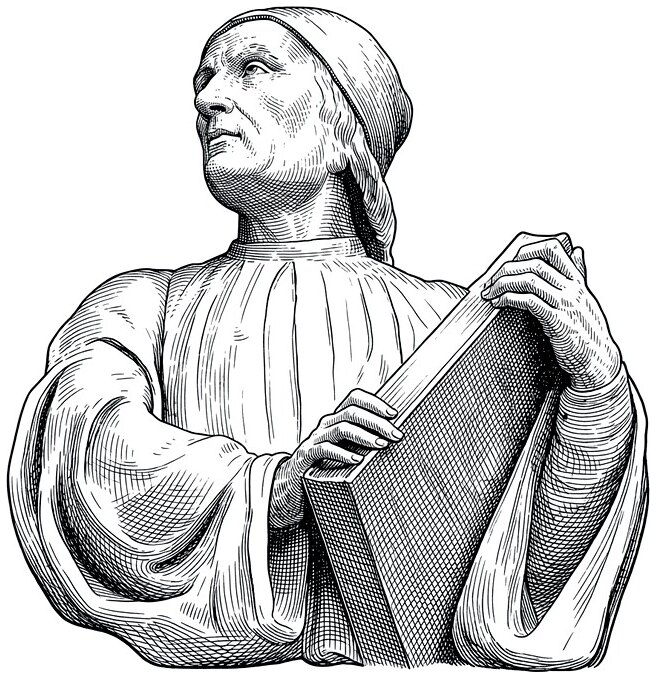
Ficino got his tomb late, but in 1521, when the Medici were back in favour, the sculptor Andrea Ferrucci carved him for the south side of the cathedral nave. The white marble bust still sits in a red niche in a canon’s robes, turned towards the light under the dome, and holds a large book in both hands.
The Latin below it reads, in our translation: “Look, stranger: here is Marsilio, father of wisdom. He brought the Platonic teaching back to light, buried by the fault of the times, and was the first to open its sacred doors to Latium. He lived happily by the gift of Cosimo and Lorenzo de’ Medici; now he lives again at public expense.”
The stone is signed by the Senate and People of Florence, 1521.