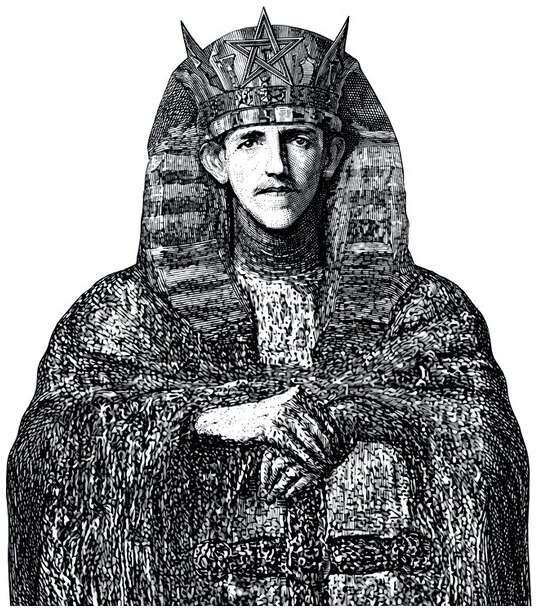
On 18 December 1967 a parcel from Scotland reached the cottage of Ithell Colquhoun, a British painter close to the Surrealists who also practised ritual magic, and inside it was an oil painting. A relative of a Mrs. Weir had come across it while sorting lumber before a house move and, instead of putting it on a bonfire, offered to send it to Colquhoun. Mrs. Weir had once led a magical lodge in London, a branch of a secret society, and that lodge had been founded by Moina Mathers, the woman who painted the picture.
Colquhoun tore away the wrapping. Out of the shadows looked a man in a striped Egyptian headcloth and a red mantle, with both hands folded on the hilt of a sword. “The face of an angel” was her first thought, she wrote later; she kissed the painted lips and then, crouched on the floor beside the picture, burst into tears. She had seen it once before, as a student, in Mrs. Weir’s drawing-room, and from what people had told her about the sitter she expected a domineering, difficult man. The face she unwrapped looked to her “compassionate” and “transparently sincere”. The man was Samuel Liddell MacGregor Mathers, and the painter was his wife Moina. He had died in Paris on 20 November 1918.
Colquhoun spent the next years writing his life. She called the book Sword of Wisdom (1975), and on its title page she set lines from a French poem that she thought might have been written for the portrait: “his two hands resting / On the sword of wisdom”. When she reached his death, she found that the people who had known him disagreed about it.
The man in the painting
Mathers was born in Hackney, in London, on 8 January 1854. In 1888 he and two other men founded the Hermetic Order of the Golden Dawn (the Golden Dawn for short) in London, a secret society whose members, men and women, studied and practised magic. Its aim, as Moina later put it, was “to bring a man to the knowledge of his higher self”, and the teaching was given “principally by Ceremony, Ritual, and Lecture”. According to her, Mathers wrote nearly all of it himself, guided by “occult teachers” who told him to found the order, handed him “the skeleton of the work” and later told him to move to Paris. In the order these unseen guides were called the Secret Chiefs, and Mathers spoke of them as beings whose presence a mortal could hardly bear. He told the poet W. B. Yeats, one of his students, that he sometimes met them in a crowd and knew them for phantoms only “by a shock that was like an electric shock to his heart”.
He also translated old books of magic into English. One was The Book of the Sacred Magic of Abramelin the Mage (1898), a ritual of many months for meeting one’s guardian angel, which is the subject of the film A Dark Song. Another was the Goetia, a list of seventy-two spirits and how to summon them (see The Ars Goetia).
Moina was born Mina Bergson, the sister of the French philosopher Henri Bergson, and she was the first person initiated into the order. In 1892 the couple moved to Paris. In 1900 the members in London expelled Mathers from the order, and in Paris he carried on with a successor order called the Alpha et Omega. In France he called himself the Comte de Glenstrae, after an ancestor who, Moina wrote, had gone over to France after the Jacobite rising of 1745 and been made a count by the French king Louis XV. Colquhoun left that claim for “some dedicated genealogist to verify”.
The death certificate
Colquhoun traced the French record of his death and printed it in her book. According to the certificate, Mathers died at his flat at 43 rue Ribera, in the Auteuil quarter on the western edge of Paris, on 20 November 1918, nine days after the armistice ended the fighting of the First World War. It calls him by his French title of count. It gives his birthplace as “Perth, Ecosse”, in Scotland, and his age as fifty-eight, although he was born in Hackney and was sixty-four. Colquhoun thought that Moina, or a friend she sent in her place, gave these details to the clerk at the town hall and was perhaps too shocked to get them right. The certificate names no cause of death, because French law at the time did not require one.
The historian Ellic Howe, whose documentary history of the Golden Dawn came out in 1972, also gives 20 November 1918, and adds: “It is extraordinary how little is known of his life after 1900.” Today Wikipedia gives the date as “5 or 20 November” and calls the certificate lost, although Colquhoun printed it. The 5 November date sits in Wikidata, the free database that feeds many reference sites, and the only reference given for it there is “imported from Wikimedia project”, which suggests it was copied from a Wikipedia page rather than from a book or document.
Mathers’s birth certificate names his father as William Mathers, a merchant’s clerk. On the certificates of his marriage in 1890 and his death in 1918, the father has become William MacGregor Mathers.
Four ways to die
With no cause on paper, the people who had known Mathers filled the gap, and each of them filled it differently.
Yeats wrote first. In The Trembling of the Veil, privately printed in 1922, he remembered staying with the couple in Paris in the 1890s. At night Mathers would dress in Highland costume and dance the sword dance, and Yeats noticed that he was drinking neat brandy, “not to drunkenness, but to detriment of mind and body”. “He was to die of melancholia,” Yeats wrote, using the old word for a deep depression, “and was perhaps already mad at certain moments or upon certain topics”. Moina was badly upset by the book, and in letters to Yeats she denied that any melancholia had ever touched her husband. In their whole marriage, she wrote, he had been seriously ill only once, for about three months during the First World War, and his mind stayed clear: he was doing mental work up to the moment of his death.
Dion Fortune, born Violet Firth, joined the London branch of the Alpha et Omega in 1919, the year after his death. In her book Applied Magic, published in 1962, she wrote: “Mathers himself died in Paris from influenza during the epidemic.” The epidemic was the Spanish flu that was sweeping Europe that year, and other writers repeated her. Colquhoun doubted it, on the grounds that a man dying of a violent flu could not have kept up his mental work to the end, and that Fortune could not have taken the cause from the certificate, which gives none.
The English magician Aleister Crowley (see the Birth of Aleister Crowley) had been initiated into the Golden Dawn by Mathers in 1898 and was still reporting to him in 1900, before he became his enemy. Each man is said to have worked magic against the other. Dion Fortune wrote that Mathers “cursed Crowley with bell, book and candle”. That phrase was the Church’s old formula for casting a sinner out. In his Confessions, Crowley told a darker story. By his own account, in 1904, at Boleskine, his house on the moors, he decided that Mathers was attacking him by magic: most of his dogs died, and his servants kept falling ill. So he struck back with magical charms from Mathers’s own translation of Abramelin, “evoking Beelzebub and his forty-nine servitors”. His account of Mathers’s end, though, has no magic in it. After Mathers’s expulsion, Crowley wrote, “the Secret Chiefs cast him off”: his unseen masters abandoned him, and he “lived in sodden intoxication till death put an end to his long misery”. Colquhoun called Crowley “the prime source of Mathers-fiction”.
The fourth explanation came from inside the marriage, and it brings back the Secret Chiefs. From what Moina wrote, Colquhoun gathered that the death came at the end of a visit from these Chiefs, the kind of meeting he had long before warned could be too much for a mortal. Colquhoun ended the thought with Mathers’s own favourite saying, “There is no part of me that is not of the gods”, which in her words “became true at last”.
The elixir and the grave
When Yeats was young and new to the order, he remembered, the students secretly wondered whether Mathers had been taught by some old man who had found the elixir of life, the medicine of the alchemists against age and death. Mathers never told them otherwise, and he liked to say: “If you find the elixir, you always look a few years younger than the age at which you found it. If you find it at sixty you will look fifty for a hundred years.”
Colquhoun could find nothing about his burial or his will. For many years his grave was unknown, and some people claimed that he had never died at all and had become immortal. In June 2014 Jean-Pascal Ruggiu, a senior officer of the Paris temple of a modern Golden Dawn order, announced that he had found the tomb. He and a colleague, Nicolas Tereschenko, had searched public records and cemeteries without success, until Ruggiu was allowed into the private cemeteries and found it in one of them. He described a mosaic of a sun rising over the ocean with a Celtic cross above it, and an inscription he could not yet read: “It might even be in the Celtic language.” He kept the place secret, so the find rests on his word.
In January 1971 Colquhoun published a photograph of the portrait in the magazine Prediction. Readers wrote in to say they saw Egyptian gods in the paint, and also the Secret Chiefs and magical signs. Colquhoun suggested that light playing on the uneven surface brought such images out, but she also wrote that when she passed close to the wall where it hung, she sometimes felt a heat coming from it that common sense could not explain.
All Souls’ Night
Moina outlived him by ten years and died in 1928. In 1926 she wrote a preface to a new edition of The Kabbalah Unveiled, his English version of a Latin book on the Kabbalah, the mystical tradition of Judaism, first published in 1887. There she wrote that “since his death at the end of 1918” she had received “innumerable visits, letters and enquiries from all parts of the world” from his readers, but she did not give the day.
Yeats also wrote him into a poem. “All Souls’ Night”, subtitled “An Epilogue to A Vision” and collected in The Tower in 1928, is set at midnight on the night of the dead, while “the great Christ Church Bell”, the bell of the Oxford college, sounds through the room. Two long glasses of muscatel bubble on the table, because a ghost may come and drink the breath of the wine, and the poet calls up dead friends one after another. One of them is Mathers:
And I call up MacGregor from the grave, For in my first hard springtime we were friends, Although of late estranged. I thought him half a lunatic, half knave, And told him so, but friendship never ends; And what if mind seem changed, And it seem changed with the mind, When thoughts rise up unbid On generous things that he did And I grow half contented to be blind.