The cell called the Pozzetto is a box about three metres square. The only way in or out was a trapdoor in the ceiling, and the food came down on a rope. A small window with three rows of gratings faced the cathedral across the courtyard, the one piece of the outside world the prisoner could see. A slit in the wall let the guards watch him without being seen. They feared his gaze, which they believed could hypnotise them into setting him free, and they were ordered not to speak to him.
On 26 August 1795 the man in that cell died. The death register of San Leo records a sudden stroke at about a quarter to eleven at night, and gives his age as fifty-two years, two months and eighteen days. Under the name Giuseppe Balsamo, nicknamed Count of Cagliostro, the entry adds that he was a heretic, excommunicated and impenitent, denied burial by the rite of the church.
For almost two decades that man had told Europe he was immortal. As the Grand Cophta of his own Egyptian Rite of Freemasonry he claimed to be centuries old, a witness to the crucifixion who kept the elixir of youth. The Many Masks of Cagliostro carries the whole life. This page marks the other anniversary, the death-day a tradition holds for its own: the day the story ended in a parish register. Its pair, the Birth of Cagliostro, falls on 2 June.
The cell has two names. The Italians call it the pozzetto, the little well, because the only entrance was a shaft and a trapdoor overhead. A second name, cagliostrina, comes from the prisoner himself, and Rome’s Castel Sant’Angelo, where he spent the months before the trial, still shows a cell called la Cagliostra.
The living burial
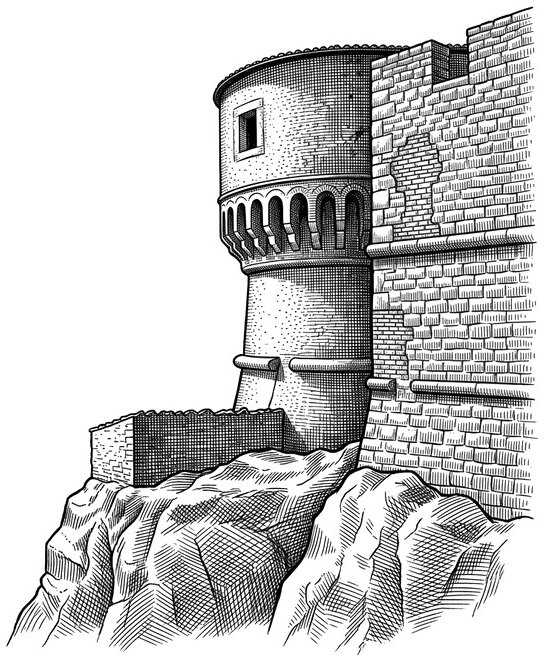
The Inquisition condemned him on 21 March 1791 for heresy, magic and Freemasonry and sentenced him to death by strangulation and burning. Pope Pius VI commuted it on 7 April to perpetual imprisonment, and in the last days of that month Cagliostro reached the fortress of San Leo, a rock above the Val Marecchia that Machiavelli called Italy’s finest military redoubt and that Dante drew on for his Purgatory.
He began in the Treasury vault, the bleakest room in the fortress, named for the treasure of the Dukes of Urbino. When reports came that his followers were planning a rescue, the commander moved him to the Pozzetto. The register counts what followed: four years, four months, five days. In that time he asked for a confessor, and when they lowered a Capuchin friar through the trapdoor, Cagliostro tried to strangle him. The friar, the stronger man, overpowered him.
The archpriest Luigi Marini wrote the death certificate in Latin. It is still in the parish archive of San Leo, and it ends with a verdict: born unhappy, the more unhappily he lived, most unhappily he died. On 28 August at 18:15 the body was buried in unconsecrated ground on the western point of the mountain, between the two sentry towers, with no rite of the church.
The grave that was never found
Landslides have eaten the cliff of San Leo for centuries, and no one has ever located the grave. In 1797 the fortress fell to Polish legionnaires serving in Napoleon’s army, under General Dombrowsky. The local legend says they opened the grave and drank to the patriots from a skull they had filled with wine. No primary source records it, and modern guides class it as folklore.
The other story is that Cagliostro was never in that grave at all. The prison registers say nothing about his death, a silence that has fed doubt ever since. In 1890 Blavatsky asked in print whether he was dead and buried. Some said he escaped from his aerial prison; others held that he still lived on the strength of the elixir. Her follower Hartmann repeated a story that Cagliostro was seen in Russia after the supposed death and produced fresh strawberries in the middle of winter. Hartmann’s answer for the faithful was that an adept can leave the body behind, so the body may have been buried while Cagliostro himself went on. The ghost legend keeps the same doubt alive: people say his spirit still walks the fortress looking for the burial it never got.
Drinking from a skull is one of the oldest gestures in European writing. Herodotus says Scythian warriors made cups from the skulls of the first enemy they killed. The Polish soldiers of the San Leo legend were acting out a very old story.
The two immortals
Cagliostro had a counterpart, the one man who made the same claim and never had to answer for it. The Count of Saint-Germain also said he was centuries old and refused to die; he left no corpse behind. Cagliostro left a dated death certificate in a parish archive. The Theosophists took both men as Adepts who had outlived their deaths, which is why the two names keep appearing together in occult histories. The Unforgivable Sin of Not Dying maps the wider pattern, the way a society treats the person who will not die. The Inquisition’s version of the punishment was literal: a death sentence commuted to a living burial.
Rome’s Castel Sant’Angelo held him before the trial, in the cell still called la Cagliostra. The same fortress imprisoned Giordano Bruno, burned in 1600.
The anniversary today
San Leo is a museum now, and visitors reach the Pozzetto through a doorway cut in the nineteenth century; in Cagliostro’s time the only entrance was the trapdoor overhead. The cell has a wooden bed, and people leave flowers on it. A painted inscription at the entrance, hard to read, alludes to the impossibility of escape. The fortress keeps its Masonic meaning as well: Italian lodges treat it as a place of pilgrimage, and the museum shows Masonic aprons and portraits.
The village has turned the anniversary into a festival. AlchimiAlchimie runs in the last days of August and fills the streets with fire, acrobatics and music. The 2026 edition ran on 25 and 26 August and ended on the anniversary night with the Incendio alla Fortezza, a fireworks display that lights the fortress above the village.