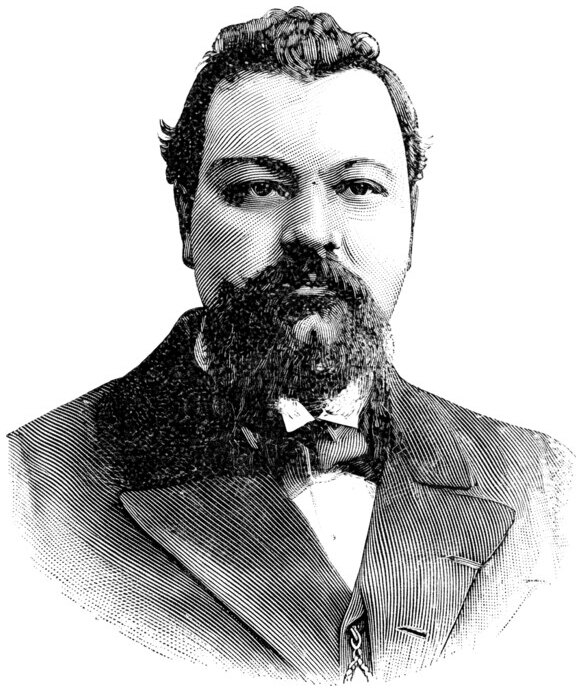
A medical student in 1880s Paris spends his free hours at the Bibliothèque Nationale, where he orders up books on alchemy and Kabbalah. In a supplement to Éliphas Lévi’s Dogme et rituel de la haute magie he finds the Nuctemeron, a short text attributed to Apollonius of Tyana, which names the genii ruling the hours of the night. The genius of the first hour carries the gloss “physician” and the name Papus, and the student, whose day job is medicine, takes it for his own.
July 13, 1865
Gérard Anaclet Vincent Encausse was born on July 13, 1865, in A Coruña, on the Galician coast of Spain. His father, Louis Encausse, was a French chemist; his mother was Spanish. The family moved to Paris when Gérard was four, and he was educated there.
For Martinists and for the continental school of occult tarot, July 13 is the birthday of the man who organized the French occult revival. French sources count roughly 160 published works under the name Papus, an output that earned him the epithet “the Balzac of occultism.”
The clinic and the faculty
He took his Doctor of Medicine at the University of Paris in July 1894, with a dissertation on philosophical anatomy, and ran a clinic in the city; French biographies describe him treating patients with hypnosis and electrotherapy alongside conventional medicine. The occult career was older than the medical one: his first major book, Traité élémentaire de science occulte, appeared in 1888, when he was 23 and still a student.
In October of that same year he founded the journal L’Initiation, which he edited for over two decades. He co-founded the Kabbalistic Order of the Rose-Croix with Stanislas de Guaita, Joséphin Péladan and Oswald Wirth, and opened an esoteric bookshop and publishing house, the Librairie du Merveilleux, with Lucien Chamuel. A year later came Le Tarot des Bohémiens (1889), which organized the entire tarot deck around the Tetragrammaton, the four-letter name of God, and became the foundation of the continental school of occult tarot; where that school sits in the longer history of the cards is traced in Tarot and Cartomancy: from Mamluk warrior poetry to the cards in your hands.
In 1888, Encausse and Augustin Chaboseau exchanged initiations to consolidate two separate lines of descent claimed from the mystic Louis-Claude de Saint-Martin. Chaboseau had received his from his aunt two years earlier.
In December 1889 he founded the Groupe indépendant d’études ésotériques, an occult school that grew into the Faculté libre des sciences hermétiques in 1897. The Ordre Martiniste, the order he is remembered for, was formally organized with a Supreme Council in Paris in 1891. Among the younger men who moved through these circles was Yvon Le Loup, who wrote as Sédir; his doctrine of magical plants is the subject of The Green Grimoire: Paul Sédir’s Hidden Language of Plants. The crowded scene around him, with its salons and rival orders, is mapped in Occult Paris: The City That Put Magic on Trial, where Papus appears as the man who stitched it together.
The Alexander Palace
Encausse traveled to Russia between 1901 and 1906. The 1901 visit is the best documented: he made it in the company of the man he called his spiritual master, the Lyon healer Nizier Anthelme Philippe, who went on to hold real influence with Tsar Nicholas II and Tsarina Alexandra before the court pushed him out.
The famous story belongs to a later visit, and it is a legend with a named source. In October 1905, at the Alexander Palace in Tsarskoye Selo, Papus is said to have conducted a séance for the imperial couple and summoned the spirit of the Tsar’s dead father, Alexander III, who advised his son to crush the revolution then beginning, and warned that it would return. The story comes from the diaries of Maurice Paléologue, the French ambassador to Russia, who was writing down court rumor; historians have never been able to confirm it.
Paléologue recorded a companion rumor: Papus had promised the couple that revolution would not overthrow them while he lived. His biographers add that in later correspondence he warned the Tsar and Tsarina against the influence of Grigori Rasputin.
Patents and charters
In March 1895 he joined the Ahathoor Temple of the Hermetic Order of the Golden Dawn in Paris. Two years before that he had been consecrated a bishop of Jules Doinel’s Église Gnostique de France under the name Tau Vincent; when Doinel abdicated in 1895, the church passed to a synod that included Encausse.
Papus joined Madame Blavatsky’s Theosophical Society as a young man but soon resigned; he preferred the Western esoteric tradition to the Society’s Eastern focus.
On June 24, 1908, he organized an International Masonic and Spiritualist Conference in Paris, where he and the German occultist Theodor Reuss exchanged patents: Reuss made him a tenth-degree member of the Ordo Templi Orientis, and Encausse helped Reuss set up the Ecclesia Gnostica Catholica as an offshoot of the French Gnostic Church. In 1913, on the death of John Yarker, he was elected Grand Hierophant of the Antient and Primitive Rite of Memphis-Misraim.
Division 93
When the war came, Encausse joined the French army medical corps and served as a médecin-major at the front through the autumn and winter of 1914; in a military hospital he contracted tuberculosis. He died in Paris on October 25, 1916, at 51. In Petrograd, Paléologue noted the alarm the news caused at court, and Nicholas II abdicated 141 days later.
He is buried in Père Lachaise cemetery, division 93. Paris legend places many magicians in that cemetery; Papus is one of the few who really is there.
His son Philippe Encausse, ten years old when his father died, relaunched L’Initiation on January 1, 1953 and edited it for three decades. The journal Papus founded in 1888 appears today as L’Initiation Traditionnelle, a free quarterly published online; the issues for 2026 are on its site.