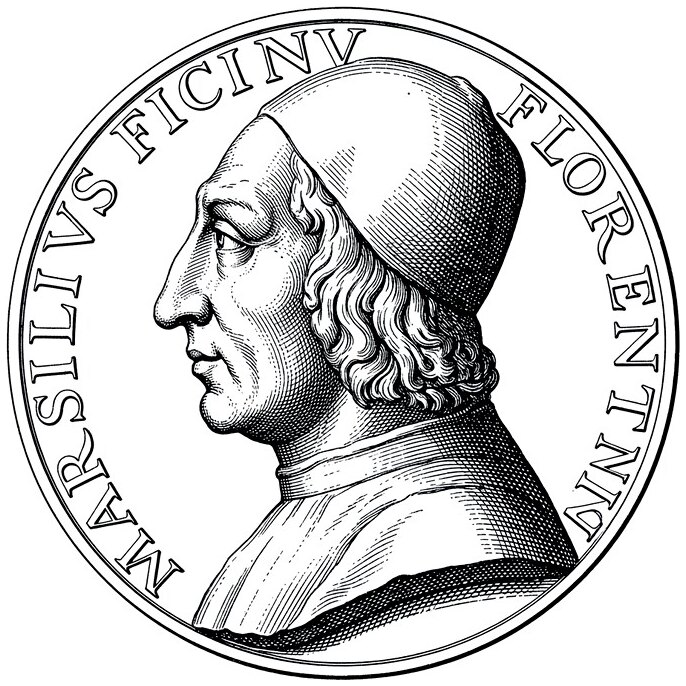
Marsilio Ficino, the Italian priest who translated the complete works of Plato into Latin, believed the planet Saturn had stamped him at birth. His birthday survives only because a friend asked for it. In 1489 a German admirer wanted his birth chart, and Ficino’s answer is dated 29 August.
“The nineteenth day of October was my birthday,” the answer begins, “in the year of our salvation 1433.” Nobody had written down the hour. His father, later a doctor, had not noted it. From what his father and mother remembered, Ficino guessed it was about the twenty-first hour of the day.
A boy from Figline
Ficino was born at Figline, a small town southeast of Florence. No document records the birth, so the date rests on that one letter alone. His working life belongs to the day he died.
His father was still a medical student in 1433. Later he served the Medici as a physician. His mother, Alessandra, came from nearby Montevarchi and was barely fifteen. There was already a son, Carlo, six months old, who died young. Many more children followed.
A mother who dreamed true
Ficino believed his mother could see things in her sleep. He told two of her dreams in a letter to a friend, as proof that the soul can know things the body cannot.
Her own mother, Angela, was away in Florence and wrote that she would come home the next day. That night Alessandra, in Figline, and her father, in Montevarchi, both dreamed of Angela. In Alessandra’s dream Angela stood at the door, refused to embrace her and asked for priests to pray for her. A messenger went to Florence. Angela had died that night.
The second dream came after the birth of one of her sons. Alessandra gave the baby to a country wet nurse. Seventeen days later she dreamed at noon that her dead mother was comforting her: “Do not grieve, my daughter.” The next day the country people brought the news that the nurse had suffocated the child.
She also dreamed, Ficino adds, that her husband would fall from his horse, and where. He drew two lessons: a soul living cleanly can foresee things in sleep, and the dead still care about the living.
The surname Ficino probably comes from his father’s first name, Dietifeci. Ficino’s first biographer, Giovanni Corsi, describes him as short, slim and slightly hunched, with curly golden hair and a stammer on the letter S. He was cheerful in company and melancholy when alone, and “he burned up” the melancholy by working through the night.
Saturn on the horizon
Ficino read his own character straight out of the sky of that October day. At any moment one sign of the zodiac is coming up over the eastern horizon. Astrologers call it the ascendant. By Ficino’s reckoning his ascendant was Aquarius, and the planet Saturn sat inside it, right on the rising point.
Medicine then taught that four body fluids, the humours, set a person’s temper. Too much black bile left the soul “sad and fearful”, in Ficino’s own words. Saturn ruled that humour. In Ficino’s books it is the highest of the planets, cold and dry, and named for the old Roman god (see Saturn).
To his closest friend, Giovanni Cavalcanti, Ficino put it plainly: “Saturn seems to have impressed the seal of melancholy on me from the beginning.” Venus and Jupiter, he added, “have, perhaps, offered some resistance.”
In the Latin of the same letter he calls the melancholy “a very bitter thing.” It would stay bitter, he says, if he did not sweeten it with frequent playing of the lyre. He sang the ancient Orphic hymns to that instrument. Cosimo de’ Medici, head of that family, once ended a note to him: “Come, and bring your Orphic lyre with you.”
On the page he hedges: maybe the temperament did not come from Saturn, and if it did, Aristotle would call it a “unique and divine gift.”
Cavalcanti answered that Ficino owed his learning to that planet: “You have made your way by disused and overgrown paths through the whole of Greece, even penetrating into Egypt.”
Saturn also took the blame for illness. One August he fell ill with fever and diarrhoea while correcting a book. “Perhaps this year Saturn threatened me with this,” he told another friend. He prayed to the Virgin Mary and got better.
In 1489 he turned the problem into medicine. His Three Books on Life open with the health of scholars, and he told his German friend that the request had spurred him on.
Saturn and Mercury, he explains, make learned people cold and dry from birth. Black bile drags the mind inward and upward, toward “whatever is highest”, because it fits Saturn, “the highest of planets.” The same humour can tip them into depression and even into folly.
Saturn comes back
Saturn takes about thirty years to go round the sky. In 1492 Ficino looked back on Saturn rising in Aquarius as the guide of his whole life. When the planet first came back to Aquarius, he translated Plato for Cosimo. Now it had come back again, and he was back at Plato, writing longer commentaries.
The same sign tied him to a younger friend, the young nobleman Giovanni Pico della Mirandola. Pico was born in 1463 “under his own Saturn occupying Aquarius,” as Ficino put it, “under which I too had been born thirty years earlier.” Pico arrived in Florence on the very day Ficino’s Plato came off the press in 1484. He talked Ficino into translating Plotinus next.
Across traditions: the birthday nobody told
Ficino’s birthday letter to the German friend, Martin Prenninger of Konstanz, starts with a philosopher who refused the same request. “Our Plotinus” never gave his birthday to friends who often begged for it. Ficino would deny his friend nothing.
The story is in the life of Plotinus written by his pupil Porphyry. Plotinus “never disclosed the month or day” because he wanted no birthday sacrifice or feast. Yet he sacrificed on the traditional birthdays of Plato and Socrates and gave a banquet, where every pupil who could was expected to speak. Ficino’s own circle revived the banquet for Plato’s birthday.
Albrecht Dürer’s famous engraving Melencolia I (1514) shows a winged figure brooding among tools.
From 1923 on, the art historian Erwin Panofsky read it through Ficino’s idea of the gifted, Saturn-born mind, passed on to Dürer by a German writer on occult philosophy. In that reading the “I” marks the first of three kinds of melancholy, the kind that drives artists. Not everyone accepts the chain of borrowing.
On the wall behind the winged figure hangs a four-by-four magic square. It is the square of Jupiter, the planet thought to fend off melancholy. Ficino had named Jupiter as the planet that perhaps held his own Saturn back.
The day today
Figline named its main square after him. Piazza Marsilio Ficino has been a trading place since the town began, and a market still fills it every Tuesday morning.
The square also hosts the town’s big events, from the Palio di San Rocco to Autumnia, a fair of farming and food, which returns to the town on 6-8 November 2026.
In Washington, the National Gallery of Art keeps a small bronze medal cast around the year he died. One side shows his profile in a cap, with the words MARSILIUS FICINUS FLORENTINUS. The other side carries a single word: PLATONE.