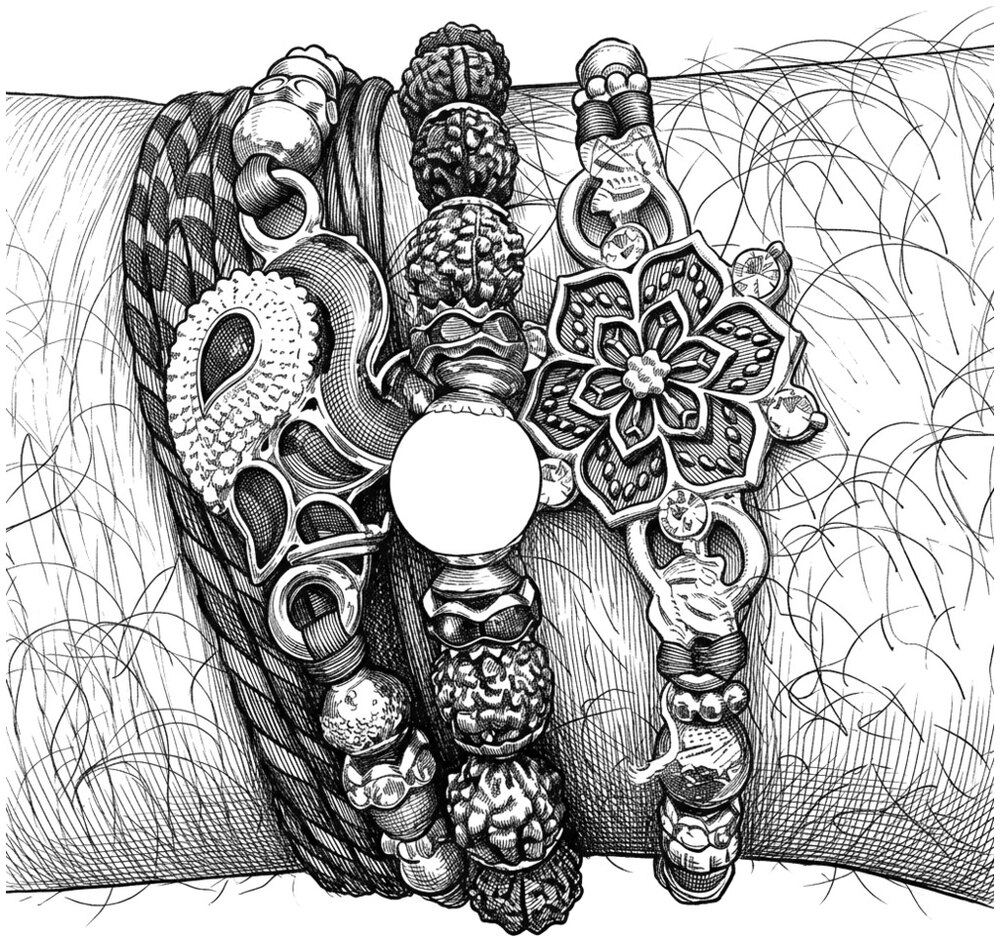
Before the morning is an hour old, the thali is laid out: the rakhi on its cushion, a smear of vermilion, unbroken rice, a lamp. The sister marks her brother’s forehead with the red paste and turns the lamp in a slow circle before him. Then she ties the thread around his right wrist, and the sweets and the small gift or money follow. Raksha Bandhan means the bond of protection, and the Hindi word rakhi goes back to the Sanskrit rakṣā, a word for guarding that also meant an amulet.
The full moon that closes the month
The day is Shravana Purnima, the full moon that closes the Hindu month of Shravana, usually in August; in 2026 it falls on Friday, August 28. Hindus keep the festival across India, and Sikhs and Jains observe it too. Earlier in the same month comes Nag Panchami, the festival of the serpent deities, and the full moon before Raksha Bandhan, Guru Purnima, honors the teacher. Nepal marks the same moon as Janai Purnima, a public holiday; in the south it is Avani Avittam, the day Brahmin men change the sacred thread worn across the chest, and in Gujarat Pavitropana, when Shiva receives water and cotton wicks.
The thread and the ceremony
The tying keeps a fixed order: she prepares the thali with the rakhi, kumkum and unbroken rice, and puts the tilak on his forehead; the aarti with the lamp follows, and the thread goes on the right wrist last, while the old mantra is recited. The brother answers with a gift, or money; a 1951 diary entry records ten rupees. In the village the rite belongs to a wider system: married sisters return to their natal homes, and the brother stays the lifelong link between her two households.
Rigveda 10.85.28, a wedding hymn older than the festival’s name, describes the red and black thread that drives off evil spirits and binds the bride to the groom. The chant spoken over the rakhi looks back to King Bali: “by the thread with which Bali, the mighty lord of the demons, was bound, I bind you. O Raksha, be firm, be firm.” The janai, the sacred thread, is renewed on this full moon in Nepal and in the south, while priests tie the yellow-and-red doro on everyone else’s right wrist. The ethnographer McKim Marriott, studying a north Indian village in 1955, found two rites running side by side, the sister’s thread and the Brahmin priest tying a protective charm on his patrons, and the day is named for the sister’s version.
In Haryana and Punjab the older folk rite was called Saluno. Sisters placed barley shoots behind their brothers’ ears, a gesture that predates the thread and survives beside it.
The stories the thread carries
The origin stories are many, and the faithful tell them all. In the most quoted one, the gods are losing to the demon Vritra, and the guru Brihaspati tells Indra to have his wife Sachi tie a mantra-charged thread on his wrist on Shravana Purnima; Indra wins back his kingdom. Another telling names King Bali: Vishnu, pleased with the devoted demon-king, stood guard at his palace, and Lakshmi, missing her husband, came disguised and tied a thread on Bali’s wrist the way a sister does; her boon was Vishnu’s freedom. The river legend has Yamuna tie her thread on her brother Yama, the god of death, who grants long life to any brother so honored. And in the Mahabharata, when Krishna cuts his finger, Draupadi tears a strip from her sari to bind the wound; years later, in the assembly where his enemies try to strip her, his endless cloth repays the debt. Krishna’s own birth is kept a week later at Krishna Janmashtami.
A thread that crossed other lines
The thread has been bound to causes beyond the family. In 1905, against the British partition of Bengal, Rabindranath Tagore called on Hindus and Muslims to tie rakhis on each other’s wrists as a sign of brotherhood. Hundreds did, in Kolkata, Dhaka, Sylhet and Rangpur; Tagore tied rakhis to clerics at a mosque. The protests ran until 1911, when the partition was withdrawn. Tagore’s school at Santiniketan still keeps the custom, and students tie rakhis on neighbours and strangers.
The thread also collects invented origins. The popular story of Rani Karnavati of Chittor sending a rakhi to the emperor Humayun appears in no contemporary chronicle; it first surfaces in James Tod’s 1829 book, and the historian Satish Chandra gives it little credit. The 1941 film Sikandar added a rakhi scene between Porus and Roxane that film historians cannot trace anywhere older. The 1975 hit Jai Santoshi Maa gave the festival a new founding tale in which the goddess Santoshi is born so that Ganesha’s sons could have a sister.
The first English use of the word “rakhi” appears in 1829, in James Tod’s Annals and Antiquities of Rajasthan. The same book carries the disputed Karnavati story above.
The thread today
The 2026 market shows how far the object has travelled. Simple rakhis run from ten to fifty rupees; designer versions reach five hundred. Stalls sell evil-eye rakhis against bad luck and personalized rakhis with names. Seed rakhis carry real seeds that can be planted after the festival. Students mail rakhis to the Prime Minister and to soldiers on the border; in 2026 the Gaya aspirants sent more than a thousand with the army emblem. In Mauritius and across the diaspora, rakhis travel by post weeks early and get tied over video calls. This year the full moon also carries a partial lunar eclipse, invisible from India, so the morning tying runs its normal course before the sky does anything unusual. The seed rakhi holds the day in one object: a small protection that is meant to grow.