In Varanasi, one well in the Jaitpura quarter is drained every year for a single day. The water is drawn out, and a Shiva linga that has sat submerged in the dark for twelve months stands visible while the well is cleaned for Nag Panchami. Wrestlers from the city’s akharas come down to pay their respects, because the well is tied to Patanjali, the sage who wrote the Yoga Sutras and whom tradition holds to be an incarnation of the thousand-headed serpent Shesha. Vendors set out clay cobras, and for one day the snake gods are the centre of the city.
The fifth of Shravana
Nag Panchami falls on the fifth day of the bright half of Shravana, the monsoon month of the Hindu calendar, and it belongs to the nagas, the serpent deities of the underworld who guard water and treasure in the myths of India, Nepal and Southeast Asia. Hindus across the subcontinent keep it, and it is also listed as an observance of Jains and Buddhists. The date moves with the moon; in 2026 it falls on Monday, August 17, and Indian newspapers note that the day coincides with the third Sawan Somwar, a Monday of Shiva’s holy month, which they call a rare conjunction.
The full mythology belongs to the compendium entry for the Naga. On the ground, a festival about a race of mythic serpents is about the real snakes of the monsoon, the cobras that come out with the rains and share the fields with the people who plough them.
The customs
The core of the day is an offering of milk. Serpent images made of silver, stone, wood, or painted on walls are bathed in water and milk and worshipped with flowers and sweets. Doorways and the walls outside the house are painted with pictures of snakes, and a rangoli of a five-hooded serpent is drawn on the floor in sandalwood paste. In the villages the offering goes to the anthill, where a snake is believed to be resting; people pour milk into the hole and leave incense burning. The milk is an offering to the idea of the snake, because snakes do not drink milk.
Two rules shape the day. The earth is not dug on Nag Panchami, because the snakes live under it and a hoe or a plough could kill one; farmers leave the fields alone. The other rule is for brothers: women worship the snakes for their brothers’ safety, a rite known as Bhratru Panchami, and in the south they tie a turmeric-dipped thread on the right wrist and sprinkle milk on their brothers’ backs with a hibiscus flower.
The customs run thick and regional. In Karnataka, girls make white-clay snake images and keep a salt-free fast. Kerala’s Nair and Ezhava homes keep a sarpa kavu, a serpent shrine in the southwest corner of the ancestral compound. Punjab shifts the whole observance to Guga Nauvami, when a dough snake is paraded in a winnowing basket and buried. West Bengal and Odisha give the day to Manasa, the queen of snakes. Varanasi’s wrestlers treat the day as their own, because the serpent’s shed skin is a symbol of virility and renewal.
The Nav Nag stotra, the hymn of the day, invokes nine principal serpents: Ananta, Vasuki, Shesha, Padmanabha, Kambala, Shankhapala, Dhritarashtra, Takshaka and Kaliya. Two of the nine, Ananta and Shesha, are the same being under two names: the thousand-headed serpent who holds up the world.
Legends & beliefs
The charter story comes from the Mahabharata. King Janamejaya’s father Parikshit died of a snakebite, so the king performed a sacrifice designed to draw every serpent in the world into the fire, and the snakes began to die by the thousands. The gods appealed to Manasa, who sent her son, the boy-sage Astika. His learning impressed the king, who offered him a boon; Astika asked for the sacrifice to stop, and it stopped. The day it stopped was the fifth of Shravana, which is why the fifth is kept. The Mahabharata itself was first recited at that same sacrifice.
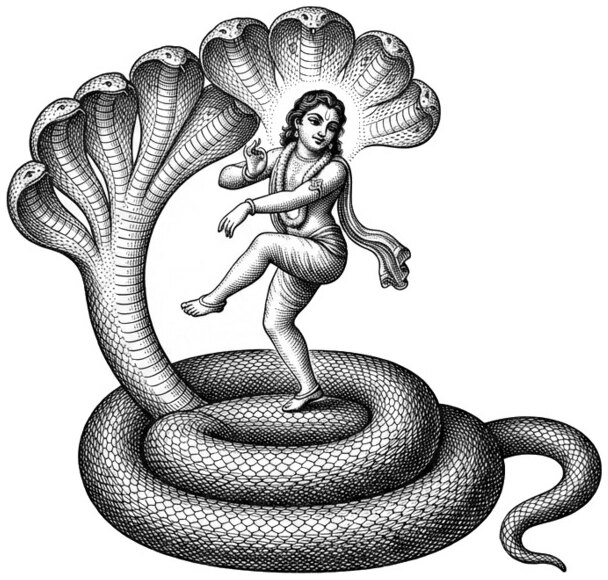
The other great legend is Krishna and Kaliya. The serpent Kaliya had poisoned the Yamuna near Vrindavan. The child Krishna jumped into the river, danced on the serpent’s hoods until Kaliya submitted, and then, instead of killing him, sent him away to the sea. The scene is one of the most painted in Indian art, and it is the image Nepali households paste above their front doors on Nag Panchami, to bring rain and keep lightning off the house.
A folk story explains the no-digging rule. A farmer broke open an anthill with his plough and killed the young serpents inside. Their mother killed the farmer and his family, but spared his eldest daughter, who had worshipped a snake made of fragrant pigments. She gave the girl nectar to bring the family back. The story treats the earth as a house with other tenants, and the festival as the day the household pays them respect.
Across traditions
The serpent kings travelled east with traders, Brahmins and monks along the trade routes, and the temples of Angkor still line their causeways with naga balustrades. The Theravada and Vajrayana worlds keep their own naga observances; the Tibetan Buddhist Naga Day falls on a different date but honours the same beings. In the Buddhist telling, the naga king Mucalinda sheltered the meditating Buddha from a storm with his hood.
Serpent veneration reaches further back and wider than India. The 1911 Encyclopaedia Britannica records a South Indian festival on the fifth of Shravana in which the serpent deity is bathed in milk, the same rite in the same month, and it parallels the Indian snake-saint Guga with the Egyptian Mert-seger, the serpent who guarded the Theban necropolis. The Egyptians wore the rearing cobra, the Uraeus, as the crown of kings, and the Mesopotamians paired two snakes around a rod, an emblem that survived into the healer’s staff. People have read the shed skin as renewal in many places, and the oldest stories explain why snakes keep theirs: in the Gilgamesh epic a snake steals the plant of rejuvenation, and that is why it molts while people age.
The day today
In Battis Shirala, a town in Maharashtra that for centuries paraded live cobras on bullock carts on Nag Panchami and released them unharmed, the Bombay High Court banned the capture of the protected cobras in 2002. The town now worships clay snakes under police watch, and politicians have been pushing to bring the live procession back. Animal-welfare groups and herpetologists say the old offering of milk to live cobras kills them, and PETA India urges devotees to use idols and let the snakes live.
The worship has kept its crowds: in Mumbai’s Lalbaug market in 2026, the snake idols went on sale the day before the festival, and shoppers crowded the stalls; in Ujjain, the Naga Chandreshwar shrine inside the Mahakaleshwar temple opened its doors for twenty-four hours, the one day a year it does. The clay cobra bought in the market spends the day on a doorstep, bathed in milk and turmeric, and is put away when the offering is done, until the next monsoon brings the festival round again.
