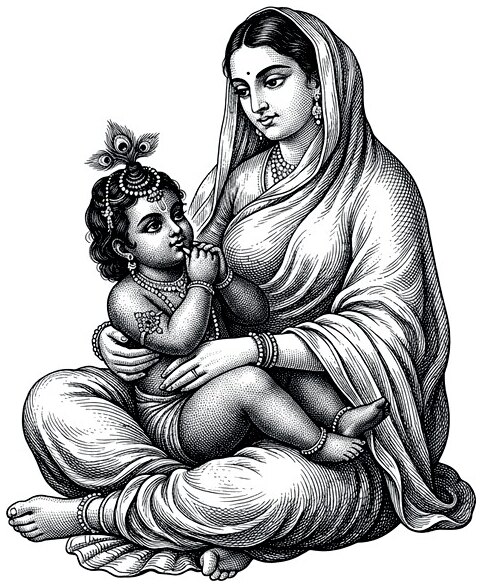
On the morning of the festival, in many homes across Tamil Nadu, someone draws a trail of tiny footprints in rice paste from the front door to the prayer room. The feet belong to a child who has not arrived yet; he is expected at midnight.
An eighth-day birth
Krishna Janmashtami is the birthday of Krishna, counted by most Vaishnava Hindus as the eighth avatar of Vishnu. The name means “dark” in Sanskrit, and images show him dark-skinned, a child cowherd or the charioteer who speaks the Bhagavad Gita. The festival falls on the eighth day of the waning moon in the Hindu month of Bhadrapada, between August and September, and the birth is set at midnight. In 2026 most of India keeps it on Friday, September 4, while many Vaishnava and ISKCON temples observe September 5. Panchangs count this year as the 5,253rd anniversary of the birth.
Its homeland is the Braj country around Mathura and Vrindavan, where Krishna was born and raised. From there the festival spread across the subcontinent and, in the last century, around the world; Nepal and Bangladesh both keep it as a national holiday.
A birth in a prison cell
The story comes from Book 10 of the Bhagavata Purana. Kamsa, the king of Mathura, was at the wedding of his sister Devaki when a voice from the sky told him her eighth son would kill him. He threw Devaki and her husband Vasudeva into prison and killed their first six children. The seventh, Balarama, was moved to another womb and survived.
At midnight the eighth child came. With the guards asleep, the shackles fell and the prison door opened by itself. Vasudeva carried the newborn through a storm and crossed the flooding Yamuna; the water rose only to the infant’s feet. In the village of Gokul he traded the baby for the newborn daughter of the cowherd chief Nanda and his wife Yashoda. The girl became the goddess Yogamaya; she reminded Kamsa of his fate and vanished. Krishna grew up in Gokul and Vrindavan as Nanda and Yashoda’s son, and years later he returned to Mathura to kill Kamsa, as the voice had promised.
Devotees keep two pictures of the birth together. In the cell Krishna first showed Devaki his four-armed divine form, then became an ordinary baby at her prayer. In Gokul the same night he was a baby like any other, born to Yashoda and Nanda, who marked the birth with a village feast; the next day, called Nandotsava, carries the celebration on.
Fasting and the clay pots
The day is a fast: devotees eat nothing, or take only milk and fruit, until the birth hour, and break the fast after the midnight puja timed to Nishita Kaal, the Hindu midnight. In 2026 the Delhi window runs from 11:57 pm on September 4 to 12:43 am on September 5.
At home, families lay out a small image of the baby Krishna, Laddu Gopal or Bal Gopal, and bathe it in panchamrit, the mixture of milk, curd, ghee, honey and sugar. They dress the image in new yellow clothes and seat it in a flower-hung cradle, then offer makhan-mishri, butter with sugar candy, and sing the baby to sleep.
The region shapes the rest: in Tamil Nadu the footprints lead to the prayer room and children dress as the baby Krishna. In Maharashtra and Gujarat the drama moves outside the next day, when teams of young men called Govindas stack into human pyramids to break clay pots of curd and butter hung high above the street, a re-enactment of Makhan Chor, the butter thief. Crowds chant “Govinda Aala Re!” and share the spilled curd. Some events offer prizes, and India’s Supreme Court bars children under twelve from the pyramids. The temples of Mathura and Vrindavan stay open all night; there Ras Lila dance-dramas retell the childhood, and the kitchens serve Chappan Bhog, the fifty-six-dish offering.
The butter thief and the fifty-six dishes
The butter theft explains the hung pots and the pyramids. The fifty-six dishes look back to the day the boy held up Govardhan Hill: to shelter the cowherds from the storm sent by the offended god Indra, Krishna is said to have lifted the hill on one finger for seven days and missed meal after meal. When the rain stopped, the villagers made good the missed meals with fifty-six dishes, eight a day for seven days.
These are the stories of a child among cattle and butter pots, and behind them sits a claim that still divides Vaishnava schools. All give Krishna a place in Vishnu’s line of avatars, usually the eighth. Krishna-centered traditions, from Gaudiya Vaishnavism to the Pushti Marg, call him Svayam Bhagavan, “God himself,” the source of the avatars, and cite the Bhagavata Purana’s line that Krishna is the original Godhead. Other schools, such as the Sri Vaishnavas, keep Vishnu supreme and read Krishna as his avatar. The argument is old, and Janmashtami is the one day both sides celebrate the same birth.
A Greek pillar in the record
Worship of Krishna is older than any temple now standing in Braj. At Besnagar in Madhya Pradesh stands a pillar raised around 113 BCE by Heliodorus, a Greek ambassador of the Indo-Greek king Antialkidas. Its inscription, in Brahmi script, calls the ambassador a Bhagavata, a devotee, and says he set up the pillar to Vasudeva, “the God of Gods.” It is the earliest inscription we have for the cult, and it already treats Krishna as supreme. The Gita, spoken by Krishna to the warrior Arjuna on the battlefield of Kurukshetra, became the text Hindus across the world still read; the day that commemorates its speaking has its own place in this calendar at Gita Jayanti.
The day today
The festival now runs on two calendars, and in the Braj country a thread links the season’s two festivals: the rakhi tied on Raksha Bandhan a week earlier is worn for eight days, then taken off on Janmashtami and laid at Krishna’s feet. The grove at Vrindavan where Krishna is said to dance at night, Nidhivan Sacred Grove, still draws pilgrims who keep the older geography alive.
In 2026 the two dates mean two nights of celebration. Mathura expects crowds in the hundreds of thousands; for the first time a five-hundred-drone sky show over the Krishna Janmabhoomi temple was planned to retell the birth. ISKCON temples in more than seventy-five countries keep the midnight hour. In Kathmandu the stone Krishna Mandir in Patan, built in 1667 with its twenty-one spires, glows with oil lamps while conches sound at the birth, and in Dhaka a procession moves through the old city to the Dhakeshwari temple. And in a million homes the small image rocks in its cradle until the fast ends and the butter and sugar candy go round.
The miniature of Vasudeva carrying the newborn across the Yamuna, painted around 1700 for a court at Mankot in the Punjab Hills, keeps the child clear of the flood while a many-hooded serpent shelters the crossing. The Bhagavata Purana says the water rose only to the infant’s feet.
The Gaudiya Vaishnava school counts Krishna’s flute-playing childhood in Vrindavan, not his kingship, as the highest revelation; Janmashtami is the hinge on which that childhood begins.