In 1958 the American anthropologists Stanley and Ruth Freed watched a Brahman family of the priestly caste in a village near Delhi prepare for the day after Diwali. At half past eight in the morning, the senior woman of the house shaped dung from the family’s cattle into a human figure in the courtyard, complete with limbs and features. She set a small pot of milk on it, outlined it with wheat flour (her way of feeding the god), and covered it with a string bed for safekeeping until evening. Beside it she laid sugarcane, a churn, and a mortar.
The villagers called the figure Gobardhan, their way of saying Govardhan: a name encoding both “nourisher of cattle” and “cow-dung wealth.” The day carries the same name. In North India Hindus keep it as Govardhan Puja (the worship of Govardhan), or as Annakut, the “mountain of food.” Govardhan is a real hill near Mathura, south of Delhi, and Krishna is said to have held it up over his people against a storm. So what was that family worshipping on their courtyard floor: the hill, the god, or the dung?
The day after the lamps
Hindu festivals follow the moon. Diwali, the festival of lamps, is kept on the night of the new moon in the autumn month of Kartik, and Govardhan Puja on the first day after that new moon, which is usually the next morning. In 2026 Diwali was kept on Sunday, 8 November, but the new moon lasted until about midday on Monday, so this year there is a free day between the two festivals, as the Jaipur astrologer Yogesh Pareek explained to the Indian news channel ETV Bharat. Most of North India keeps Govardhan Puja on Tuesday, 10 November; the Krishna temple at Nathdwara in Rajasthan held its rites on the Monday.
“I am the mountain”
The Puranas, the Sanskrit texts of myth and ritual, hold the story behind the day. In H. H. Wilson’s 1840 translation of the Vishnu Purana, the boy Krishna grows up among cowherds in Braj, around Mathura. Every rainy season ends with offerings to Indra, the king of the gods, because he sends the clouds that water the grass and grain. Krishna argues them out of it. “We are not shut in with doors, nor confined within walls,” he tells them. “We have neither fields nor houses.” Herders live by their cattle, so their gods are the cattle and the mountains, whose spirits walk the woods and can turn into lions if they are angered. “What have we to do with Indra?”
The cowherds agree and bring their offerings to the hill. They feed hundreds of Brahmans and guests, and walk circles around their cattle hung with autumn flowers. Then Krishna appears on the summit and declares, “I am the mountain,” consuming much of the food the cowherds had brought. Yet at that same moment he stands also among them in his ordinary boy’s body, climbs the hill with them, and “worships his other self,” the mountain. The Bhagavata Purana, another telling of Krishna’s childhood, says the same thing in three words: śailo ‘smi, “I am the mountain.”
Indra takes revenge. He sends his clouds over Braj, and the rain falls so hard that cows shield their calves with their own bodies. Krishna pulls the hill out of the ground and holds it up with one hand “as a large umbrella” over the herds, and the whole village shelters under it for seven days and nights until Indra gives up. The Bhagavata says he held it as easily “as a child holds up a mushroom.”
Both texts describe the feast differently. The Vishnu Purana’s cowherds offer curds, milk, and meat. In the Bhagavata, Krishna asks for cooked food: sweet rice, soups, baked and fried cakes, every kind of milk dish. This heap of food becomes the Annakut.
Not everyone in the old stories was impressed. Wilson noted that in another telling the king Sisupala mocks the deed and says Govardhan was nothing more than an ant-hill.
The real hill
The hill itself is low. F. S. Growse, who described the Mathura district in 1883, found a narrow ridge four or five miles long rising from the flat plain to an average height of about 100 feet. Pictures of it, he wrote, show a lone conical peak, “as unlike the reality as possible.” People called it Giri-raj, the royal hill, and older writings, Growse noted, gave it the same name as the feast: Annakut, or “mountain of food.”
In the neighbourhood, people were certain the hill sank year by year, just as the river Yamuna was shrinking, and that it had once been visible from towns four or five miles away. No stone could be taken from it for building. Where the road crossed its lowest point, travellers had to pass over rock on a paved causeway. The folklorist William Crooke recorded in 1894 that nobody would carry a stone away from Govardhan “because it is supposed to be endowed with life.”
In the month of Kartik, pilgrims walked the dusty road around the hill, a circuit of about twelve miles. Some measured it with their own bodies, Growse noted: they lay face down, marked a line in the sand as far as their hands reached, stood up at that line and lay down again, repeating this for a week or two. Wealthy pilgrims paid local Brahmans 50 to 100 rupees to perform the circuit on their behalf.
The day after Diwali brought two great rites to the village of Jatipura at the hill’s foot: the worship of Giri-raj and the Annakut. It also brought conflict. Priests of two rival Krishna temples, Sri-nath and Gokul-nath, renewed an old dispute over the festival each year, and feeling ran high enough, Growse reports, that the authorities would regularly “take heavy security from the principals on either side that there shall be no breach of the peace.”
A hill of food, a hill of dung
Families far from Mathura could not visit the hill itself, but Sanskrit law books contained a solution. As the historian of Hindu law P. V. Kane summarised in 1958, those near the hill worship it in the morning, while others make a Govardhan “with cowdung or with heaps of cooked food,” or draw one, and worship it alongside Krishna. The food offering was to be grand in scale, which is why this worship is also called Annakut, the “heap or hill of food.”
Both forms exist side by side. At a temple near the hill, the anthropologist Paul Toomey documented a mound of rice, “sometimes numbering thousands of kilos,” built in the courtyard before the god. In the farmyards, families made the hill from dung. Crooke quoted a description from the Punjab where women arranged Krishna in cow dung on his back, surrounded by dung loaves for mountains, cotton tufts on stems for trees, dung balls for cattle, and dung herdsmen in scraps of cloth standing guard. The cowherds entered and saluted it, the bullocks had their horns dyed, and no one could eat or press sugarcane until a Brahman had taken the first bite.
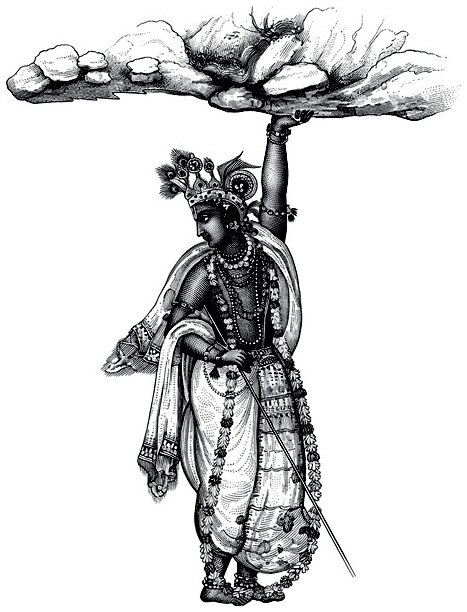
The festival reached the Mughal court. Crooke noted that the emperor Akbar (ruled 1556-1605) joined in it, and the Ain-i Akbari, the record of Akbar’s court written by Abu’l-Fazl, says that on Diwali, “on which the Hindus pray to the cow,” several cows were decorated and brought before the emperor. Akbar’s painters also illustrated the Govardhan story. The drawing at the top of this page is made after a page from a copy of the Harivamsa, a Sanskrit text about Krishna’s life, painted around 1590-95; Akbar had such Hindu classics translated into Persian and illustrated by his court artists, the Metropolitan Museum of Art notes.
“Cow-dung worship, not Krishna worship”
The Freeds called their village Shanti Nagar, a pseudonym, studying it in 1958 and again in 1977. There, they found, the day mattered more than Diwali. The Jats, the village’s largest caste and farmers who kept many cattle, said it plainly: “the festival of the Jats is Gobardhan, not Diwali.” Nobody recited a story at the rite, and some insisted there was no story at all. When the Freeds asked about this, one Brahman explained that the real hill cannot be moved, so the hill itself “told its devotees that they could worship cow dung, which is also Gobardhan, in their homes.”
Nearly everyone they spoke to said the god they worshipped was the dung, Gobardhan, rather than Krishna. Of about 25 people, only one, a Brahman woman, said clearly that the two were the same. A barber’s family had placed a small image of Krishna under cloth within its dung figure’s hand, yet insisted: “This is cow-dung worship, not Krishna worship.” An educated Brahman attributed this partly to the Arya Samaj, a Hindu reform movement opposed to Krishna worship and to many gods. A dyer explained the objection differently: after the festival the dung figure becomes fuel cakes and burns, and Arya Samaj followers held that burning a figure of a man meant killing a man. So his family stopped making a figure and made only a pile instead. Among the 31 or so Gobardhans the Freeds observed or heard of, all seven made by Brahman families were human figures, while four of the six Jat families made a plain heap.
Scholars disagree about which came first. The anthropologist McKim Marriott, studying another North Indian village in 1955, held that the Puranic story came down into the villages and coarsened in the descent: “The sacred hill of the Purana has become in each household yard a literal pile of cowdung.” Charlotte Vaudeville, an Indologist, argued the opposite in 1980: the Annakut with its “primitive ritual” must predate every Puranic telling of the lifted hill, since those tellings already assume that the herders of Braj worshipped their cattle and their mountain. The Freeds favoured Vaudeville’s reading, pointing out that in the story itself Krishna speaks of mountain spirits the herders should worship, spirits that must have existed before he took their form.
The rice mountain at Nathdwara
The temple to Sri-nath once stood on the summit itself. Growse wrote that this shrine was founded in 1520 by the teacher Vallabhacharya, but when a raid by Mughal emperor Aurangzeb threatened, its image was taken to Nathdwara in the princely state of Udaipur, where it has remained ever since.
On Monday, 9 November 2026, ETV Bharat reported from Nathdwara. The temple’s cows, decorated with henna and peacock feathers, their horns tinted with colour, trampled a dung Govardhan in a tradition ETV Bharat traces back 353 years. That night, the temple set more than 50 quintals of rice (five tonnes) and over a hundred other dishes before the god as the Annakut. As tradition requires, members of the Adivasi, the tribal communities, then carried it away.
In the Freeds’ courtyard the hill’s ending was quieter. After evening worship, when the men had walked around the figure and thrown puffed rice on it, the family would make dung cakes, always in odd numbers (five, seven, or eleven), to be dried and stacked with the household’s fuel. The ground where it had lain could not remain empty, because an empty space invites evil spirits, so the family plastered it with cow dung, drew a square in wheat flour, and set two small loaves of dung and the ritual lamp at the center.