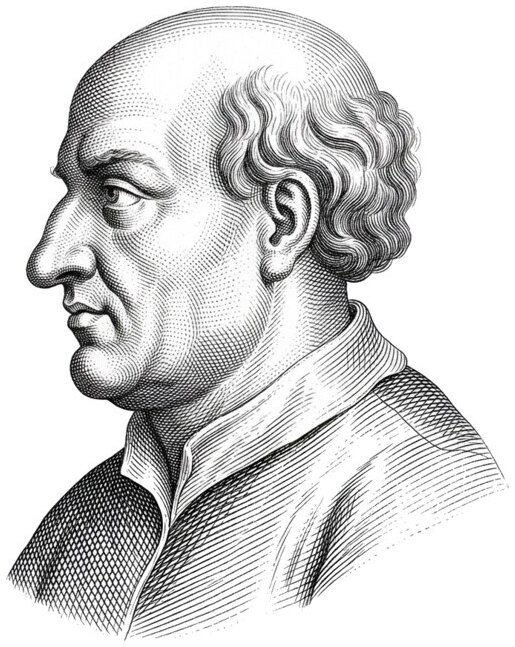
Paracelsus was the physician who burned the textbooks of his day, lectured in German instead of Latin, and treated the poor for nothing. When he died in Salzburg on 24 September 1541, he was 47.
Three days before the end he dictated his will in a room at an inn in the old town. He provided for relatives in Einsiedeln and for friends in the city. The rest of his property went to the poor.
The life he had lived before that week is the subject of Paracelsus: The Doctor Who Burned the Textbook.
The cause
Nobody settled the cause, then or since, though Salzburg’s city history offers one answer: he had treated an inflammation with mercury, and the mercury killed him. The same text cites chemical tests on his remains.
Other reference works are more careful. They say the cause can no longer be established with certainty. His bones carry insoluble mercury far above the normal level. That fits years of handling the metal better than one fatal dose. He had written about mercury poisoning among miners, so he knew what the metal did. A cure he gave himself for a disease he probably had is one possible route.
The Catholic Encyclopedia of 1911 gives the plain version, a natural death.
Theophrastus von Hohenheim—born in 1493 at Einsiedeln to a pharmacist father and a woman who was a serf of the abbey—remained the abbot’s vassal for life. Under the law of the time, the son of a serf was a serf, so the lord of Einsiedeln held his claim until Paracelsus died.
The grave he asked for
He asked to be buried outside the old town, in the almshouse cemetery of St Sebastian. It belonged to a home for the old and the infirm.
A friend paid for the slab over the grave, and it is still legible. It lists what the doctor claimed to cure: dreadful wounds, leprosy, gout and dropsy. It records that he had his goods given to the poor, closing on the date: in the year 1541, on the 24th day of September, he exchanged life for death.
Travellers came to look at the grave by about 1600. In 1752 the archbishop of Salzburg had a monument built in the passage of the church—Salzburg’s first memorial to a layman—with the old slab at its base and the bones kept like a shrine-relic in a chamber inside. In the cholera epidemic of 1831 people came as pilgrims.
The obelisk above carries a portrait relief added in 1941. Its Latin names the effigy and the bones of Paracelsus, who won such fame through alchemy. A verse from the Book of Job follows: until he is clothed again in his skin.
The will was printed in Strasbourg in 1574 and the original is lost. A receipt from the abbot of Einsiedeln, drawn up in Salzburg on 8 December 1541, survives among the estate papers.
The hole in the skull
In 1818 the anatomist Samuel Thomas von Soemmerring examined the skull and found a fissure running into the dense bone behind the ear, the kind a blow could have made—and Paracelsus did have enemies. That opened the murder story.
Later readers explained the hole differently. Franz Hartmann blamed the gravedigger’s pick and shovel, arguing from the will: a wound like that in life, he wrote, would have made a testament of that length impossible to dictate. Modern anatomists see traces of an ear infection that reached the bone, though they cannot say whether it killed him or had healed years earlier.
The sword belongs to the same story. In the portraits made after his death he grips a sword with Azoth written on the pommel—the alchemists’ name for a universal medicine and for mercury. A tale printed in 1915 hid the philosopher’s stone inside the pommel and saw the sword end in a river.
The other feast
The day Paracelsus died was already a feast in Salzburg. On 24 September 774, the city’s first cathedral was consecrated and the bones of St Rupert, the city’s patron, were carried into it by an Irish bishop, Virgil. The diocese keeps both saints on 24 September.
The province treats the date as a holiday. Buses and trains inside Salzburg run free for the day. A procession goes from St Peter’s to the cathedral for a pontifical mass. Around the squares, the Rupertikirtag fills the old town with market stalls and a beer tent for five days. In 2026 it runs from 23 to 27 September, and it counted about two hundred thousand visitors in 2025.
Keeping a death day is an old habit. The Sufi tradition keeps an annual observance at a saint’s grave on the day he died, and calls it an urs. This calendar marks the teachers of alchemy and magic on the days their lives ended. In Salzburg, that date is the feast of the city’s own patrons.
The passage today
The monument stands in the passage from the Linzer Gasse into the cemetery. The passage is open every day. A tablet beside the stone gives the Latin in German and English, so anyone who stops can read it.
The 1941 anniversary was staged by the Nazi regime as the year of a German physician. Its Paracelsus society was dissolved after the war, and its successor was wound up in 2015 for lack of members. A local group took over the name.
His name also sits on a medical university founded in 2002 and on a beer brewed since 1893. At the monument, visitors leave flowers. A photograph from 2022 shows cut blooms on the ledge of the obelisk, and more of them at the foot of the slab.