A person facing the last week of the Egyptian year tied a strip of linen around the throat, with the names of gods and short spells drawn on it. The throat was thought a weak point, the place a sickness could enter, and the days ahead were the most dangerous of the whole calendar. People carried torches, and in the temples the king performed a rite called “Pacifying Sekhmet” to hold off the lioness goddess and the messengers she sent with the plague.
These were the five days the Egyptians kept outside the year, and the first of them was the birthday of Osiris.
Five days that belonged to no month
The Egyptian civil calendar ran on twelve months of thirty days each. That comes to 360, and a solar year is a little over 365. The Egyptians closed the gap by adding five days at the end and counting them apart from the twelve months. Their name for them was Ḥryw Rnpt, “those upon the year,” days sitting on top of the year rather than inside it, described in Encyclopaedia Britannica and the standard reckoning of the calendar.
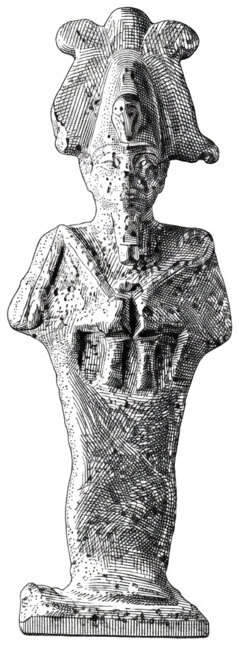
Each of the five was a god’s birthday. The order, fixed by the Middle Kingdom, ran Osiris, then Horus, then Set, then Isis, then Nephthys, the children of the sky-goddess Nut and the earth-god Geb. Osiris is the god who was murdered by his brother Set and put back together by his wife Isis. The Egyptians made him king of the dead, and his birthday opened the five.
The five days sat just before the New Year, which began on the first of the month of Thoth. The whole arrangement was pinned to a star: the Egyptians timed their year to the heliacal rising of Sirius, called Sopdet or Sothis, the morning the star first reappeared over the horizon after weeks of absence. That reappearance came close to the start of the Nile flood, the event the entire farming year turned on. So the five birthdays of the gods fell in the window before Sirius rose and the flood began.
The Egyptian civil year had no leap day. It lost about a quarter of a day against the sun every year, so the calendar slid backward through the seasons, a full day every four years, and only came back to where it started after roughly 1,460 years. This slow slide is called the Sothic cycle.
That drift is why a fixed date is a soft thing here. In ancient times the rising of Sirius near Memphis fell in mid-July; modern practitioners who keep the day place it anywhere from mid-July into early August, depending on where they reckon the star’s rising. Our almanac holds it on July 14, inside that window, rather than as a date the Egyptians themselves would have called permanent.
What was done in the five days
The danger came from Sekhmet, the lioness goddess thought to loose her messengers, wandering spirits that carried disease, across the land at the turn of the year. The pharaoh answered with the rite of Pacifying Sekhmet, which was meant to calm her before she struck.
Ordinary protection was smaller and portable. People wore the apotropaic charms drawn on linen at the neck, and Egyptologists connect this to a wider practice of protective spells copied onto papyrus. One such text, Papyrus Leiden I 346, carries spells against the demons of the last day of the year and the five days that follow. In its logic, knowing the names of the days, and the names of the powers loose in them, was itself the protection.
Egyptian scribes also kept calendars of lucky and unlucky days. A New Kingdom example of this kind of text, from around 1550 to 1070 BCE, survives in the British Museum. The five days at the year’s end sat among the unlucky ones.
Not every one of the five days weighed the same. Plutarch records that the third, the birthday of Set, was reckoned so ill-omened that the kings did no business and attended to nothing until after nightfall.
How the five days were won
The oldest full story of where the five days came from was written down around 100 CE by the Greek writer Plutarch, in a work on Isis and Osiris, and he tells it through Greek names for the Egyptian gods. That makes it a late outsider’s account, but it is the version that survived whole.
In Plutarch’s telling, the sun god was angry with the sky-goddess and cursed her: she would not give birth in any month or any year. The god of writing, whom Plutarch calls Hermes and the Egyptians called Thoth, was fond of her. He sat down to a board game with the Moon and won from her a small part of each of her days of light. Out of the winnings he made five whole days and set them outside the 360, where they belonged to no month and no year. On those days the goddess, free of the curse, bore her children.
Osiris was born on the first. Plutarch writes that at the hour of his birth a voice rang out, saying, “The Lord of All advances to the light.”
The same story in two tongues
The account we have is a translation: Plutarch writes Hermes for Thoth, Rhea for Nut, Cronus for Geb, and Helios for the sun god Ra. A Greek reader of his day met the Egyptian year through gods he already knew, and a good deal of Egyptian religion reached the wider ancient world in that softened, familiar shape. The bones underneath are older than Plutarch by more than two thousand years: the birthdays of the gods on the added days are already there in the Pyramid Texts.
The Egyptologist El Zahraa Megahed, who has studied Sekhmet’s messengers, describes the disease they carried as arrows loosed from the mouths of wind demons. “Winds are invisible, just as demons were,” she notes, and the wind was real enough: the flood season stirred the air over standing water and carcasses, and sickness rose with it. The five days sat at that turn of the year, so the danger people guarded against with linen and torches had a physical side under the story.
The day now
The old civil calendar is gone, but the five days outlived it. Modern Kemetic communities, people who practice a reconstructed form of the ancient Egyptian religion, still keep them. They watch for the rising of Sirius and count back from it to place the five birthdays before their New Year, Wep Ronpet. On the first day some set out offerings to Osiris, whose birthday has stood first in the order for four thousand years.
The date moves for them as it moved for the Egyptians, because the anchor was never a number on a page: it was the star coming back over the edge of the world, and the water that rose up behind it.
