To be cured of a scorpion sting in late Egypt, a person could walk to a slab of dark stone covered edge to edge with carved figures and dense lines of spell, pour water over it so the water ran across the cut words, and drink what came off. One such stone survives, now called the Metternich Stela, made in the reign of Nectanebo II around 340 BCE and held today in New York. The words it carried were the words of Isis, spoken when she cured her own poisoned son in the marshes, and the sick drank her magic along with the water.
The fourth of the five days the Egyptians added to the end of their year was her birthday.
The fourth birthday of the year
The Egyptian civil year ran twelve months of thirty days, which left it five days short of the sun. The Egyptians added those five at the end and kept each as the birthday of a god. Osiris came first, then Horus the elder, then Set, then Isis on the fourth day, then her sister Nephthys on the fifth. The order is set down by Plutarch, a Greek writer of around 100 CE whose account of the myth is the fullest one that survived whole. How the five days worked, and why people feared them, belongs to the first of them; we tell that story on the day-page for the Birth of Osiris.
Her name in Egyptian was Aset, written with the sign of a throne, the same throne she wears on her head in the carvings. The Egyptologist Kurt Sethe read the name as meaning she was once the throne itself, the seat that made a man a king. “She of the Throne” is the closest short translation. Everything else she became grew out around that first idea of the power that seats a ruler.
The goddess of magic
Isis was the great magician of the Egyptian gods, and one story explains where the power came from. In a text preserved on Papyrus Turin 1993, the aged sun god Ra walks the world drooling in his old age. Isis gathers his spittle, mixes it with earth, and shapes a snake, which she leaves on his path. It bites him. No god can cure the poison because no god knows Ra’s true, hidden name, the name that holds his power. Isis tells him she can heal him only if he gives her that name. In agony he yields it, on the condition that she pass it to no one but her son Horus. From that day the secret name is hers, and with it the deepest magic in the world.
That magic was borrowed by the living. People wore the tyet, the “knot of Isis,” an amulet shaped like an ankh with its arms folded down. Spell 156 of the Book of the Dead asks for one cut from red jasper and laid at the throat of a mummy, and gives the words to say over it: “the blood of Isis, the charms of Isis, the power of Isis are a protection.” The red stood for her blood. On the healing stelae like the one in New York, her spells were poured off the stone in water and swallowed, so that a stung child in a village drank the same magic the goddess had used on her own.
Isis and Nephthys were often drawn as kites, the shrill hunting birds of the Nile. One old reading connects the kite’s wailing call to the cries of mourning women, and its circling search for carrion to the two sisters searching for the body of their murdered brother.
The one who put the pieces back
Her husband and brother was Osiris, king of the living world until his brother Set murdered him and, in Plutarch’s telling, scattered the body. Isis went looking for the parts to bury them. In the older Egyptian versions she does more than bury him: she uses her magic to breathe life back into the body long enough to conceive a child by him. Then she hides in the papyrus thickets of the Delta and bears Horus in secret. She raises him out of Set’s reach and keeps the snakes and scorpions of the marsh off the child.
That marsh childhood is why the healing stelae exist. The spells they carry are the words Isis is said to have spoken over the sick Horus, and a person in danger stepped into the story by using them, standing where the god’s mother once stood. The search for the scattered body and the child raised in secret are the acts that made her, across three thousand years, the Egyptian figure people prayed to when a body was broken and needed mending.
The goddess of many names
Isis did not stay in Egypt. Greek and Roman travelers met her and matched her to their own gods: Herodotus set her beside Demeter, since both wander the earth grieving for a lost family member, and others tied her to Aphrodite. By the Roman period her temples stood around the Mediterranean, from Pompeii to the provinces, and she had become something larger than a national goddess. In Apuleius’s novel The Golden Ass, written in the second century CE, she rises out of the sea to the desperate narrator and names herself the single power the whole world worships under different faces: Cybele in one land, Minerva in another, Venus, Diana, Ceres, and, she says, by her true name, Isis.
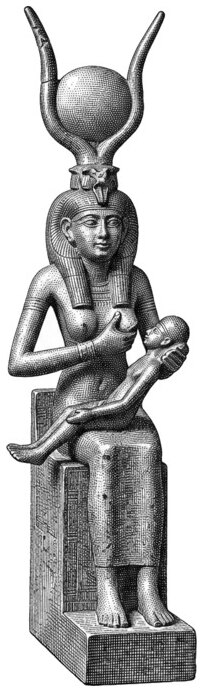
One parallel is argued over to this day. Images of Isis seated and nursing the infant Horus circulated in the Mediterranean for centuries, and they resemble the later Christian image of Mary nursing the child Jesus closely enough that scholars have long debated a connection. A 2012 study in the Journal of the Canadian Society for Coptic Studies lays out both sides: the nursing Isis is documented for a thousand years before the nursing Madonna appears in Egypt, yet the same authors caution that a visual echo is not proof of a borrowed cult, and the two images carried different meanings for the people who made them. The likeness is real; what it means is still open.
The day now
Isis outlasted the pharaohs who claimed her throne. When Rome took Egypt in 30 BCE and the old temples began to close, the island temple of Isis at Philae kept going, its rites for Isis and Osiris running on for roughly five more centuries, one of the last places on earth where the old religion was still practiced. It was finally shut under the emperor Justinian, around 535 CE, more than three thousand years after the first Egyptian carved a throne over a woman’s head.
Today the people who keep her birthday are modern Kemetics, who reconstruct the ancient religion and reckon the five added days by the return of the star Sirius, as the Egyptians did. They set the fourth day for Isis somewhere in the window from mid-July into early August, wherever they place the star’s rising. Our almanac holds it on July 17. Some mark it simply, with water and a few words for the goddess who was said to know the one name that could heal anything.
