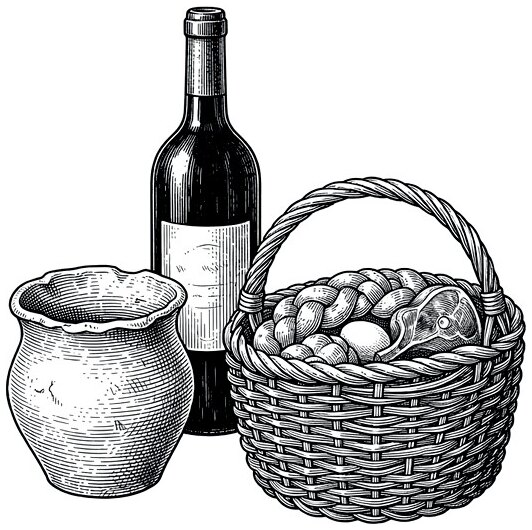
Early on a Soul Saturday, the Serbian day for the dead, in a village house of the 1890s, the family got up and prayed, then brought the head of the house a pile of thin wax candles and small loaves. He paired each candle with a loaf, saying for each: “This for the repose of my father’s soul, God forgive him.” He continued this through his mother, his grandparents, and every one of his dead, with a final pair for “all my dead, known and unknown.” The candles were carried to church and the loaves to the poor.
What the day is
Zadušnice are the Saturdays when Orthodox Serbs remember their dead. The word comes from duša, soul. People go to church, then to the graves, and light candles for the people they have lost. The day always falls on a Saturday, the church’s weekly day for the dead.
This one is named after Miholjdan on 12 October. Miholjdan is the feast of a desert hermit whom villagers call Sveti Miholj. The name sounds like Michael, hence the loose English “Michaelmas”, but the Archangel’s own day is in November. The Soul Saturday falls just before the hermit’s feast. In 2026 that is 10 October.
Candles, loaves and the book of the dead
Every orderly house kept a čitula or pomenik, a small book with the names of all its dead. On a Soul Saturday the head of the house took it to the priest, who read the names aloud at the service. One in Ripanj went back to 1711. In a house in the Užice district the list held a bishop, five monks, a nun and nine priests.
Not every book survived intact. A village headman in Kutlovo knew of a peasant whose čitula covered 321 years, but the priests could not read the old names and swore at him for it. When he copied out only the dead since 1840, he burned the original.
In some churches the candles had a second life. Church pupils came round with icy water and baskets, put out the flames and collected the stubs. Monks or priests later made new candles from them and burned them in church.
The customs changed from valley to valley. In eastern Serbia people started a day early, pouring drink over the graves on the Friday while the priest named the dead. For children who had died before they ever ate bread, families cooked rice instead of wheat and sent some of it to the children next door. On the Glasinac plateau in Bosnia each member of the household lit a candle for one of the dead and stuck it on the east wall of the room. After sunrise the families carried rakija and food to the graveyard. There they pooled the food on the grass and ate together, kissed the crosses and gave the rest to the poor. A Bosnian saying of the time took in this whole range: “Koliko sela, toliko adeta” — as many villages, so many customs.
A candle that is not your own
In Bosnia a candle lit for the dead could also heal. A schoolteacher, Stevan Delić, wrote the cure down in 1893 in the journal of the Sarajevo museum.
When the church fills with candles at Zadušnice, take one without anyone seeing. It must be a stranger’s candle, never one of yours. Keep it at home in a chest. If a swelling rises on your body, press the burnt end of the candle into it three times while speaking the words, then smear the spot with pitch.
Delić had been treated this way himself, and in a footnote he reported that the swelling went down, though he added a skeptical note: “Maybe from the pitch!?”
The Saturday the old books do not have
For all their detail, the 19th-century records do not agree on how many Soul Saturdays a year holds, and none of them has this one.
Vuk Karadžić’s Serbian dictionary of 1852 knows two, one before Lent and one after Trinity. A survey of peasant life from 1894 knows three, the last before Mitrovdan, St Demetrius’ day. In the heart of Serbia, the same book adds, people kept only the winter one. In Bosnia that year the count was four, one before each of the church’s long fasts.
Some Serbian papers say the Russians brought the autumn Saturday, after a Russian prince won a battle at Kulikovo in 1380. In Russia that story belongs to a different day, the Saturday before St Demetrius. Russian church scholars think the battle link is late, probably from the 18th or 19th century. In Serbia the Demetrius Saturday is the Mitrovske Zadušnice, four weeks after this one.
When the Michaelmas Saturday joined the Serbian year, we could not find out.
Other autumn Saturdays of the dead
Russia keeps its own autumn Saturday of the dead before St Demetrius’ day, in early November. Its folk name is Dedova subbota, Grandfathers’ Saturday. In some places spoons were laid on the table for the dead. When a thaw came during the week before, the understanding was that the souls were getting a rest.
Bulgaria moved its autumn day after the church changed calendars in 1968. Bulgarians now keep it before the Archangel Michael’s feast and call it the Archangel’s Zadushnitsa. In the Latin West, Abbot Odilo of Cluny fixed All Souls’ Day on 2 November around the year 1000.
The South Slavic dead were also expected home on other nights of the year. That belief has its own long article: When the Dead Come Home.
The day today
Today the day starts with the liturgy. Families bring koljivo, boiled wheat, to church, and the priest pours red wine over it. Then they go out to the graves, tidy them and light the candles. If the graves are too far away, the whole rite is held in church.
Many families still carry bread and the dead person’s favourite food. Ethnologist Snežana Ašanin calls the food “very wrong,” holding that only the candle, the wine and the wheat belong at the grave. Yet the custom is so deeply embedded that the priests do not intervene.
A wartime postcard with a German caption, printed between 1914 and 1918, shows such a meal: a Serbian family sits on the grass beside a wooden cross, with a bottle, a clay pot and baskets of food. Men in uniform caps stand behind them.