Krstovdan is the Serbian feast of the cross, kept on 27 September. In old village belief it was also the day the snakes went away. Snakes belonged to the devil, farmers in the west of the country said, so every snake had to hide from the cross by this feast. A snake still out after that had stayed out for evil.
In 2026 the feast falls on a Sunday.
A feast of lifting
In church language the day is the Exaltation of the Cross, one of the great feasts of the church year. The Serbian church keeps the old calendar, which now runs 13 days behind the civil one. Its 14 September is therefore 27 September.
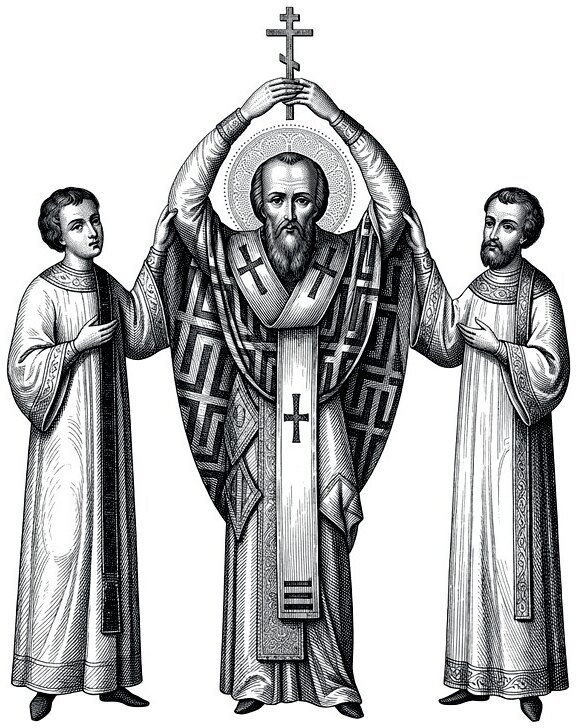
The church name, Vozdviženje, means “lifting,” and the reading for the day explains why. When the Cross was found in Jerusalem, the crowd was too dense for everyone to see it. The bishop of Jerusalem climbed onto a raised place and held it up, and the people cried “Lord, have mercy.” That gesture anchored the feast.
The date itself comes from a church dedication in Jerusalem. On 13 September 335, the churches the emperor Constantine had built over Golgotha and the tomb of Christ were consecrated. The Cross was shown to the people the next day.
In the late fourth century a pilgrim woman named Egeria saw the anniversary kept. It lasted eight days, and forty or fifty bishops came to it. It was kept “with the highest honour, because the Cross of the Lord was found on this same day.”
How the story grew
The story of the finding came later than the churches. The earliest account, by the emperor’s own biographer, records no cross. By the early fifth century the legend had grown: the emperor’s mother Helena searched for the Cross, and three crosses came out of the ground.
To find the right one, the bishop needed a sign. In a version written down around 440, a dying woman touched each cross and was healed by one of them. In the version read in Serbian churches, a dead man carried past on a bier rose when the right cross was laid on him.
In the seventh century, a second story entered the feast: a Persian army took Jerusalem in 614 and carried the Cross away. The Byzantine emperor Heraclius won it back and returned it to Jerusalem on 21 March 630.
In the church reading, the emperor carried the Cross toward Golgotha on his own back, dressed in purple and wearing his crown. At the gate he could not take another step. The patriarch saw an angel standing there. Christ, the angel said, had not carried the cross that way.
The reformer John Calvin mocked the relics of the Cross in 1543: there was enough wood in them, he said, to fill a ship. In 1870 the French architect Charles Rohault de Fleury measured the known relics and found they made up only about 4% of one cross.
Two days of the cross
Serbs have two days called Krstovdan, one in winter and one in autumn, and people often mix them up. The winter day falls on 18 January, the eve of Epiphany, and belongs to baptism. The winter Krstovdan has its own page. The autumn day is about the Cross found in Jerusalem. Both already stand in the Serbian dictionary of 1852, dated 5 January and 14 September by the old Julian calendar.
Fasting, basil and a clean house
Krstovdan is a fast day every year. On a weekday the fast is strict, without even oil. In 2026 the feast falls on a Sunday, so the church eases it to oil and fish, a theologian explained on Euronews Serbia. Many people still eat only bread and grapes on the day.
In church, the cross is laid on a tray of basil on the eve and carried out on the priest’s head. Basil picked on Krstovdan is blessed, by an old custom. People also tidy the house and get it ready for winter.
Older farm customs survive in Serbian press accounts. Cattle were daubed with tar in the shape of a cross to keep sickness away. The poljaci (the village field-guards) were paid off, since their season ran from St George’s Day in May to Krstovdan.
The day was also read for the coming winter. A cloudy Krstovdan meant a snowy winter, and a gentle rain meant a mild one. Thunder promised a fruitful year.
Near Skopje, in the village of Gradovci, children gathered the acorns of the sweet blagun oak around Krstovdan. They roasted them on the fire like chestnuts. The custom appears in an ethnologist’s report on acorn food from 1953.
Snakes under the cross
The belief comes from Mačva (the flat farming district between the Drina and the Sava). The Belgrade writer Milan Milićević recorded it in 1894, in a book on the life of Serbian peasants. Farmers believed snakes belonged to the devil and had to hide from the cross before Krstovdan.
Along the Sava and the Danube, a second belief held: many snakes on the surface meant a great flood was coming, and peasants grew afraid of the water at the sight of them.
Modern Serbian newspapers carry the belief in a harder form: all snakes rest on Krstovdan, and any snake seen afterwards is sinful, rejected by the earth, and should be killed.
One snake is exempt: a black house snake from Šumadija (in central Serbia) that the 1894 book describes, which lives in a hole under the house and comes out to sun itself. It harms no one, and if it is killed, the head of the household will die. Its story is told under Guja.
The 1852 dictionary, by the language reformer Vuk Karadžić, has a stranger rule. Do not make the sign of the cross while it thunders. At that moment St Elijah is striking at devils, and a devil could slip under your cross, where the thunder will not hit it.
The same days in other lands
The Bulgarian church, which follows the newer calendar, keeps Krastovden on 14 September. It is the day the sowing of winter wheat may begin, and seed for sowing is blessed. Bulgarians say the sun “turns back” toward winter from this day, as day and night “cross” and become equal. In the Bulgarian folk calendar the swallows leave on St Anne’s day or on Krstov den.
Among the East Slavs the snake belief runs stronger. In Polesie (the marsh lands of southern Belarus and northern Ukraine), an old rule forbade going into the forest on this day, “when snakes and reptiles go into the earth.” The birds leave at the same time. Slavic belief sent them to iriy (the world of the dead). In Russian villages the day also opened the cabbage season, with girls’ evening parties called kapustniki.
A Belarusian saying gives the jackdaw the keys of summer. When the jackdaw flies south in autumn, it takes the keys with it.
One Sunday, two fires of the cross
The Ethiopian church reached the same date by its own calendar. There the feast is Meskel, the word for “cross”, on 17 Meskerem. In 2026 that is Sunday, 27 September, the same day as Krstovdan in Serbia. By Ethiopian church tradition the finding took place in March. The feast moved to September to stay out of Lent and to match the dedication in Jerusalem.
On the eve, people build a great bonfire called the Demera and decorate the wood with the yellow daisies of the season. The largest one burns in Meskel Square in Addis Ababa. In the Ethiopian telling, Empress Helena was told in a dream to light a fire, and its smoke showed her where the Cross lay buried. UNESCO added the feast to its list of the intangible heritage of humanity in 2013.
When the fire has burned down, people take the charcoal and draw a cross on their foreheads.