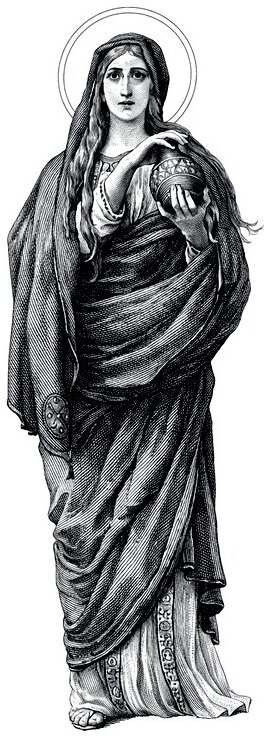
Before the feast Mass in Saint-Maximin-la-Sainte-Baume, a crier walks the streets of the Provençal town and calls out, in the old dialect, “Santo Madaleno, patrouno de nosto villo et de la Prouvenço.” Flutes and drums follow him through the streets, along with horses from the Camargue and men firing salutes. In the evening the town walks behind candles, singing the hymns it has sung for centuries, and the reliquary that holds what the town believes is Mary Magdalene’s skull is carried up from the crypt. This has happened on July 22, or near it, for nearly 750 years.
What the day is
July 22 is the feast of Mary Magdalene, the woman the Gospels name as the first person to find the empty tomb and see the risen Christ, and the one he sent to tell the others. The Western churches fixed the date by the thirteenth century. The Roman Catholic, Anglican and Lutheran calendars all keep it on July 22; the Book of Common Prayer sets its own collect and readings for the day.
For most of that history it was a memorial, a lower rank in the Catholic calendar. That changed in 2016. On 3 June the Vatican’s Congregation for Divine Worship issued a decree raising her observance to a Feast, the rank the calendar gives the apostles, under the old title apostolorum apostola, apostle to the apostles. Archbishop Arthur Roche, who wrote the commentary, tied the decision to the dignity of women and the mystery of divine mercy. The woman the medieval West had turned into a penitent prostitute now stood in the calendar beside the Twelve. We tell the story of how that legend was made, and unmade, in the full article on Mary Magdalene.
For fourteen centuries the Western church remembered Mary Magdalene as a reformed harlot, an identity built in 591 when Pope Gregory the Great fused her with two other women in a homily. No Gospel calls her a prostitute, and the Eastern church never accepted the label. The 2016 decree honours her instead as the first witness.
The customs
The largest living custom is the Provençal pilgrimage. In 1279 Charles II of Anjou, Count of Provence, unearthed relics at Saint-Maximin that were declared hers; the first solemn feast was held the next year, in 1280. Ever since, the town keeps a feast week in July around the 22nd. Pilgrims climb the wooded slope to the Sainte-Baume, the cave in the cliff where medieval legend placed her last years as a hermit, and gather at the great basilica below.
In the Serbian Orthodox calendar the day arrives on the Julian reckoning, July 22 old style, which is August 4 on the civil calendar. There the people call her Blaga Marija, gentle or mild Mary. It is an immovable holiday and carries no red letter in the church books, yet in the villages no heavy work is done in house or field, the same restraint kept for the fiercer summer saints, so as not to offend her. She is counted a protector of women. Folk custom holds that a woman who comes to church on her day, prays and lights a candle may ask one thing, and the saint will not refuse.
Legends and beliefs
The Orthodox East keeps the day for a different Mary than the Provençal hermit. Here she is the Myrrh-bearer, the woman who brought spices to anoint the body, and the Equal-to-the-Apostles, the first sent to carry the news. The best-known story attached to her is the red egg. By tradition she came before the Emperor Tiberius in Rome to speak of the Resurrection, and when he scoffed that a dead man could rise no more than the egg in her hand could turn red, it reddened in her palm. Orthodox icons still paint her holding it, and the tradition is given as one root of the red Pascha eggs. Tradition also has her ending her life at Ephesus, helping the Apostle John, and buried there.
The Serbian belief runs on an older current. Blaga Marija is made the sister of Sveti Ilija, Saint Elijah the Thunderer, whose day falls two days before hers. Storms and hail are expected around it, the villages say, “because brother and sister are talking.” She belongs to a whole July family of Marys in Serbian folk religion, alongside fiery Ognjena Marija, and the gentle one is the sister who calms the fire before it burns the fields. The ethnographer Veselin Čajkanović read this cluster as an old thunder cult resettled onto Christian names.
Across traditions
One woman, one date, and three feasts that barely resemble each other. Rome elevated her to apostle. In the Greek and Slavic East she stayed the myrrh-bearer with the reddening egg, while the Serbian countryside folded her into a weather calendar as the Thunderer’s mild sister, a saint you ask for a single favour and do not cross with a day’s work. None of these grew from the others in a straight line. They are what a first-century woman becomes when three religious cultures keep her memory for centuries and shape it to their own needs.
The day today
In Provence the crier still walks, the horses still come, and Dominican friars still keep the cave. The July 22 Mass in Rome now carries its own Gloria and Preface, added with the 2016 rank. And in Serbian villages women set aside the day’s work on Blaga Marija, go to light a candle, and watch the August sky for the storm that means brother and sister are talking again.
