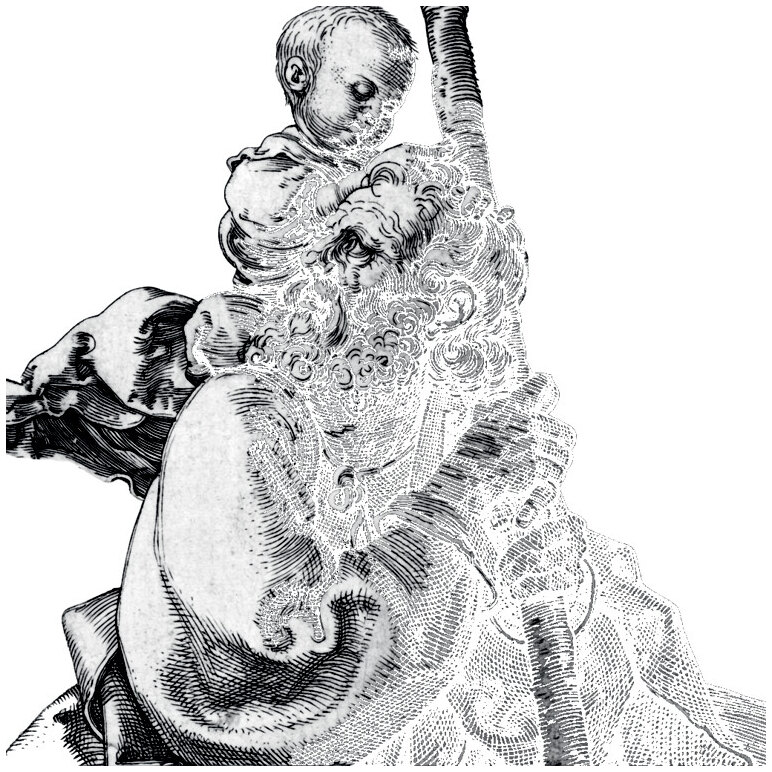
On July 25, 1933, so many cars and taxicabs lined up outside St. Christopher’s Church in Baldwin, on Long Island, that the traffic backed up and the priests came out to bless them every half hour. The parish had just raised a shrine to the saint from a chromium-plated Cadillac radiator frame, a cross and a St. Christopher medal set where the carmaker’s badge used to be. TIME reported it that August as a curiosity of the new motor age. It was really something much older arriving at the filling station: the feast of the traveler’s saint, kept for centuries by people on foot and on horseback, meeting the automobile.
What the day is
July 25 is the Western feast of St. Christopher, the patron of travelers and, since cars arrived, of drivers. The story behind the name, the giant who carried a child across a river and staggered under the weight of the world’s maker, belongs to the full article on Christopher the Christ-Bearer. What matters for the day is that a saint whose written life the church itself calls legend became one of the most handled holy images in modern life, riding on the dashboard of anyone in motion.
In the 1969 reform of the calendar, Rome took his feast off the universal Roman calendar and left it to local ones, on the grounds that it had entered the calendar late and his acts are legend. The world read this as the church firing Saint Christopher; no such thing happened, and July 25 is still kept across Catholic Europe and the Americas. The Orthodox East keeps a different day for him, May 9, as Christopher of Lycia.
The whole custom rests on a medieval promise: that whoever looked on an image of St. Christopher would not die a sudden, unprepared death that day. That is why churches painted him huge on the wall facing the door, so a traveler caught sight of him before riding out, and it is the same bargain a driver makes glancing at the medal clipped to the visor.
The customs
The living heart of the day is the blessing of vehicles. A priest works down a line of cars and motorcycles in a churchyard or a square, sprinkling holy water and reading a prayer for a safe year on the road. The custom grew with the automobile itself. Baldwin’s parish traces its car blessings to the 1920s; in Germany the first motorized Christopher pilgrimage set out from Munich to St. Christoph-Steinhöring on July 24, 1932, out of the older processions of teamsters and riders.
Barcelona keeps one of the most elaborate versions, at the little Regomir chapel that dates its first vehicle blessing to 1907, the first in Spain. Drivers who bring their cars are given a blessing, a sprig of lavender and a printed prayer card, and the day has its own pastry, the volante de Sant Cristòfol, a brioche shaped like a steering wheel. There, as in much of Spain, the feast falls on July 10 rather than the 25th. Elsewhere in the country, in cities like Vitoria and Valladolid, drivers’ associations decorate their vehicles with flowers, drive in procession and sound their horns.
Austria turned the day into a work of charity. Since 1960 the missionary agency MIVA has run its Christophorus-Aktion through July, asking motorists for a tenth of a cent for every accident-free kilometre they drove that year, the money buying jeeps and ambulances for missions with no roads. The parish blessing and the collection box go together.
Legends and beliefs
Under all of it sits a simple piece of medieval reasoning about a safe death. Christopher was counted among the Fourteen Holy Helpers, the emergency saints invoked against plague and against dying suddenly with no priest at hand, and his particular gift was the good end to a journey. The medal made the promise portable. People had carried his image for protection since the sixteenth century, long before there was an engine to protect, and the dashboard version simply moved the fresco off the church wall and into the car.
The refitting was easy because the saint was already about carrying people through danger. A patron of ferrymen and travelers on foot became the patron of muleteers, then of truckers, then of every motorist, without any of the story needing to change. Eastern Christianity keeps its own strange layer, the icons that give Christopher the head of a dog, which we follow in the full article; the Western day left that behind long ago and kept the river-crosser.
Across traditions
The two calendars pull him in different directions. In the Orthodox churches the May 9 martyr of Lycia stays tied to the ancient cult and to the old questions about who he was, dog-headed icons and all. In the Catholic West the July 25 feast drifted toward the road. It could have faded quietly after 1969, once Rome could no longer vouch for the biography, except that it had already fastened onto the one machine almost everyone now uses, and it held.
The day today
The medals still ride on visors and key rings, sold as briskly after 1969 as before. Around July 25, and July 10 in Spain, priests still walk the lines of cars with holy water, MIVA still counts the kilometres, and in Barcelona someone drives home with a sprig of lavender on the dashboard and a steering-wheel brioche on the seat, blessed for another year.
