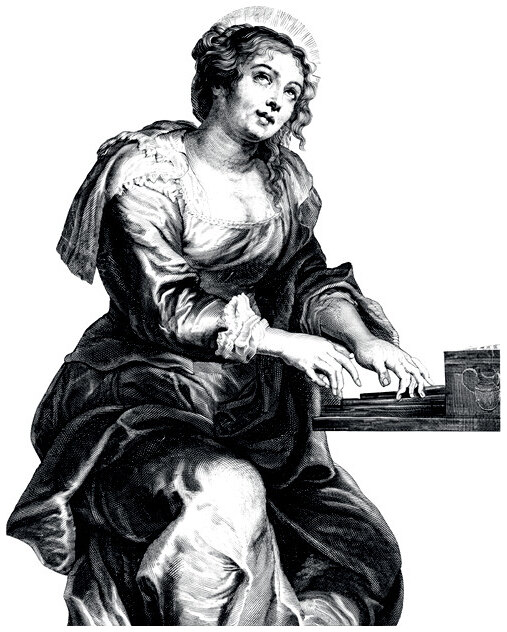
In November 1692 a London monthly, the Gentleman’s Journal, reported on a dinner. On 22 November the city’s music lovers had met at Stationers’ Hall, the hall of the London guild of printers and booksellers. Before they sat down to eat, they heard a new ode called “Hail, bright Cecilia”: a poem in praise of music, set for solo singers with choir and orchestra. The words were by a clergyman, Nicholas Brady, and the music was by Henry Purcell, one of the leading English composers of the day. The ode was “performed twice with universal applause”, the magazine wrote, “particularly the second Stanza, which was sung with incredible graces by Mr. Purcell himself.”
That stanza is a solo for a high male voice that begins “‘Tis Nature’s voice”, and the graces, the ornaments a singer adds to a tune, are written out note for note in the score. In 1857 the music historian William Henry Husk, who collected what he could find on these dinners, called this the only record he knew of Purcell singing.
The woman being praised that evening was a Roman martyr. The magazine’s editor, Peter Motteux, had already explained why London’s musicians gathered for her every year. They met, he wrote, “not thro’ a principle of superstition, but to propagate the advancement of that divine science”, by which he meant music. How did an early Roman martyr come to have new music written for her every November? The answer starts in Normandy, and the sources say more about what the musicians did than about what they believed.
A saint for musicians
The feast of St. Cecilia falls on 22 November in the Catholic calendar. Her legend makes her a young Roman noblewoman who had vowed herself to God and was married against her will to a pagan named Valerian. With the help of an angel she converted him, and she died for her faith: an executioner struck her neck three times without cutting off her head, and she lived three more days. The story of her life, her church in Rome and her tomb is told in our entry on Cecilia of Rome.
Music arrived late in that story, and Husk noticed that older retellings barely mention it. In Chaucer’s Canterbury Tales, where a nun tells her story, there is a single scene: at her wedding, “Whil the organs made melodie / To God alloon in herte thus sang sche.” While the instruments played, Cecilia sang to God in her heart. Husk also observed that painters seldom showed her with an instrument before the fifteenth century. After that the silent singer became a musician. Raphael painted her holding a small portable organ, and she took the title of patroness of music.
A silver organ in Normandy
The oldest known festival that celebrated her day with new music was held at Évreux, a cathedral city in Normandy. Around 1570 (the French national library dates it to that year, and the first recorded feast is from 1571), twenty-one men founded a brotherhood of St. Cecilia there. They were canons (the priests who served the cathedral), chaplains and choirmasters. Local noblemen and officials were among them, and so was Guillaume Costeley, organist to the French king Charles IX. They paid for a service “in honour of God, under the invocation of St. Cecilia, in the Cathedral Church of Our Lady at Evreux, on the Feast day of the said Saint, in each year to come for ever.”
Husk worked from the brotherhood’s own records, which two French archivists had printed in 1837. The services ran over three days: evening prayers on the eve, high mass on the feast itself, and on the morning after, a requiem mass for the founders who had died. Each year the brothers elected one of their number as “Prince”, the master of that year’s feast. He had to provide tapestries and candles for the church and garlands of flowers for the image of the saint. He also had to set a table for the brothers after mass. The rules allowed him to leave the cost of the meal to the others. Most Princes paid for it themselves and tried to outdo the man before them. Costeley was the first Prince, in 1571, and held the dinner at his own house.
In 1575 the brotherhood added a contest for new compositions, which it called the Puy de Musique. The prizes were small instruments made of silver. The best Latin motet (a choral setting of a sacred text) won a silver organ, and the second best won a silver harp. The two best French songs for five voices won a silver lute and a silver lyre. The most pleasing air, or tune, for four voices won a silver cornet, a wind instrument of the time. The best four-part song won a silver flute. The highest prize, a “Triumph of St. Cecilia” worked in gold, went to the best French sonnet. Each year two hundred notices were printed in Paris and sent out three months ahead, so that composers from far away could compete. The cathedral choir sang the entries. A panel of brothers judged them, and the winning motets were sung again at the great door of the cathedral while the winners’ names were read out.
The first silver organ, in 1575, went to Orlando de Lassus, then chapel master to the Duke of Bavaria and one of the most celebrated composers in Europe. His winning piece was a five-voice motet, Domine Jesu Christe. In 1987 the musicologists Elizabeth Teviotdale and Christine de Catanzaro argued that he wrote it for the contest. He won the organ again eight years later. In 1587 an organ builder named Roch d’Argillières joined the brotherhood. He paid only half a ducat, in return for which he promised to come every St. Cecilia’s Day to tune the organ.
France was at war with itself in these years, Catholics against Protestants. In the worst of the fighting the records say the contest was not held “because of the troubles”. The brothers kept electing Princes for another decade and admitted new members for a few years more, before the records stop. The archivists who printed them could not find the books in which the winning pieces had been copied.
London’s Musick Feast
More than a century after Évreux, a London version of the custom turns up in the records. The first recorded celebration came in 1683. A club called the Musical Society, made up of professional musicians and amateurs, chose stewards every year to organise a feast on 22 November. According to Motteux, many of its members were “persons of the first rank”. Purcell wrote the music for the first feast. When he printed it in 1684 he called St. Cecilia “a great Patroness of Music; whose Memory is Annually honour’d by a public Feast made on that day by the Masters and Lovers of Music, as well in England as in Foreign parts.” The poem he set, by a writer named Christopher Fishburn, greeted the room as “This Musical assembly, that seems to be / The ark of universal harmony!”
By the 1690s the day had a fixed order. The members went to St. Bride’s church in Fleet Street for a service that included an anthem (a choral piece on words from the Bible) and usually a sermon in defence of music in church. The new ode came next, and then dinner. The singers came from the choirs of St. Paul’s Cathedral, Westminster Abbey and the Chapel Royal, the monarch’s own choir, with some from the theatres. No women seem to have sung, and boys took the high parts. From 1684 the feast was held at Stationers’ Hall. In 1694 the Stationers’ Company ordered that the hall should not be let for less than five pounds, “in consideration of the damage that may be done … by setting up scaffolding and fixing tables and benches”.
Motteux described the evening in 1692. Six stewards were chosen each year, four “persons of quality or gentlemen of note” and two musicians. The feast was “one of the genteelest in the world”, and “whilst the company is at table, the hautboys and trumpets play successively.” Hautboys are oboes. The trumpeter John Shore had taught his instrument “to sound with all the softness imaginable.” By 1693 the feast was advertised in the official London Gazette, and tickets were sold at goldsmiths’ shops in Fleet Street and Lombard Street.
No feast was held in 1688 or the year after. The likeliest reason is politics: William of Orange had landed at Torbay eighteen days earlier to take the throne from James II.
Harmony that built the world
Each year’s ode was a poem in praise of music, and some of the leading poets of the time took the work. In 1687 the stewards asked John Dryden, and the poem he gave them begins with the creation of the world:
From Harmony, from heavenly Harmony This universal frame began. When Nature underneath a heap Of jarring atoms lay, And could not heave her head, The tuneful voice was heard from high, Arise, ye more than dead.
In Dryden’s picture, the world at first was a heap of atoms in conflict. A voice from above sang, and the four qualities from which the old physics built all matter, “cold, and hot, and moist, and dry”, leapt into their places. Creation then ran “from harmony to harmony” through the whole compass of the notes and ended in human beings: “The diapason closing full in Man.” A diapason is the whole range of notes, the full octave.
The poem then turns to Cecilia by way of Orpheus, the singer of Greek myth, who could make wild animals follow him and trees pull up their roots and walk after his lyre. “But bright Cecilia rais’d the wonder high’r,” Dryden wrote: when she played her organ, “An Angel heard, and straight appear’d, / Mistaking earth for heaven.” Some decades earlier, around 1640 to 1659, the engraver Schelte à Bolswert had printed the same comparison under his engraving after a painting by Rubens, which shows Cecilia at the organ with a dog asleep at her feet. The Latin verse beneath it ends Ille feras; caelum haec ad sua plectra trahit, which means: he drew wild beasts, she draws heaven to her strings.
The last stanza runs to the end of time. Just as music set the heavenly spheres turning at the creation, so on the last day, “The trumpet shall be heard on high; / The dead shall live, the living die, / And Music shall untune the sky.” In the poem, the music that put the heavens in tune at the beginning will take them apart at the Last Judgement. In 1961 the literary scholar John Hollander took that line as the title of his study of ideas about music in English poetry from 1500 to 1700, The Untuning of the Sky.
Brady’s ode of 1692, the one Purcell sang in, says the same thing in other words. It calls music “Soul of the world!”, the power that made “the jarring seeds of matter” agree and bound “the scatter’d atoms” by “laws of true proportion”, until “Thou tun’dst this world below, the spheres above, / Which in the heav’nly round to their own music move.” The idea is an old one, the music of the spheres: the heavens move in exact proportions, like the notes of a scale, and their movement makes a harmony. Plato and the Roman Cicero described it, and its history is traced in The Philosophy of Music: Number, Myth, and the Song of the World. Whether the stewards and their guests took it as a description of the universe or as a fine way of speaking, none of the sources says. Motteux, the one guest who wrote about the feast, called the art they served a “divine science”.
In 1693 tickets for the feast were sold at the shop of the goldsmith Richard Hoare, at the sign of the Golden Bottle in Fleet Street. In 1857 Husk noted that Hoare’s successors, by then bankers, still kept the Golden Bottle over their door and on their cheques.
The eve of the feast, 1695
Purcell wrote for the church service as well. For the feast of 1694 he composed a Te Deum and Jubilate, two hymns of praise, for choir and orchestra, and the Society planned to have them sung every year.
Henry Purcell died on 21 November 1695, the day before St. Cecilia’s Day. The musicians met for their feast the next day, and John Blow supplied that year’s Te Deum. Purcell was buried in Westminster Abbey on 26 November. The memorial tablet there says that he “left this life and is gone to that blessed place where only his harmony can be exceeded.”
Alexander’s Feast and the end of the series
Two years later the stewards went back to Dryden. In September 1697 he wrote to his son: “I am writing a song for St. Cecilia’s feast; who, you know, is the patroness of Music. This is troublesome, and in no way beneficial; but I could not deny the stewards, who came in a body to my house to desire that kindness.” The result was Alexander’s Feast, or the Power of Musick, a poem about the singer Timotheus playing on the feelings of Alexander the Great at a banquet. Walter Scott later repeated a story that Mr. St. John, later Lord Bolingbroke, found Dryden trembling one morning, after writing the whole ode in a single night. Another account says the Society paid him forty pounds after all.
The poem ends by bringing Cecilia in as Timotheus’s rival. Dryden calls her the “Inventress of the vocal frame”, that is, of the organ, and closes:
Let old Timotheus yield the prize, Or both divide the crown; He rais’d a mortal to the skies; She drew an Angel down.
Jeremiah Clarke, one of the stewards, set it to music, but Husk could find no copy of his score. The yearly series ended in 1703, and Husk could find no record of why. He guessed at the war with France and at the arrival of Italian opera, which drew London’s music lovers elsewhere. Only the sermon at St. Bride’s went on. A survey of London’s churches printed in 1714 still lists “A Musick-Sermon on St. Cecilia’s day”.
The poems outlived the feast, and in September 1739 George Frideric Handel set Dryden’s song of 1687 in ten days. On Thursday 22 November, “being St. Cecilia’s day”, he performed it at the Theatre Royal in Lincoln’s Inn Fields, a square in London, after his setting of Alexander’s Feast and an organ concerto. The newspaper notice promised that “particular care is taken to have the house well air’d; and the Passage from the Fields to the House will be covered for better conveniency”, meaning a roofed walk from the square to the theatre door.
The day today
The Accademia Nazionale di Santa Cecilia, with its orchestra and choir, traces its history to May 1585, when Pope Sixtus V founded a brotherhood of the city’s musicians, the Congregazione dei Musici, under the protection of the Virgin Mary and of Saints Gregory and Cecilia.
London’s feast came back in another form. Since 1946 the Musicians Benevolent Fund, a charity that supports musicians in need and now works under the name Help Musicians, has held a Festival of St Cecilia every year on the Wednesday nearest 22 November. The service is sung by the combined choirs of Westminster Abbey, Westminster Cathedral and St. Paul’s Cathedral, and it moves between the three churches. The 80th festival service was announced for Westminster Cathedral on 18 November 2026, with a new work by the composer Ryan Wigglesworth. Next year’s goes to St. Paul’s.
One English composer shared the saint’s day as his birthday. Benjamin Britten was born on 22 November 1913, and in 1935 he wrote in his diary that he was having “great difficulty in finding Latin words for a proposed Hymn to St Cecilia.” He set English words in the end, a poem by W. H. Auden. In 1942, when Britten sailed home from the United States in wartime, American customs officers took his manuscripts away. They seem to have feared the written music might be a secret code. He wrote the hymn out again on board the ship Axel Johnson and finished it on 2 April. Its first performance went out on the radio on St. Cecilia’s Day 1942, Britten’s twenty-ninth birthday, sung by the BBC Singers under Leslie Woodgate.
