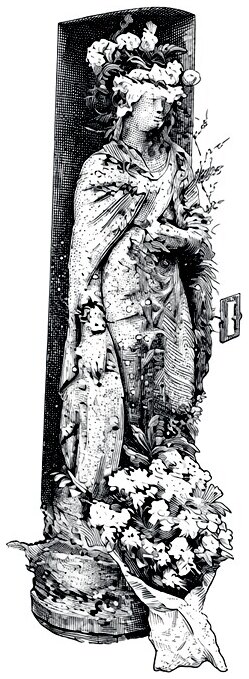
A photograph taken for the Agence Rol, a Paris press agency, on 25 November 1925 looks down on a street corner in the 2nd arrondissement of Paris. On the first floor of the corner house a stone saint stands in a niche, with a wreath of white flowers on her head and a big bouquet wrapped in paper at her feet. A street plate beside the window reads “Rue de Cléry”, another beside the niche “Rue Poissonnière”. Every face in the open window is turned down to the street, and the street below is so full of hats that you cannot see the pavement. The agency’s caption names the people the crowd had come for: les midinettes devant la statue. Midinettes was the Paris name for the young women who sewed in the fashion workshops, so the caption means the seamstresses in front of the statue.
The statue is St. Catherine, and 25 November is her feast. For centuries women in many parts of Europe kept this day as a feast of their own, and they did not all keep it the same way. In Paris the seamstresses crowned her. The lacemakers of the English Midlands held a tea when the long evenings of work by candlelight began, and in Estonia women dressed in white knocked on farm doors to ask for wool. This page follows the day through those three places.
Why women chose her
Catherine of Alexandria belongs to legend. The story makes her a learned princess who argued with the emperor’s philosophers, was sentenced to be torn apart on a spiked wheel, saw the wheel shatter at her touch, and was beheaded. In the 1820s the English writer William Hone opened his entry for her day with the sentence “It is doubtful whether she ever existed”. In 1969 the Catholic Church took her feast off the calendar of feasts kept everywhere in the Church, for the same reason, and in 2002 it restored her as an optional memorial. Her life, her monastery on Mount Sinai and her voice in the trial of Joan of Arc are told on her own page, Catherine of Alexandria.
Two things in the legend may explain why she became the women’s saint. The wheel made her the patron of everyone who worked with wheels, the spinners among them. Her refusal of every husband but Christ made her, in the eyes of young unmarried women, their patron. Hone wrote that she was “esteemed the saint and patroness of spinsters”, and that young women met on her day “and making merry together, which they call ‘Cathar’ning’”.
Two answers for one French saying
In French, a woman still unmarried at 25 is said to coiffer sainte Catherine, “to do St. Catherine’s hair”. The explanation found in most accounts today is a church custom: girls in France belonged to devotional groups for the saint, and every 25 November they made a new headdress for her statue. A girl left the group when she married, so the one still dressing the saint’s head at 25 was the one who had not.
A collection of French proverbs published in Lille in 1860 by a Mademoiselle Amory de Langerack gives this answer too, but second. Her first answer comes from weddings. On a wedding day, she writes, it was the custom to let the girl who most wished to marry next fasten the bride’s headdress, in the belief that it would help her to a husband soon. No saint named Catherine ever married: every one of them, in her words, chose “the immortal Bridegroom”, Christ. By her reckoning, a girl “left to do St. Catherine’s hair” could marry only after she had dressed this saint for her wedding, a condition, she writes, “impossible to fulfil”. She admits that this explanation, “although authentic, is a little complicated”, and offers the simpler one about the statues in the churches.
The seamstresses’ holiday in Paris
According to the costume historian Dorothea Nicolai, who draws on the long research of the French ethnologist Anne Monjaret, the custom came to Paris in the 19th century with young women from the provinces who came to the city for work, most of them in the growing fashion trade. As it faded in the rest of France, it survived in the ateliers. From the early 1900s, on 25 November, every unmarried 25-year-old seamstress or milliner in a workshop became a catherinette. Her colleagues had secretly made her a hat: around 1900 a pastel bonnet, from the 1920s a real hat, extravagant, and in the saint’s colours, yellow and green. They crowned her queen of the atelier for the day and set a table for a meal, and there was dancing. Nicolai also points out that in many trades a woman had to stop working when she married, which meant that staying single could also mean keeping one’s work.
After work the catherinettes walked through the streets in their hats to the statue at the corner of rue de Cléry, in the Sentier, the district of the garment workshops, and decorated it, as the crowd in the 1925 photograph was doing. In the late 1920s, Nicolai writes, a Catholic service for them began at the nearby church of Notre-Dame-de-Bonne-Nouvelle, and it was held until the mid-1960s. Two press photographs of 26 November 1932 show the parish priest blessing a group of catherinettes and young women laying flowers on the statue. In the evening there were balls in the big dance halls of the city, among them the Salle Wagram, the Moulin de la Galette and the Olympia, and from 1930 there were prizes for the best hats. Nicolai herself writes that the religious side “has never been very strong” in the Paris version.
In the Square Montholon, a small park in the 9th arrondissement close to the old workshop streets, stands a marble group by the sculptor Julien Lorieux dedicated to the young working women of the quarter. Nicolai dates it to 1908 and says it shows catherinettes celebrating.
The custom was strongest in the 1950s and 1960s. In the 1990s it almost disappeared, perhaps partly because the idea of the “old maid” had come to seem outdated. When it returned, Nicolai writes, it came back changed. Young men and women are now celebrated together, and the old pressure to marry has dropped out. The city of Paris receives the catherinettes of the fashion houses at the Hôtel de Ville, the city hall.
Cattern in the English lace villages
In Protestant England the feast lived on among working people. Hone printed a report sent to him in November 1825 by a correspondent who signed “R. R.”: on St. Catherine’s evening, the workmen of the royal arsenal at Woolwich used to carry a man dressed in woman’s clothes, with a large wheel at his side to stand for the saint, round the town in a wooden chair, stopping at houses to recite a speech. The correspondent added that the custom had stopped eight or nine years before.
The lacemakers of Buckinghamshire, Bedfordshire and Northamptonshire kept the day longest, as far as the surviving accounts show. They made lace by hand on pillows, and they called the feast “Cattern”. In May 1862 a reader signing “A. A.” wrote to the London journal Notes and Queries that on Cattern Day “these hard-working people hold merry-makings, and eat a sort of cakes they call ‘wigs,’ and drink ale.” The lacemakers’ own explanation, he reported, was a queen: a Queen Catharine “who, when the trade was dull, burnt all her lace, and ordered new to be made”, so that the court ladies had to follow her and the trade revived. He asked the journal’s readers who this queen might have been.
The lace historian Fanny Bury Palliser later gave an answer that is still repeated. In her account, Catherine of Aragon, Henry VIII’s first wife, had taught the craft to the women of Bedfordshire while she lived at Ampthill in 1531 to 1533. Other writers proposed Catherine Parr, his last wife. The lace historians of the website Lace in Context went back through the whole correspondence and concluded that no tradition of the lacemakers themselves linked that queen to the beginning of their craft. The story rests, they write, on “no greater authority than Mrs Palliser’s romantic inference”, a guess she made from the lacemakers’ vague talk of a good queen. Mrs Orlebar of Hinwick House, from a family of Bedfordshire landowners, described the custom in 1900 for the book Lace-making in the Midlands. She thought the queen was Catherine of Aragon too, but she added: “The poor people know nothing of the Queen, only state that it was an old custom to keep ‘Cattern.’”
Lace in Context calls her account the fullest description of the day. In Podington and the neighbouring villages, she wrote, the lacemakers kept Cattern on 6 December, St. Catherine’s Day by the old calendar that England had left in 1752. Each woman paid sixpence, half a shilling, for a shared tea, at a time when their lace earned them five or six shillings a week. They called the tea “washing the candle-block”, after the stand that held their shared candle (more on it below). She explains that the phrase was only a saying for an evening of gossip over tea and Cattern cakes, “seed cakes of large size”, with sugar balls passed round. After tea they danced while one old man whistled or played the fiddle, “and they enjoyed themselves like queens!” A large apple pie was cut for supper, and they were in bed by about eight.
The candle-block also helps explain why this was the lacemakers’ day. In 1868 John Plummer, who came from Kettering, wrote in Notes and Queries that some people called the feast “Candle Day”, because it marked the start of the season for working at lace by candlelight. Candles were expensive, so women worked together in one room round a single candle on a stand, the candle-block. Glass globes filled with snow-water stood around it, and the globes gathered the light like lenses and threw it onto the lace pillows of the women around it. Lace in Context records one candle shared by as many as eighteen lacemakers. Mrs Orlebar remembered one rhyme of the day:
Rise, maids, arise! Bake your Cattern pies! Bake enough, and bake no waste, So that the old bell-man may have a taste!
The white kadris of Estonia
In Estonia, on the eastern shore of the Baltic, the saint’s day is kadripäev, “Kadri’s day” (Kadri is the Estonian form of Catherine), and the customs belong to the evening before, 24 November. Estonian folklorists describe it together with Martinmas, the feast of St. Martin two weeks earlier. On both evenings, young people dressed up and went from farm to farm. They sang at the door until they were let in, then danced. They asked for gifts and wished the house luck for the coming year. The folklorist Ülo Tedre, writing in 1974, says these were the only two such begging rounds known across the whole country, and that the Martinmas visitors were meant to be frightening, in furs and dark clothes, while the kadrisandid, the Kadri visitors or “kadris” for short, were the beautiful ones. According to the older reports he collected, only women went as kadris; later, men dressed as women joined them. The University of Tartu folklorist Taive Särg describes them dressed in white, with sheets and ornaments.
Their songs suggest what the day was about. While the Martinmas singers wished the farm a good harvest, the kadris wished luck with the herds and above all with the sheep, and sheep were not to be sheared between Martinmas and St. Catherine’s Day. In the song in which they asked for gifts, they asked for the materials of a woman’s winter work. Tedre quotes it: Katri tahab takkusida, / Katri vingub villasida, / nuuksub lina nuustakaida! Roughly: Katri wants tow, Katri whines for wool, she sobs for a hank of flax. Tow is the short, coarse fibre combed out of flax, which was spun into rough yarn. Särg suggests that the day was probably an old feast marking the start of the women’s winter handicraft, when they spun yarn and thread from wool and flax and made the clothes for the whole family. When the round was over, the kadris held a feast together with what they had been given, and they called it kadripulm, Kadri’s wedding.
On the island of Muhu the kadris came as geese. An archive record quoted by Tedre says they wore straw round their necks, straw wings on their heads and beaks made of straw bands, called “kii-kaa-kaa” behind the door, walked like geese once inside, and were given peas, beans and meat.
The corner today
In Estonia the round survives, though Särg writes that today it is mainly children who go out on both evenings, and that getting into houses has become harder. In Paris the hats survive in the fashion houses, and so does the statue. A photograph taken in December 2013 shows her in the same first-floor niche at number 1 rue Poissonnière, on the corner of rue de Cléry, above the street where the midinettes gathered in 1925.
For the masked visitors of Martinmas two weeks earlier, see St. Martin’s Day.
