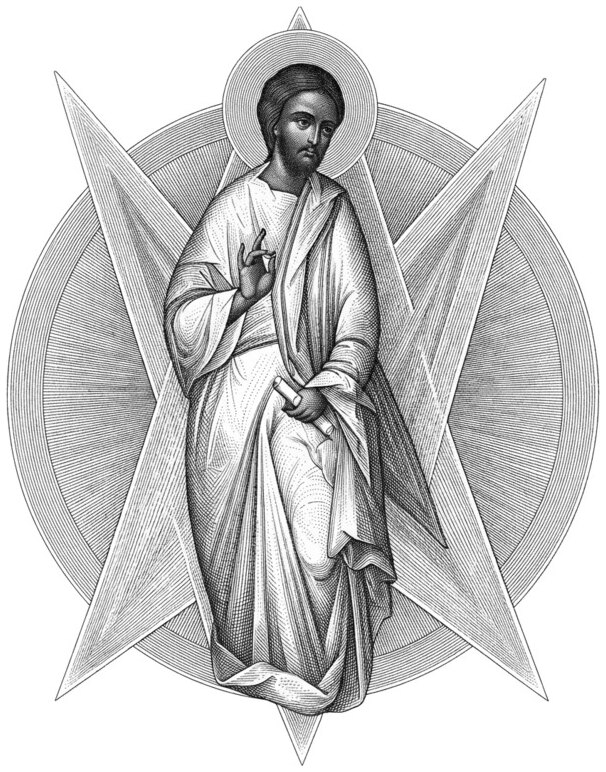
In villages across Serbia people say that on the night of Preobraženje the sky changes three times, and that whoever watches it and tells another person what they saw will lose their mind. Nobody explains what the sky changes into. The warning is all anyone will say.
What the day is
The Transfiguration, kept on August 6, remembers the moment in the gospels when Jesus took Peter, James and John up a high mountain. His face shone like the sun and his clothes turned dazzling white; Moses and Elijah appeared beside him and spoke with him. A bright cloud covered them and a voice said: “This is my beloved Son; listen to him.” The gospels never name the mountain. Since Origen in the third century, tradition has identified it with Mount Tabor, the lone round hill on the Jezreel plain, and pilgrims have climbed it ever since. Elijah, one of the two witnesses on the mountain, has his own Saint Elijah the Prophet page.
The gospel word for the tents Peter wanted to build is the same word the Greek Bible uses for the booths of the Jewish autumn feast of Sukkot. Whatever the historical timing, the gesture reads as the instinct of someone who has seen too much and wants to hold it.
The feast is older in the East than in the West. It is absent from the writings of Egeria, the fourth-century pilgrim, and the first clear testimony of a feast of the Transfiguration comes from the sixth century, in a life of Saint Savvas. By the end of the ninth century it was kept across the Eastern Roman Empire, and the date was fixed with arithmetic: August 6 is exactly forty days before the Exaltation of the Holy Cross on September 14, so the interval reads as a second Lent running toward the cross. In the Latin West the feast spread slowly. It only became universal in 1457, when Pope Callixtus III, giving thanks for the Christian victory over the Ottomans at Belgrade the year before, set August 6 for the whole Western church and wrote the prayers of the day himself.
The Byzantine church keeps the same feast on August 6 of the Julian calendar, which in our century falls on August 19. That observance, with its own grape customs, has its own page: Preobraženje.
Apples and grapes
The feast sits where the church year meets the harvest. In the Orthodox tradition it falls inside the Dormition fast, and in Greece it is the one day of that fast when fish is allowed. The first grapes of the season are carried to church, blessed, and handed out, a practice that reaches back to the ancient offering of first fruits. Where grapes do not grow, other fruit takes their place.
In Russia the day is known as Yablochny Spas, the Apple Spas. Spas means the Saviour, and three August feasts carry the name: honey is blessed on August 14, apples and pears on August 19, nuts and new bread on August 29. The apple ritual is the Byzantine grape blessing moved to a country where grapes were scarce. Folk custom forbade eating apples before the feast; only after the blessing could the new crop be eaten. It was said that children in heaven receive apples only when their parents on earth kept the rule.
The uncreated light
The Transfiguration carries a serious esoteric history. In the fourteenth century the light on Tabor became the subject of a theological battle. The monks of Mount Athos who practiced hesychia, the discipline of inner stillness and the repeated Jesus Prayer, described seeing the same uncreated light the apostles saw. A Western-trained monk named Barlaam called this a delusion and argued that the light was a created thing. Gregory Palamas, a monk of Athos who later became archbishop of Thessalonica, answered that God’s essence stays unknowable while his energies are real and uncreated, and that the light on Tabor was one such energy, divine and visible to a person made pure. Three councils in Constantinople, ending in 1351, upheld Palamas and condemned Barlaam’s reading. In the Orthodox world the feast of August 6 is also the feast of a claim: that the uncreated light is real, and that a person made pure can see it.
Hesychast icons of the Transfiguration painted the doctrine. Around Christ they placed a mandorla drawn with straight sides inside a circle, the shape the new theology used for the uncreated light, with golden rays, halos of light, and a Christ whose white robes blaze. The icon on the page header of this article, attributed to Theophanes the Greek, is one of those paintings.
The light under other names
The same feast wears different folk clothes. Armenia keeps it as Vardavar, the festival of the burning rose, whose pre-Christian core was a water festival for the goddess Astghik. The church absorbed the festival rather than abolishing it, and today Vardavar is a nationwide water fight on its own movable date, weeks after the August feast. Ethiopia makes the day a feast of fire and children: Buhe, when boys carry burning torches through the streets singing Hoya Hoye, crack whips to sound the thunder of the mountain, and collect dabo bread baked only for that day. The Serbian sayings turn on the weather instead. From Preobraženje there are no more great heatwaves, all nature is transformed, and the day was once the last for swimming in the rivers. Grapes blessed at the service are shared at the cemetery for the dead.
The day today
On Mount Tabor the church has been rebuilt many times. The Franciscan basilica completed in 1924, designed by Antonio Barluzzi, keeps the three grottoes of an older Crusader church as chapels of Christ, Moses and Elijah. In the West the feast gained a quieter stream of devotion in 2002, when Pope John Paul II added the Luminous Mysteries to the Rosary, placed the Transfiguration among them, and named it the mystery of light. The basilica’s apse holds a gilded mosaic of the Transfiguration, and on the morning of August 6 the sun strikes a glass plate set in the floor and lights the mosaic for a few minutes. Pilgrims still time their climb for it.