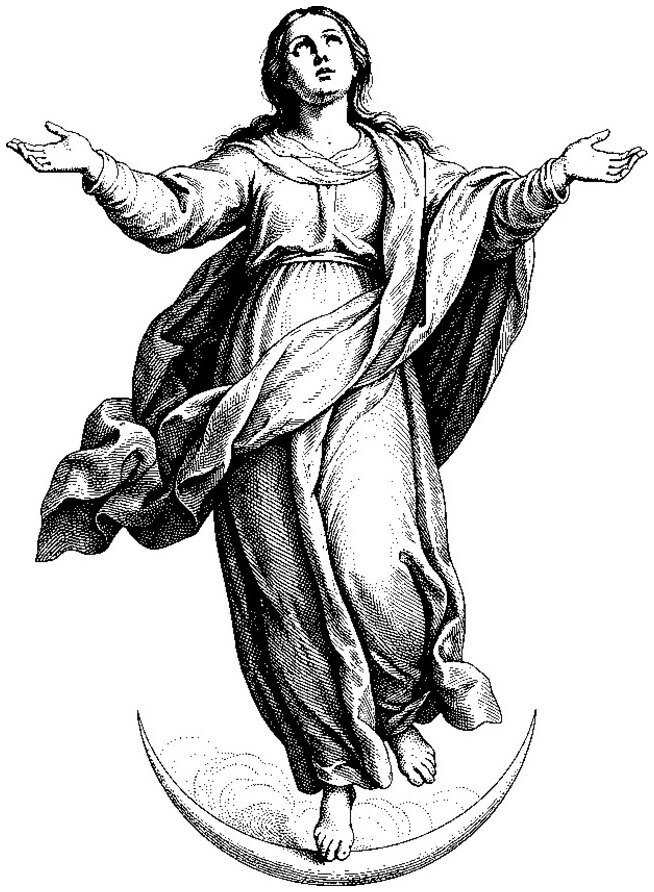
On the morning of August 15 the first work of the day is in the meadow. People cut the last stems and bind them into a bunch: St John’s wort and yarrow, chamomile and peppermint, chicory and mugwort, tied around one stalk of mullein, with roses and ears of grain tucked in. The Kräuterbuschen goes to Mass to be blessed and then hangs at home by the crucifix. In Bavaria and Austria the day still carries its old nickname, Our Lady’s Herb Day.
August 15 is the feast of the Assumption of the Virgin Mary. The Catholic dogma, defined by Pius XII in 1950, holds that Mary, “having completed the course of her earthly life, was assumed body and soul into heavenly glory.” The usual promise is a body that decays and a soul that waits; Mary is taken up whole, ahead of the resurrection. The feast is older than the dogma: the monks of Palestine kept a memorial of Mary on this day, the emperor Maurice made it universal across the Byzantine Empire in 602, Rome adopted it in the seventh century, and only around the eighth century did the West rename the Dormition the Assumption. In much of Catholic Europe the day is a public holiday: l’Assomption in France, Ferragosto in Italy, the Fiesta de la Asunción in Spain, and in Poland the feast of Our Lady of the Herbs.
The herb blessing
The German-speaking lands turned the feast into a festival of plants. Herbs and flowers are bound into bunches and blessed at Mass, then taken home. Which plants go in depends on what grows nearby. The classic list runs to seven: St John’s wort, yarrow, chamomile, peppermint, chicory, mullein and mugwort. Lavender, marjoram, sage, thyme, rue, wormwood and hyssop can join them. The count is symbolic too: seven, nine, twelve, twenty-four or seventy-seven herbs, and in Weissbach near Salzburg the parish binds an arrangement of up to seventy-two species. The blessed bunches are dried and kept about the house, in the attic or the stable. Old belief gave them a full job description: they guard against illness and evil spirits, and when a thunderstorm came, a corner of the bunch was burned so the smoke would protect the farm.
The thirty days that follow, from August 15 to September 15, are the Frauendreißiger, the Thirty Women’s Days, a folk season walled in by Marian feasts. The Assumption opens it; the Queenship of Mary, her Nativity, her Name and the Seven Sorrows close it. Our Lady of Sorrows is the last of them, on September 15. The lore of the season says herbs gathered now are three times as strong, poisonous plants turn harmless, and snakes do not strike. In Alpine shrines Mary herself appears dressed in a robe covered with ears of grain.
The city of Würzburg in Bavaria used to be a favoured centre of the Assumption herb blessing.
The empty tomb
The customs rest on a legend about the grave. In the Bavarian telling, when the apostles opened Mary’s tomb they found roses, lilies and herbs where the body had been, and that is why the plants are blessed on this day. The medieval Golden Legend tells it differently. There the tomb holds only the grave clothes; the doubting Thomas receives Mary’s girdle, dropped from the air, as proof that she was taken up; and Mary’s age at death is given as sixty, or in one reading seventy-two. The story reaches into the fifth century. At the Council of Chalcedon in 451, when the emperor asked for Mary’s relics, the bishop of Jerusalem answered that her tomb, opened at Thomas’s request, was empty; only the shroud was sent on to Constantinople.
The esoteric heart of the day is the claim about the body. The devotional tradition read Mary as the first fruit of the resurrection, harvested into heaven ahead of the season; the writer Florence Berger said “Assumption Day opens the harvest season and first fruits are sanctified.” The folk tradition answered in its own idiom: herbs that keep their virtue through the winter, blessed on the very day that promises an uncorrupted body. That is the same plant world that stocked the Renaissance still-room, where herbs carried hidden signatures and powers. The Green Lion traces that vegetable alchemy and the doctrine of signatures.
The Golden Legend gives Mary two ages at her death, sixty or seventy-two, and says the apostle Thomas received her girdle, dropped from the air, as proof that she had been taken up bodily.
Across traditions
In many places the feast absorbed an older August harvest. In Italy, Ferragosto carries the name of Augustus’s Feriae Augusti, the rest day the emperor gave farm workers in 18 BCE, added to older festivals such as the Consualia; beasts of burden were released from work and decorated with flowers. Poland calls August 15 Matki Boskiej Zielnej, Our Lady of the Herbs: bunches of herbs and grain are blessed and the walking pilgrimages arrive at Jasna Góra. The Armenian Church blesses the first grapes of the vineyard, and no one tastes the new harvest before the priest does. Sicily keeps La Quindicina, two weeks of fruit abstinence before the feast, and on the day the baskets of blessed fruit come out; the Golden Legend even has a priest squeeze a ripe grape into the chalice. In Austria priests walk the fields blessing the harvest, and in Alpine France they ride up to the pastures to bless the animals. In Portugal the ocean and the fishing boats are blessed on the afternoon of the day.
The Orthodox world keeps the same mystery under the older name, the Dormition, on the Julian calendar’s August 15, which falls on August 28 in the civil year. The Serbian church calls it Velika Gospojina, the Great Lady’s Day, and Velika Gospojina (Dormition) has its own page here, with the grain harvest and the new bread. Even Japan has a herb day in its calendar, though at the other end of the year: the Nanakusa no Sekku (Seven Herbs Festival) in January, when the seven spring herbs are eaten in porridge for health.
The day today
The customs are still alive: Lower Austrian parishes bind and bless the Kräuterbuschen around August 15. Jasna Góra draws about a hundred thousand pilgrims for the feast, the peak of a walking-pilgrimage season that ends on the day. Italian cities empty for Ferragosto, and Siena runs its Palio on the sixteenth. And in farmhouse kitchens the dried bunches still hang by the crucifix, their herbs faded and a little dusty. When the first thunderstorm of autumn comes, someone will break off a corner and put it in the fire, and the smoke will smell of St John’s wort and mugwort, and of a day when the Church says a body went up into heaven whole.