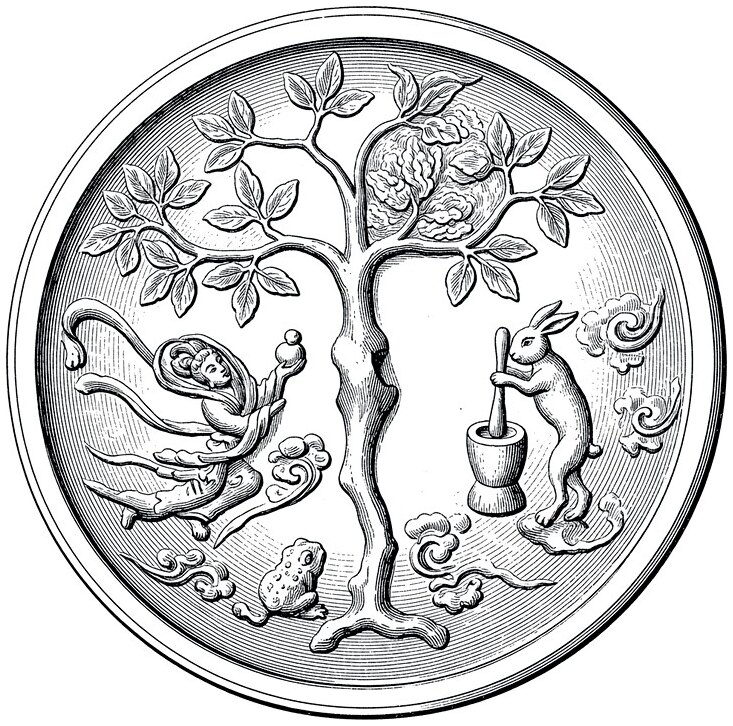
In the old Chinese capital of Kaifeng, every wine shop sold new wine in the days before the Mid-Autumn Festival. The shop fronts went up in coloured arches, with painted poles and brocade banners. By early afternoon the houses had nothing left to pour, and the shopkeepers pulled down their flags.
That night the rich decorated their terraces, and everyone else fought for a table in a wine house with a view of the moon.
This was early in the twelfth century, under the Song emperors. A man who had lived there became a refugee in 1126, when the armies of the Jin overran northern China. Years later he wrote it all down in a memoir of the lost capital, with a preface dated 1147.
The night of the full moon
The Mid-Autumn Festival is the night of the full moon in the eighth month of the Chinese lunar calendar. Families gather to look at the moon and eat mooncakes. The date moves against the Western calendar every year.
In 2026 it falls on Friday 25 September, and mainland China takes three days off, from the 25th to the 27th. Hong Kong’s public holiday is the day after, the 26th.
China made the festival a national holiday in 2008. Two years earlier it went onto the country’s first national list of intangible heritage.
The word is older than the festival. “Mid-autumn” already appears in the Rites of Zhou, an ancient handbook of court ritual. The night itself took longer to arrive. It first shows up in poems, during the Tang dynasty (618-907), and the big reference books of the Tang and the early Song still give it no entry of its own.
Tang poets made the date their own. The earliest known mid-autumn poem is by a minor court poet who died around 714. A century later the poet Bai Juyi carried the habit on. In 805 he invited his friends to watch the moon with him at a monastery in Chang’an, the Tang capital. Most of his other mid-autumn poems are about friends who were far away.
The woman who stole the medicine
The festival’s story starts with a theft. A Chinese book from the second century BC, the Huainanzi, gives it in a single line. A legendary archer, Yi, asked a goddess, the Queen Mother of the West, for the drug of immortality. His wife Chang’e stole it and fled to the moon.
Yi was left desolate, as if he had lost someone, with no way to get more.
The same book also puts a toad in the moon. A Tang bronze mirror of the eighth or ninth century, now in the Metropolitan Museum in New York, shows how the picture had filled out by then. The goddess flies on one side of a tree, a rabbit stands on the other, and a toad sits below.
Later tellings are kinder to Chang’e. In some of them she swallows the elixir only to keep it out of the hands of a wicked man, and people still set out mooncakes for her.
The tree is a cassia. A man named Wu Gang is condemned to chop at it forever, because it grows back after every cut; his story is written down in a ninth-century book of strange tales. The rabbit pounding medicine under the tree has a history of its own, told in Why Did Alchemists See a Rabbit on the Moon?
The emperor who visited the moon
One Tang tale sends a living emperor up there. Its fullest version survives in an old manuscript found at Dunhuang, a desert oasis in China’s far northwest. On the night of the fifteenth of the eighth month, the Tang emperor Xuanzong was watching the moon from a high place with a Taoist master named Ye Jingneng. Ye offered to take him to the moon palace.
The emperor asked what they should wear. White padded gowns of brocade, Ye told him, because the halls up there are crystal and the cold is overwhelming. A spell took them there in an instant. The towers and windows were crystal, and women in pearl garments carried crystal trays. A tree rose so high that its branches reached across thousands of worlds. Its leaves were the colour of silver.
The cold got into the emperor’s bones. He asked to go home, and Ye wanted to stay and show him the flowers. When the emperor said he could not last another moment, Ye smiled, cast his spell, and they stood in Chang’an again.
A scholar of Chinese poetry, A. R. Davis, thinks the poet Su Shi knew some version of this tale.
At mid-autumn in 1076, Su drank until dawn and thought of his younger brother Ziyou. The song he wrote that night is in every anthology of his lyrics. In it he wants to ride the wind up to the heavenly palaces, and he fears that in those jade towers he could not bear the cold.
In Kaifeng the night market ran until dawn, and the children of the city played through the whole night. People living near the palace could hear its pipes late into the evening, “as if beyond the clouds”.
Bowing to the moon
In Beijing, the moon was worshipped at home. A Manchu writer, Dunchong, described the evening in his book of the city’s yearly customs, published in 1906. Households sent each other mooncakes and fruit.
When the moon was full, they set out melons and fruit in the courtyard, along with soybeans in the pod and cockscomb flowers. Watermelon for the moon was cut in zigzags, so that it opened like a lotus.
The men mostly did not kowtow at this offering. Beijing had a proverb for it: men do not bow to the moon, and women do not sacrifice to the Kitchen God.
Paper shops sold a picture for the rite, known as the moonlight horse. At the top sat the moon’s star lord, Taiyin Xingjun, painted like a bodhisattva. Below was the moon palace, and in it the jade rabbit stood upright like a man and held a pestle. The biggest sheets were seven or eight feet tall.
The family set the picture up facing the moon and burned incense before it. When the rite was over, they burned the picture too, together with paper money.
Market craftsmen also shaped the moon’s rabbit out of yellow clay and sold it as Lord Rabbit. One wore an official’s robes under a parasol, another wore armour and carried banners, and some rode tigers.
Beijing called its paper god pictures “horses”, because people did not dare to name the gods outright.
Reunion cakes
Dunchong rated one shop outside the Qianmen gate the best mooncake maker in the capital. Cakes made for the moon offering could be more than a foot across, painted with the moon palace and its toad and rabbit. Some families ate them once the rite was over. Others kept them until New Year’s Eve and called them reunion cakes.
The idea of reunion is older. In Ming Beijing, around 1635, the fruit and cakes offered that night had to be round. Married daughters visiting their parents had to go back to their husbands’ houses on the fifteenth, so it was known as the Festival of Reunion.
The best-known mooncake story is about a revolt. Rebels against the Mongol Yuan dynasty are said to have hidden notes inside the cakes, reading “uprising on the fifteenth night of the eighth month”. The story is repeated everywhere. Smithsonian magazine, telling it again in 2024, counted it among the anecdotal accounts of how the cake began.
The same moon next door
The same full moon is a holiday across East Asia. In Korea it is Chuseok, when families hold rites for their ancestors with rice from the new harvest and rice cakes, songpyeon. In the southwest of the country, women join hands under the full moon and dance ganggangsullae, a circle dance on UNESCO’s heritage list since 2009.
Vietnam keeps the night as Tết Trung Thu, today above all a children’s festival, with lanterns and lion or unicorn dancers in the streets. Japan watches the same moon tonight as Tsukimi. China’s older state rite for the moon was held at the equinox, and Qiufen tells how commoners were kept out of it.
The day today
Xiamen, on the Fujian coast, plays dice for its cakes. Six dice go into a bowl, and each throw wins a cake graded by the ranks of the old imperial examinations. A full set has 63 cakes, from one for the top scholar down to 32 for the lowest grade.
Local lore gives the game to the soldiers of the Ming loyalist general Zheng Chenggong. Gong Jie, a Xiamen local historian, went through the histories and family registers and found no proof of it.
Tai Hang, in Causeway Bay on Hong Kong Island, was once a Hakka village. The story is that a plague hit it in 1880. The villagers built a dragon, stuck joss sticks all over it, and carried it through the village with firecrackers on the evenings of the 14th, 15th and 16th of the eighth month, and the plague stopped.
The dance has gone out on those three nights every year since, for more than 130 years, and in 2011 it went onto China’s national heritage list. Tai Hang is now part of a busy commercial district. Tonight is the second of the three nights, and the dragon carries its incense through the streets again.