In a Singapore housing estate in late summer, a temporary stage goes up beside the car park, and the first row of plastic chairs is never used. The seats are fine and the view is good; they are left for an audience the living cannot see, because the seventh lunar month has begun.
The month the dead come back
Ghost Month is the seventh month of the Chinese calendar; in 2026 it runs from August 13 to September 10. On its first night, at eleven in the evening, the gates of the underworld open. The dead come back: ancestors with families to receive them, and the ones with nobody left, called politely the good brothers (好兄弟). For a month the boundary between the living and the dead is treated as a practical matter: you feed them and burn money for them, and the first row of the stage stays empty.
The opening is a ceremony: on the evening before the month begins, temples unseal their ghost gates. At Keelung in northern Taiwan the best-known rite belongs to the Laodagong Temple, whose shrine niche is opened with a key. The tradition dates to 1851, when settlers from Zhangzhou and Quanzhou fought over land and water and the dead of the feud were gathered into one temple to be honored. Eleven surname associations still take turns hosting the great sacrifice.
What the living do
At home the customs are small and specific: on the first day families set out a basin of water, a towel, and a toothbrush at the front door, so a visiting spirit can wash before eating. Some temples seal their bells and drums for the whole month, so the dead are not disturbed at their offerings. Food is laid out and incense lit; joss paper, printed for the dead and called hell money, goes into metal bins or burns at the roadside, and paper houses, cars, and phones with it.
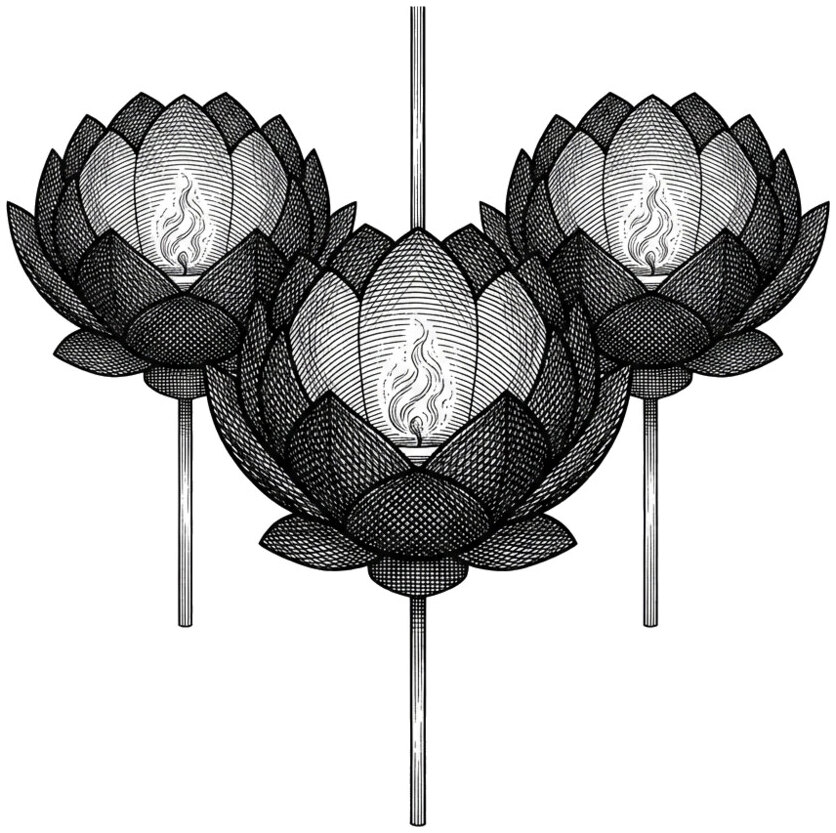
At night the living entertain the dead: Singapore and Malaysia run getai, song stages with pop covers, Hokkien ballads, and comedy, put up in the districts and paid for by the residents. The front row is kept for the other audience, and it is bad luck to sit there. On the water, paper lanterns are set loose to guide the lost; Murakami Hideo painted the rite at Keelung in 1927, a river crowded with small lights.
The month has a keeper: the Dashiye, the Great Master, is a paper effigy built fresh each year with a green face, fangs, horns, a long red tongue, and a small Guanyin on its head. Tradition says he was the leader of the evil ghosts until Guanyin subdued him and set him over the wandering spirits. He keeps order among the dead, and at the month’s end his effigy is burned; when the fire takes him, the good brothers go back with him. In Malaysia these effigies reach more than forty feet, and the way one falls is read as an omen. Other closings call in Zhong Kui the demon queller, whose dancers drive the spirits out with an exorcism dance.
Mulian’s bowl
The charter myth of the festival is Buddhist: in the Yulanpen Sutra, the monk Mulian, famous for his supernatural powers, looks with his divine eye and finds his dead mother reborn as a hungry ghost. He brings her rice, which turns to burning charcoal before it reaches her mouth. The Buddha tells him that no single person’s power can lift a debt that deep. On the fifteenth day of the seventh month, the end of the monks’ summer retreat, Mulian must offer food to the whole monastic community; the pooled merit frees his mother and seven generations of ancestors, and the festival has followed that instruction every year since.
The Daoist reading runs beside it: the fifteenth day is Zhongyuan, the Middle Prime, one of the Three Yuan festivals, and the birthday of the Earth Official, who weighs the deeds of the living and pardons the dead. In medieval China the two met on the same full moon: the Buddhist feast for the hungry ghosts and the Daoist day of judgment and mercy. The historian Stephen Teiser reads the result as a Chinese festival assembled from Indian parts, one that by the Tang belonged to no single tradition. The peak night has its own page here, the Zhongyuan Festival.
The Yulanpen Sutra is a short text, about eight hundred characters. The word yulanpen comes from a Middle Indic word for “rice bowl”; the sutra is thought to be a genuine translation from an Indic original of the third century CE.
The hungry ghosts
The euphemisms hide a precise picture of who these dead are: the hungry ghost is the preta of Indian Buddhism, a being driven by needs it cannot satisfy. The ones who come back in the seventh month are often the unbidden, people who died without descendants and without graves, with no one to perform the rites. That is why the month’s rules are careful; they are hospitality as much as self-defense. Do not sit in the spirit’s chair, swim at night, pick up money left on the street, call a friend’s full name from behind, or clap them on the shoulder, which is said to put out the three fires of their vital force.
The underworld has a geography: Fengdu Ghost City on the Yangtze, built over two thousand years as a model of it; when the gates open, the traffic runs the other way.
The same fire elsewhere
The same logic shows up in other calendars: Japan keeps Obon in the same season, fires at the door to welcome the ancestors and fires again to send them home; Vietnam marks the Ullambana feast under the name Vu Lan. Older than either is Cambodia’s Pchum Ben, fifteen days when hell opens and sticky-rice balls are thrown at dawn for the hungry ghosts; its charter text, the Petavatthu, dates to the third century BCE. In India, Pitru Paksha sets aside the dark fortnight of Bhadrapada for the ancestors, rice balls and water offered to the crow, the messenger of Yama. The dates and the gods differ; the arrangement is the same.
The month now
The month is a living practice: the ghost gate opens at eleven on the night of August 12, and Singapore’s town councils put out metal bins for the burning while the getai stages go up on the same car parks. Some communities now call the month one of gratitude, a time for filial remembrance. At Keelung the painted river of lanterns from 1927 has a living descendant. On the night of the fifteenth the paper boats go out on the water, and in the housing estates the first row of the stage stays empty.
