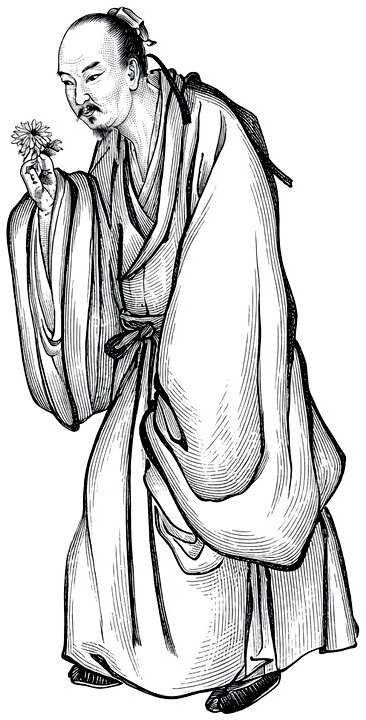
On the ninth day of the ninth month, the poet Tao Yuanming had no wine. He went outside and sat for a long time among the chrysanthemums beside his house. Then wine arrived, sent by the provincial governor, who had long wanted to meet him. Tao drank it on the spot, got drunk and went home.
That simple anecdote appears in an official history written around 490. The ninth day of the ninth month, called the Double Ninth or chongyang in Chinese, falls on Sunday 18 October in 2026. The tradition Tao observed, drinking wine among chrysanthemums to long life, still continues.
Nine on nine
The Double Ninth is the ninth day of the ninth month of the Chinese moon calendar. Like the Mid-Autumn Festival a month before it, it moves on the everyday calendar. Last year it fell on 29 October.
The name comes from the numbers. In Chinese thought odd numbers belong to yang, the bright and active force. Nine is the highest single-digit one, so a day that puts nine on nine carries the meaning of “double yang”, or chongyang.
The most famous origin story reads as a warning: a family climbs a mountain on that day to escape a disaster, and their animals die at home in their place. That legend and the strong-smelling plant the family carried have their own article, Huan Jing and the Dead Chickens.
A hat on Dragon Mountain
The Tao story has a twin in the same family. Tao’s grandfather on his mother’s side was an army officer, Meng Jia, and Tao wrote his life.
One ninth day, the grandfather’s general gave a feast on a hill, Dragon Mountain. All the officers came in military dress. A gust of wind blew the grandfather’s hat off, and he did not notice. The general signalled everyone to keep quiet, to see what he would do.
After a long while Meng Jia went out to the toilet. The general had the hat brought back, together with a teasing piece of writing about it. Both were laid at his seat. Meng Jia came back, read it and answered in writing at once. In the official history of his dynasty, compiled in 648, the whole company sighs at how fine his answer was.
The day in the old capitals
The fullest early picture comes from a refugee. Kaifeng, the capital of the Song dynasty, fell to northern invaders in 1126. One of the people who fled, Meng Yuanlao, later wrote down the city as he remembered it.
On the ninth day, the people of Kaifeng went to look at chrysanthemums. One kind was yellow and white with a heart like a lotus pod, known as “ten thousand years”, while a round yellow variety went by “golden bell”. The chronicle notes that there was no place without them. Wine shops tied chrysanthemums into gateways at their doors.
People went out of the walls to climb the hills nearby and feast there. A day or two before, families sent each other steamed cakes. Small flags of cut silk stood in the top, with pomegranate seeds, chestnuts, ginkgo and pine nuts pressed into the dough. Dough figures of a lion and a foreign king, known as “lion-barbarians”, sat on top as well.
At two of the city’s monasteries the monks preached “sitting on lions”, probably on lion-shaped seats. Those sermons drew the biggest crowds. Late in the month the shops changed their stock to paper clothes, boots, mats and hats for the dead, all burned in their honour on the first day of the tenth month.
Almost eight centuries later, around 1900, a Manchu writer set down the same day in Beijing. There people simply named it jiu yue jiu, “ninth month, ninth day”. Families carried wine pots and food boxes out of the city gates to climb high. Some went to the Taoranting pavilion in the south, others to the temples of the Western Hills. They wrote poems, drank, roasted meat and shared cakes.
Beijing’s cakes came in two kinds: layered sugar dough with fruit between the layers, or a steamed bun dotted with dates and chestnuts. In earlier times the cake shops flew green flags. Parents fetched their married daughters home to eat cake, a custom known as the Daughters’ Festival. By 1900 it was gone: “Today the cake shops fly no flags, and nobody fetches the daughters home to eat.”
Rich households banked hundreds of potted chrysanthemums in a hall until they rose like a hill, the “nine-flower mountain”. The writer could name 133 varieties from memory, and he knew of more than 200 others. One bore the name Drunken Li Bai, after a Tang poet who loved his wine.
In Chinese, gao “cake” and gao “high” sound the same. That is the usual explanation for why cake belongs to the day of climbing high. Shops still sell the Double Ninth cakes with small coloured flags stuck in the top.
Across traditions
Japan’s court took the day from China and gave it cotton. On the evening before, cotton wool was laid over the chrysanthemums to soak up the night’s dew. In the morning people wiped themselves with it against old age.
A lady at the empress’s court around the year 1000, Sei Shōnagon, liked the ninth day best in a light rain from dawn. The cotton on the flowers was then soaked through, and its scent came out more strongly.
Another court lady, Murasaki Shikibu, got the cotton as a present around 1008. A lady-in-waiting brought it with a message from the mistress of the house: “Wipe your old age away well.” Murasaki answered with a poem. She would touch the dew only enough to grow young and leave the thousand years to the flower’s owner. She meant to send it back with the poem, but the lady had already gone to her rooms. So Murasaki kept it.
Japan now keeps the day, Chōyō, on 9 September by the Western calendar. At the Kamigamo Shrine in Kyoto, priests carry chrysanthemums into the main sanctuary, which opens for only a few rites. Then two men in white with black lacquered caps hop nine times like crows and take turns cawing, nine times.
After them, local boys wrestle sumo for the god, and visitors get chrysanthemum sake poured from gilded ladles. The crows recall the shrine’s story of a three-legged crow that guided the first emperor of Japanese myth. Further south, the port festival of Nagasaki Kunchi still carries the day in its name: kunchi is a worn-down “ninth day”.
Korea kept the day too, as an almanac of 1849 shows for Seoul. Yellow chrysanthemum flowers went into sticky-rice cakes. Pear and citron were cut fine and served with pomegranate seeds and pine nuts in honey water. The people of the capital climbed the mountains north and south of the city to eat and drink. That was “the old custom of climbing high”, and the cakes came from the Kaifeng cakes, in the almanac’s own view.
The day today
In mainland China the day has been Seniors’ Day by law since 2013, defined simply in Article 12: “Every year the ninth day of the ninth lunar month is Seniors’ Day.” Taiwan declared it Senior Citizens’ Day in 1966, and its local governments often give older residents a small cash gift.
In Hong Kong the day is a public holiday, and families visit their ancestors’ graves to clean them and leave offerings. This year it falls on a Sunday, so Monday 19 October is the day off.
Last year the police kept private cars off the road to the Cape Collinson cemetery in Chai Wan by day for a whole month, from 17 October to 16 November. On weekends, the roads closed to everything but buses, minibuses, taxis, hearses and permit holders.