Goibniu the smith made weapons by three turns of the hammer. While he worked, Luchtaine the wright shaped the spear shafts with three chippings and Credne the brazier turned the rivets. The promise ran through the forge: “No spearpoint which my hand shall forge shall make a missing cast.” When the Fomorian spy Rúadán drove one of those spears through him, Goibniu pulled it from his body, threw it back and killed the man with it. Then he walked to the Well of Sláine, where Dian Cecht’s family sang spells over the water, and came out whole.
The day in the tree calendar
September 2 opens the month of Muin in the Ogham tree calendar. The year there runs in thirteen months of twenty-eight days, each month bound to a letter of the old Irish Ogham alphabet. The tenth month belongs to Muin, the letter M, and runs to September 29. Modern druids and pagans keep it as the vine month, a harvest month leaning toward the autumn equinox.
The tree calendar itself is a modern construction. It took shape in the nineteenth century with Edward Davies, then in 1948 with Robert Graves’s The White Goddess, and later with Ross Nichols, who founded the Order of Bards, Ovates and Druids. No evidence survives that the ancient Irish divided the year this way, and the calendar’s own home tradition, the OBOD journal, calls any tree calendar an entirely modern invention. Graves built his thirteen months on a miscount: Ogham has fifteen consonants and five vowels, twenty letters, not the thirteen a lunar scheme needs. The site’s other pages on this calendar tell the story from the other end: the birch month opens it in December, and the nameless day is the extra day that belongs to no tree.
The script’s own words kept the woodland: the letters were called feda, “wood,” the consonants “sides of a tree-trunk,” the strokes “twigs.” Even so, only eight of the twenty letter names are actually tree names.
The letter behind the month
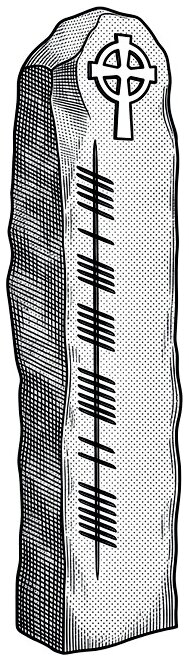
The letter itself is old: Muin is the eleventh letter of the Ogham alphabet, the five-stroke script cut along the edges of stones in early medieval Ireland. Its three word-oghams, the kennings that gloss the letters, survive from the Old Irish period: “strongest in exertion,” “proverb of slaughter,” and “path of the voice.” The name carries three homonyms in Old Irish, the neck, a wile, and love, and scholars think the letter took its name from the neck, a reading supported by the Welsh mwn and the Latin monile.
The vine came later, with the medieval Auraicept na n-Éces, the Scholars’ Primer, which glossed muin as finemhain, the vine: “highest of beauty is muin, because it grows aloft, a vine-tree.” That gloss is a scholar’s guess, and a late one: the modern study of the letter names, Damian McManus’s work in the journal Ériu, shows that only eight of the twenty letter names are actually tree names; later medieval writers assumed the whole alphabet was arboreal and read the rest as trees. The vine that names this month may never have grown in the fields the glossers knew, since grape cultivation came late to Ireland. The tree calendar took it as a vine; an earlier mind may have meant any plant that climbs.
Goibniu’s forge and the feast
The smith of the opening scene comes from the same mythic world as the month. Goibniu was the metalsmith of the Tuatha Dé Danann, one of the three gods of craft with Credne and Luchta, and his name descends from the Proto-Celtic word for smith, the same root that gave the Gaulish god Gobannus and the Welsh Gofannon. In the Second Battle of Mag Tuired his weapons never missed, and the wounded who were thrown into the singing well came out alive.
His other gift was a feast: the Fled Goibnenn, the Feast of Goibniu, was the otherworldly banquet where the Tuatha Dé drank an ale or a mead that kept off old age and sickness. The medieval texts that describe it, the Colloquy of the Ancients and the Fosterage of the Houses of the Two Milk Vessels, say Manannán mac Lir gave the feast to the warriors after the Tuatha Dé retreated into the fairy mounds, one of three protections along with the invisibility veil and the pigs that came back to life each morning. A mortal who sat at that table could share the immortality, though the Lebor Gabála, the Book of Invasions, records a different end: Goibniu himself died, together with the healer Dian Cecht, of a painful plague.
The same drink under other names
The feast puts Goibniu in wide company. The Greeks had their craftsman-god Hephaestus pour nectar for the gods in the Iliad. The Vedic immortals drank amrita, the Iranians haoma, the Norse a mead brewed from the blood of the wise being Kvasir, and the words for these drinks reach back to a shared root for honey. The Celtic feast belongs to the same idea: a drink that holds death at a distance, served by the divine craftsman. The old handbooks draw the comparison, and the resemblance is real. The great silver cauldron from Gundestrup, dredged from a Danish bog, carries the antlered god Cernunnos on its walls; the great vessel was central to the Celtic otherworld.
Ireland kept a separate stream of inspired knowledge. The filid, the poets, practiced imbas forosnai, the inspiration that illuminates, which Cormac’s Glossary sets down: the poet chewed raw flesh and slept with his palms on his cheeks until the vision came. Saint Patrick was said to have abolished it. The feast and the vision draw on the same store of inspired knowledge, but they are different practices.
In the Second Battle of Mag Tuired the mortally wounded were cast into the Well of Sláine while Dian Cecht’s family sang spells over it, and came out alive. The Fomorians finally buried the well under a cairn of stones, called Octriallach’s Cairn.
The day today
The vine month survives as a living calendar for modern pagans, a month for the harvest altar and divination, when they prune what no longer serves and turn toward Mabon at the equinox. It opens on September 2 every year in the reconstructions, while the stones that carried the real letters still stand in Ireland. Crom Dubh Sunday carries the same double life, a folk harvest feast that grows out of an older name. The smith outlived his feast in humbler places too. The Gobán Saor, the master builder of later legend, kept the old craft name in a Christian world, and a charm copied into a ninth-century Swiss manuscript still calls on him against a thorn: “very sharp is Goibniu’s science, let Goibniu’s goad go out before Goibniu’s goad.”