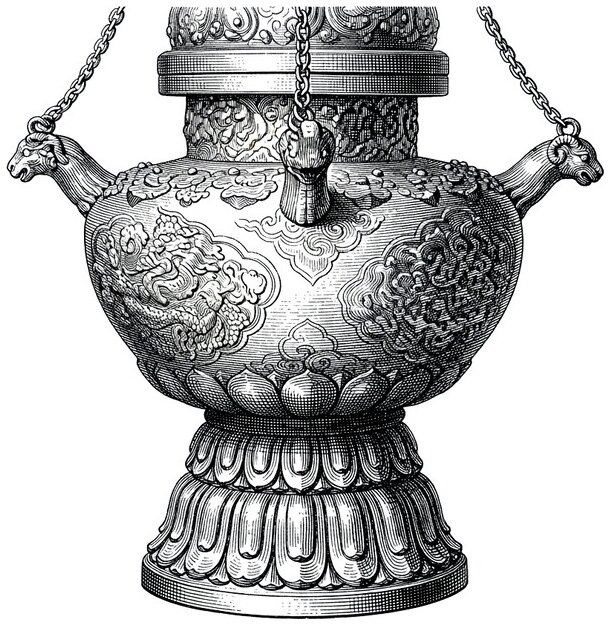
On the hills that ring Lhasa, before the morning sun clears the ridge, the smoke is already going up. Juniper boughs lie on glowing coals and the white thread of it rises off Chakpori, Bumpari, and Gephelri behind Drepung. Someone sprinkles tsampa and butter into the flames. The smoke is an offering, and the Tibetan word for it is sang.
Tibetans call juniper shukpa, the lha tree. Its smoke is the offering the local gods find most pleasing, which is why a sang fire always begins with a juniper bough.
The day itself
Zamling Chisang is the 15th day of the fifth month of the Tibetan calendar. English translates the name several ways: the Universal Smoke Offering Day, the Universal Prayer Day, the World Incense Day. It is one of the most auspicious days of the Tibetan Buddhist year for the sang practice, kept by monasteries and lay people across Tibet, Nepal, Bhutan, Mongolia and the diaspora.
Because the Tibetan year is lunisolar, the civil date moves. In 2026 the 15th of the fifth month fell on June 29; in other years it lands in early or mid-July. Different reckonings of the Tibetan calendar give dates a few days apart, and some centers in the West observe on the full moon nearest the Tibetan date; only the civil date drifts.
The sang practice is one thread in a larger Tibetan ritual calendar. The same master behind this day, Padmasambhava, is honored separately on Guru Rinpoche Day. The protectors he bound appear again on Dharmapala Day.
The fire and the smoke
The word sang means to purify and cleanse, and the rite is a fire: fresh juniper boughs are laid on the coals, sometimes dampened so the smoke hangs white and heavy. Into the flames go cedar, cypress, rhododendron leaves, roasted barley flour, butter, honey, milk. The smoke is seen as an endless cloud of nectar, and it is offered to four classes of guests: the Buddhas and Bodhisattvas, the dharma protectors, the local gods and earth spirits, and every being to whom a person owes a karmic debt.
On the day itself people climb the hills around their towns. In Lhasa the great burnings happen at the Jokhang square and on the hillsides above the city. Families wear their best clothes, chant, fly new prayer flags and picnic on the grass. The new flags join the smoke in waking the lungta, the wind-horse of personal luck that carries a person through the year.
At mountain passes the custom is older and simpler. A traveler crossing a pass, or fording a river, stops to burn a little sang and ask the local gods for a safe road. In the villages a wisp of sang smoke rises every morning before the sun. The festival is the loud, collective version of that daily practice. Practitioners distinguish two forms: dribsang for purifying a person, nolsang for purifying a place.
The legend of Samye
A story stands behind the day: in the eighth century King Trisong Detsen set out to build the first Buddhist monastery in Tibet at Samye. Each night the local spirits, who had no use for the new religion, tore down what the masons had built that day. Walls collapsed and rocks rolled down the slopes; epidemics broke out among the builders. The king sent for the Indian master Padmasambhava.
According to the tradition, Padmasambhava answered the spirits with incense woods, the five kinds of sweet dew, food and bright offerings, burned through the night with mantras. The smoke pleased the gods and demons. They were bound by oath and became dharmapalas, protectors of the dharma, and the walls went up. Samye was built as a three-dimensional mandala of Mount Meru, the mountain at the center of the cosmos, with its main temple in the middle. The first monks of Tibet were ordained there.
That binding of the old gods into protectors is a pattern that runs through Tibetan Buddhism. The same cosmology appears again in the Tibetan Book of the Dead: a world dense with beings, some kind, some hungry, all real enough to deal with.
Riwo Sangcho, the Mountain Smoke Offering, is the classic sang liturgy. It is a terma, a hidden text, concealed by Padmasambhava and revealed in the 17th century by the tertön Lhatsün Namkha Jikmé. Dudjom Rinpoche called it one of the most powerful practices for benefiting the living and the dead.
Where the fire came from
The sang offering is older than Buddhism. The scholar Chögyal Namkhai Norbu said it directly: it has a Bon root, not a Buddhist one. The pre-Buddhist Bon tradition burned fragrant herbs to honor spirits, and drove off evil with smoke and water after a hunt or an expedition. Some accounts trace the practice back about 3,500 years to the ancient Zhangzhung kingdom. Padmasambhava is remembered for folding that indigenous custom into the dharma instead of banning it.
The same shape appears across the Himalaya and Central Asia. In Mongolia, cairn shrines called ovoo stand on passes and hilltops, pre-Buddhist in origin, later absorbed into Mongolian Buddhism. The scholar José Ignacio Cabezón, studying the ritual veneration of Mongolia’s mountains, argues that when Buddhism pushed out the shamans, the local gods still had to be asked for crops and health, so the lamas reworked the old shrines rather than erasing them.
The tradition also makes an environmental claim. The smoke is said to purify the pollution of the mind and the contamination of the land and air. Sang is offered to heal a place as much as a person.
The day now
The day is kept in Tibet and in the diaspora. Buddhist centers in the United States, Europe and Asia hold fire pujas and grand sang offerings on this date. On a hillside above Lhasa, or on a pass in Nepal, the rite has not changed much: juniper still lies on the coals, tsampa falls into the flame, and the cry of Lha-Gyal-Lo, victory to the deities, goes up with the smoke.