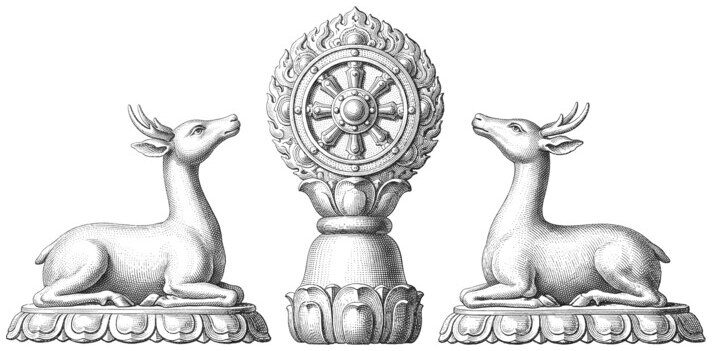
Look at the roof of almost any Tibetan monastery and you find the same two figures in gilt bronze: a pair of deer, kneeling and facing inward toward a spoked wheel on a lotus. The deer are not decoration. They mark a specific afternoon in a specific grove near Varanasi, when a wandering teacher sat down among animals and five doubtful men and said the first thing that would later be written down. Chokor Duchen is the day the Tibetan year returns to that grove.
What the day is
Chökhor Düchen, “the festival of the turning of the wheel of Dharma,” is one of the four great düchen of the Tibetan Buddhist calendar, the days on which the tradition marks the founding moments of the Buddha’s life. It falls on the fourth day of the sixth month of the Tibetan lunar calendar, which drifts across the Western calendar from year to year. In 2026 it lands on July 18.
It commemorates the Buddha’s first teaching, given, by tradition, seven weeks after his enlightenment at Bodh Gaya. The other three great days round out the story: Chotrul Duchen recalls the fifteen days of miracles at Shravasti, Saga Dawa Duchen gathers his birth, awakening, and death into a single full moon, and Lhabab Duchen marks his return from the heaven where he had gone to teach his mother. Chokor Duchen holds the beginning of his teaching career, the moment the private realization became a public path.
What sets these four days apart, in the Tibetan reckoning, is weight. The effect of any deed done on a düchen, helpful or harmful, is believed to be multiplied enormously. Kagyu almanacs put the figure at ten million times; Lama Zopa Rinpoche, citing a Vinaya text, spoke of a hundred million. Either way the day is treated as a lever, and the instruction that follows is simple: on this of all days, be careful what you do.
The customs
In Lhasa the day is spent outdoors and uphill. Pilgrims climb Mt. Gyambu Utse, the peak behind Drepung Monastery, and walk the ridge from Pabonka to the Dode valley, burning juniper as incense and tying up strings of prayer flags so the wind carries the printed mantras. Clergy and lay people join processions that carry statues of the Buddha and copies of the scriptures through the streets, and mani wheels are turned by hand, each rotation counted as one more recitation of the words inside.
Because the karmic effect of every act is thought to be multiplied on this day, one of the most popular practices is tsethar, “life release”: buying animals bound for slaughter, fish, birds, or livestock, and setting them free. The reasoning is arithmetic as much as compassion. If a good deed counts a million times over, saving a life is the deed to choose.
Inside the monasteries and the temple halls the day is quieter. Monks and lay practitioners recite scripture, among them portions of the Kangyur, the collected words of the Buddha in Tibetan translation. Many keep the day vegetarian, and butter lamps are lit in rows, each flame offered with a wish attached. Households that eat meat the rest of the year often leave it off the plate until the day is out.
The sermon underneath
The event all of this returns to is recorded in the Dhammacakkappavattana Sutta, “Setting the Wheel of Dhamma in Motion.” The audience was five ascetics, Koṇḍañña, Bhaddiya, Vappa, Mahānāma, and Assaji, who had been the Buddha’s companions in years of extreme austerity and had walked away in disgust when he began to eat again. He found them at the Deer Park and told them he had discovered a middle way between the two dead ends he now knew from the inside: the pursuit of pleasure, and the punishment of the body. Between those lay a path that led somewhere.
Then he laid out the Four Noble Truths, the frame under all later Buddhist thought: that life carries suffering, that suffering has a cause in craving, that the cause can be let go, and that a practical path leads out. As he spoke, the text says, “the dustless, stainless Dhamma eye” opened in Koṇḍañña, and the Buddha exclaimed, “So you really know, Koṇḍañña?” The name stuck. He is remembered as Aññā Koṇḍañña, Koṇḍañña Who Understood, the first person to grasp the teaching and, when the five were ordained, the first member of the Sangha. That ordination gave the young tradition its community, and it dates its full existence to that afternoon. The sutta adds that the earth deities took up the news and passed it upward through the heavens, and that the ten-thousandfold cosmos “shivered and quivered and quaked” as a measureless light appeared.
The first of three
Tibetan and other Mahayana schools read that sermon as the first of three turnings of the wheel. The second came later at Vulture’s Peak, where the Buddha taught emptiness in the Perfection of Wisdom discourses; the third, given at Vaishali and elsewhere, dealt with Buddha-nature and the nature of mind. Schools disagree about which turning is the final word, but all agree on where the wheel started moving. Chokor Duchen holds that first push.
The same first sermon anchors a festival in the southern Buddhist world too. Theravada communities in Thailand, Sri Lanka, and beyond keep it as Asalha Puja, or Dhamma Day, on the full moon of their eighth lunar month, usually in July. It is one event at the Deer Park, kept on two calendars under two names. The Tibetan reading then carries it further into tantric ground, where the single turning is understood to have outer, inner, and secret dimensions, a layering that runs through the later Vajrayana literature gathered in works like the Tibetan Book of the Dead.
The day now
Chokor Duchen is still kept wherever Tibetan Buddhism lives: in the monasteries of the plateau, among exile communities in India and Nepal, and at dharma centers across Europe and the Americas that publish the date each year and open their doors for a day of practice. The forms travel well enough, a butter lamp lit in a rented hall or an animal bought back from a market and let go. The oldest of them is the plainest, and it is fixed to the roofline of every monastery that keeps the day: two deer, kneeling toward the wheel that points them back to the grove.