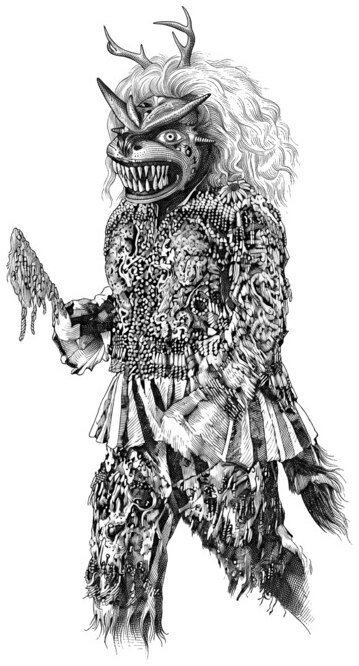
For most of the year Paucartambo is a quiet town of white walls and blue balconies, a few hours by road east of Cusco. Around the 16th of July the walls fill with devils. Dancers in horned masks and lizard-skin costumes, the saqras, climb onto the tile roofs and the balconies over the main street, and when the statue of the Virgen del Carmen is carried out on her platform, they writhe and posture above her as she passes underneath. The crowd watches the roofline as much as the procession. This is the town’s patronal feast. Peru lists it as national heritage now, but for Paucartambo it is the promise it keeps every year to its Virgin.
What the day is
July 16 is the feast of Our Lady of Mount Carmel, a Marian devotion carried by the Carmelite order and placed on the universal Catholic calendar by Pope Benedict XIII in 1726. In Paucartambo, in the Cusco region of the southern Peruvian Andes, that feast is the largest thing that happens all year. The celebration runs roughly from the 15th to the 18th, with the 16th as the central day of the main procession. Locals do not usually say “the Virgin of Carmel.” They say Mamacha Carmen, mother Carmen, in the affectionate Quechua-Spanish register of the region.
The Peruvian Ministry of Culture declared the festivity Patrimonio Cultural de la Nación in 2006. Pope John Paul II crowned the image during his 1985 visit to Peru. Those are the official markers. The living event is a four-day negotiation between a Catholic saint’s day and an Andean town’s own memory of itself, danced out in the street by people who are Catholic and Andean and see no contradiction in that.
The comparsas
The dancing is done by comparsas, organized troupes that train all year and pass membership down through families. More than a dozen take part, each one a costumed character out of the region’s history. The Qhapaq Qolla wear knitted masks and stand for the highland traders of the Altiplano who once came to Paucartambo to sell. Facing them, the Qhapaq Chunchu carry tall feather headdresses and represent the peoples of the Amazon lowlands to the east; in the story the festival tells, they guard the Virgin.
Other troupes carry harder history. The Qhapaq Negro dance in black masks and sing their devotion in Quechua and Spanish; the group remembers the enslaved Africans brought into the colonial mines of the Kosñipata valley. The Doctorcitos mock colonial judges and lawyers, the Auqa Chileno satirize the Chilean army of the War of the Pacific, and the Maqta play the clowning peasant who works the crowd. And there are the saqras, the devils, whose acrobatic rooftop dance is the image most visitors carry away.
The saqras do not simply play villains. In the festival’s own logic they are a tempting, restless “infernal court” that tests the faithful and is held in check by the Virgin’s presence. Their distinctive Paucartambo form, climbing the rooftops in scaled costumes, is often traced to the late nineteenth century and to old devil figures in colonial sacred painting.
The war at the bridge and the blessing
The sharpest moment comes at the old Carlos III bridge at the edge of town. There the festival stages its guerrilla, a ritual battle. Some accounts describe it as a fight among angels, demons, and the townspeople; others as the clash of the highland Qolla and the jungle Chunchu over the Virgin herself. Either way it is mock combat with real stakes of pride, and it ends with the Virgin’s platform brought to the bridge, where she gives her blessing toward the four directions. Local sources call them the four suyos, the same four-quarter division that named the Inca world, Tawantinsuyu. The saqras throw themselves against the railings one last time. The crowd goes silent for the blessing.
The day after the main procession, the comparsas walk to the cemetery to dance for the members who have died, the ones who used to wear the mask now being carried by someone younger. Through all four days the sponsors of the feast, the priostes, feed the dancers and the visitors in their homes, and the office passes from the outgoing prioste to the incoming one. Many people also make the pre-dawn trip out to Tres Cruces, a viewpoint about 45 kilometers away known for a strange, doubled sunrise.
Where the Virgin came from
Paucartambo tells more than one story about how Mamacha Carmen arrived, and all of them are folk legend rather than record. In one, Qolla merchants from the Altiplano found the severed head of a Virgin’s image among their trade goods and gave it to a local woman, who had a body made for it. In another, two images were shipped from Spain, one meant for Paucartambo and one for Paucarcolla, and the larger came to Paucartambo by mistake; the quarrel over the mix-up is said to survive in the Qhapaq Qolla dance. A third traces the devotion to the enslaved miners of Kosñipata, whose hidden faith the hacienda owners later took up, which is the memory the Qhapaq Negro carry.
The wider Catholic feast has its own contested origin. Carmelite tradition holds that on July 16, 1251, the Virgin appeared to the English friar Simon Stock and handed him the brown scapular with a promise of protection. Historians note that the earliest lives of Simon say nothing about a vision, that the first mention of it comes more than a century later, and that a letter offered as thirteenth-century proof, published in 1642, is now judged a forgery. The scapular devotion is real and old; the founding scene is a story the devotion told about itself.
Across traditions
The same July 16 devotion travels a long way. Our Lady of Mount Carmel is a patron across the Catholic world, and in the Americas her feast repeatedly landed on top of older material. In Haitian Vodou she is identified with the lwa Ezili Freda; in the Andes she stands over a landscape already full of sacred mountains and an earth mother, Pachamama, whom the same communities still feed with offerings.
The devils on the roofs are the clearest seam. The saqra is the colonial-era diablo of Catholic teaching, but the figure the Andes reached for to fill that costume was Supay, the Quechua lord of the underworld and the mines, a being older and less simply evil than the Christian devil. The same masked devil-dance runs through the wider region: it is the heart of the Diablada of the Carnival of Oruro across the Bolivian border, and Marian festivals like the Virgen de la Candelaria in Puno keep the same pattern of a Catholic image honored with Andean dance.
The day today
Paucartambo has not turned into a museum piece. The comparsas are full, the roofs are dangerous and the young men climb them anyway, and the town books out for the week while the families who host the priostes go into debt to feed everyone. The blessing at the bridge still stops the noise. On the 16th of July the devils dance above the street and the mother of Carmel passes beneath them, and the town keeps its eyes on the roofline and the platform together.
