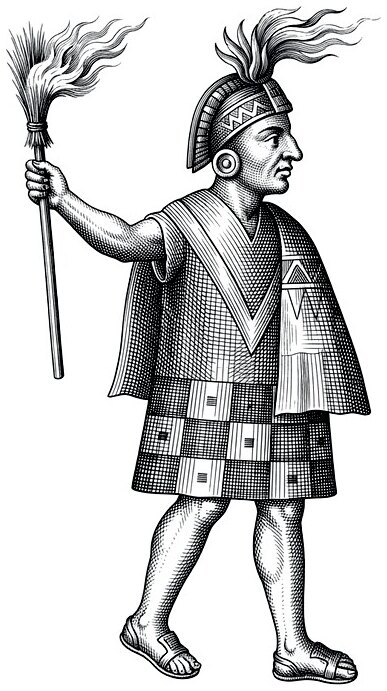
Once a year the city of Cusco emptied. Everyone born outside it left, and so did the lame, the hunchbacked and anyone whose body showed a defect. Armed men ran out in four directions to push the sickness into the rivers. At night the whole city shook burning bundles of straw at the moon, in the feast called the Situa.
The month of the queen
Coya Raymi was the Inca name for September, the queen’s month, and the Situa came inside it, as a purification timed to the rains and to the sickness they carried into the city.
The month’s feast belonged to the women. The royal women and the senior women of the realm invited the men. The nobleman Guaman Poma drew the twelve months of the Inca year in 1615, and September’s page carries the words Coia Raimi Quilla.
In his telling the moon is queen of the planets and stars, and the sun’s lady. One modern historian of the Inca calendar, Mariusz Ziólkowski, gives the queen the month, and the moon no leading role in it. The chronicles leave room for both readings. Mama Quilla keeps the lunar half of the story in the compendium.
The chroniclers disagreed about the month: the priest Cristóbal de Molina, who wrote the longest account of the feast, put it in August, and others put it in September. Our calendar keeps the day on 21 September, and this year the equinox falls on the evening of the 22nd.
The whole city smeared itself with maize porridge called zancu: the doorways, the storehouses, the wrapped mummies of the dead, and their own faces.
Out with the sickness
The purification began with a meeting inside the Coricancha, the gold-covered temple at the centre of Cusco. The ruler came, along with the leading Incas of the city and the high priest. The priests of the Creator and of Thunder brought their sacred objects over from their own temples. This council fixed the length of the feast for that year.
On the first day the outsiders had to leave, and so did people with broken earlobes, the lame, the hunchbacked and anyone with a visible defect. They waited two leagues out and came back when the city was clean. The Inca read illness as a thing that could be driven out and passed on. A person who showed it carried more of it than the rest.
The driving out happened at a run. Men in warrior dress came out of the Coricancha plaza toward Huanacauri, where they shouted and shook their weapons at disease and disaster. Four squadrons picked up the cry and ran for the four quarters of the empire. Relays carried it on to four rivers seven to ten leagues away, so that running water could take the sickness to the sea.
Inside the walls, people cleaned their houses and shook out their blankets. They smeared the doorways and the storehouses with a maize porridge called zancu, and put the same paste on their idols, on the wrapped mummies of their dead, and on their own faces. At the temple the Sapa Inca, the Coya and the statue of the Creator were anointed with the same paste. The statue got pilco feathers on its head in a rite of its own. In the compendium its name is Viracocha.
Fire at night
Torches came out at nightfall, and people shook burning bundles of straw through the streets while they shouted the sickness away.
Garcilaso de la Vega, who grew up to write the best-known chronicle of the Inca, was a boy in Cusco then, and he watched the spent bundles drift down the river the next morning. In his version the torches dealt with the evils of the night, and the lances had already taken those of the day.
Polo de Ondegardo gives the bundles their name, panconcos, and says they were shaken before the moon rose on the first night. Ramos Gavilán says the ceremony opened with the rising of the full moon. The hymns went to the gods, and to the moon in particular, whom they called mother.
Guaman Poma drew September as three armed men in patterned tunics, each holding up a burning bundle of straw. A moon with a human face watches from the corner of the page. The drawing is from 1615, and the manuscript is online at the Royal Library in Copenhagen.
Four days followed, full of sacrifices, prayers, banquets and drinking. The food of those days was a second kind of zancu. Chosen women baked it and sprinkled it with the blood of four white llamas. People ate that bread with three fingers, and nobody let a crumb fall. A bite went to every outsider in the city. They too had a share in the sacrifices, and stood in confederation with the Inca. Having eaten that dish, a man could no longer hide his sin.
The second day belonged to the Moon and the Earth, with the sacrifices and prayers each was owed. The chroniclers wrote more about the sowing than about the moon. For the historian Tom Zuidema the month is a feast of planting and of the fertility of the earth, and the timing supports him. The Situa fell just after the maize went in. That is when the rains arrive, and with them the sickness that could take the crop. The priests fasted through that stretch on boiled maize and herbs, and drank cloudy chicha. They gave up coca and stayed away from their wives until the green showed.
The same fire, named twice
Juan de Betanzos, writing in the 1550s, called September situaiquis, the month Pachacuti gave two feasts: the fire one, the Situa, and the Poray Upia. In the Poray Upia the ashes of the sacrifices went into the river at Pumap Chupan, where the two streams that bound sacred Cusco meet. Flowers and ground coca leaf went in with them. Two men walked the banks with long poles, one on each side, and pushed the offerings along for thirty leagues so that nothing snagged.
Betanzos reached for a European comparison for the fire and picked the bonfires of Saint John’s night in Spain. A reader in 1551 knew what it looked like when a whole town lit straw and shook it at the dark. Ziólkowski calls the Poray Upia in this month a chronicler’s mistake.
September answered December, when the Sapa Inca led the Capac Raymi and the lords of the provinces came to Cusco to renew their oath of loyalty.
In September the Coya led, and the same lords came again. They danced the dances of their own nations and brought their regional sacred objects with them. Those stayed in Cusco for a year, swapped for the ones kept there since the feast before. The state sent back gold, silver, cloth and servants, and let the principal lords be carried in litters. The huacas went home with fields and servants of their own.
The day today
The feast Cusco put back on stage is Inti Raymi, banned in 1572 and restored in 1944. Its script came from the Quechua scholar Faustino Espinoza Navarro, who built it out of Garcilaso’s chronicle. Humberto Vidal Unda and a circle of Cusco intellectuals pushed it through. The staging moved from the Plaza Mayor to Sacsayhuamán and now runs with more than seven hundred performers every 24 June, and the Situa never got the same treatment.
These weeks survive in the sowing, and in what people say about the ground while it happens. The Japanese ethnographer Hiroyasu Tomoeda worked among herders on the high puna, where August and September are the crossing from drought to rain. For his informants that stretch was a crisis: the Pachamama is ill, they told him, and she needs libations and offerings before she recovers. Pachamama is the earth herself in Andean practice. On the first of August, her hungry month, families still burn or bury little bundles of coca leaf, llama fat and sweets for her. The herders pour a mouthful of chicha on the ground and wait for the rain.
