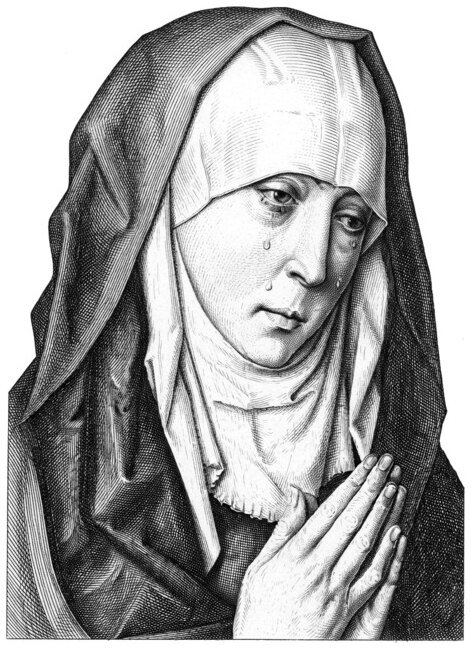
She arrives, and the room smells of perfume. The horse she mounts, the man or woman whose body she borrows for the length of a song, is washed, dressed in pink and white, and given her three rings to wear. She laughs and flirts and finds the offerings not quite enough. Then, near the end, Ezili Freda weeps. Every service she attends closes the same way: the most beloved of the Haitian spirits leaves in tears.
What the day is
July 16 is the Feast of Our Lady of Mount Carmel, and in Haiti it is one of the largest days of the sacred year. Catholics keep it as a Marian feast. Practitioners of Vodou keep it as a day for the Ezili, the family of female spirits, or lwa, of love and water. In much of Haiti the two observances are held by the same person, who sees no contradiction in lighting a candle to the Virgin and pouring perfume for the lwa on the same morning.
The best-known member of that family is Ezili Freda Dahomey. She is the lwa of love and luxury, and she belongs to the Rada rite, the older, cooler spirits whose roots reach back to Dahomey in West Africa. In the chromolithographs that hang on Vodou altars she wears the face of the Mater Dolorosa, the crowned Virgin of Sorrows pierced by swords. The tears in that picture are not incidental. They are half the reason the image was chosen.
Ezili Freda wears three wedding rings. Tradition gives her three husband-lwa, most often named as Danbala the serpent, Agwe the lord of the sea, and Ogou the warrior, and she is said to be married to all three at once.
How she is served
Freda is served with sweetness and shine. Her devotees set out perfume, sweet cakes and liqueurs, pink champagne, roses, and, in many houses, basil and Florida water; a mirror and a comb for her toilette; jewelry she can try on. Her colors are pink, white, blue and gold, and her sign is a heart. Thursday is the day most houses keep for her, though the great public day is this one, the feast of the Virgin.
The largest gathering is at Saut-d’Eau, a hundred-foot waterfall near Ville-Bonheur on Haiti’s Central Plateau, the tallest in the country. Local memory holds that the falls became sacred after an 1842 earthquake opened the cascade, and that a few years later the Virgin appeared on a palm tree nearby; a Wikipedia account names the year as 1849 and a man called Fortune Morose as the one who first saw her. From July 14 to 16, tens of thousands walk to the site. They hear Catholic Mass, and they strip and bathe in the falls, which are sacred to the serpent lwa Danbala and Ayida Wedo, and they ask their favors of the Virgin and the Ezili together, in the same water.
The weeping goddess
Everyone who writes about her returns to the crying. In the ethnographic record, from Alfred Métraux’s Voodoo in Haiti to the accounts collected by Karen McCarthy Brown, Freda is described as a spirit who can never get what she wants. She is given the finest of everything and it is never enough; the love offered to her never matches the love she imagines, so a possession by Freda ends in grief.
The filmmaker Maya Deren, who went to Haiti in the late 1940s and was herself mounted by Erzulie during her fieldwork, read those tears as the sorrow of an ideal. In Deren’s account in Divine Horsemen, Freda is the divinity of the dream of perfect love, and the dream cannot survive contact with an ordinary Thursday evening and a real body and a real altar. She weeps because she is the one spirit whose desire is, by its nature, impossible to satisfy. That is a reading, and Deren’s, but it has stuck to Freda ever since.
Her opposite inside the same family is Ezili Dantò, a Petwo lwa, hotter and harder, a dark-skinned mother with scars on her cheek who defends women and children and asks for a knife and unlit cigarettes rather than perfume. Where Freda is courted, Dantò works. She carries the face of the Black Madonna of Częstochowa, and it is Dantò, more than Freda, whom the pilgrims of Saut-d’Eau feel in the falling water.
The same fire under other names
Freda has cousins across the water. The Yoruba orisha of sweet rivers, love and gold, honored at her own Oshun River Festival, is often named as her kin, and the pan-African water spirit Mami Wata shares her mirror, her wealth and her ambivalence.
The July 16 date carries a further echo. On the same feast of Our Lady of Mount Carmel, half a world away in the Peruvian Andes, the town of Paucartambo dances for the Virgen del Carmen, and there too an imported European Virgin sits over much older gods. Haiti and Paucartambo never met. They received the same Carmelite feast from the same church and laid it, each in its own way, over the spirits already living in the water and the earth.
The day now
Saut-d’Eau fills every July. Pilgrims bathe under the falls, tie candles and ribbons to the trees, and carry home water from a place the Catholic Church and Vodou both hold sacred. In the temples Freda still arrives smelling of perfume and leaves before the night is over. The pink cake is cut whether or not she was satisfied. She never is, and she comes back the next year anyway.