Dictionaries of the occult are full of strange people. One entry in the Dictionnaire infernal, the great French dictionary of demons, spirits and superstitions that Jacques Collin de Plancy brought out in its sixth edition in 1863, is stranger than most. It reads, in full:
Lazare (Denys), prince of Serbia, who lived in the year of the Hegira [the Islamic calendar] 788. He is the author of a work entitled les Songes [The Dreams], published in 1686; 1 vol. in octavo [a small book format]. He claims to have had night visions in the kingdoms of Stephan, Melisch and Prague.
Three things in these four lines do not fit together. The Hegira is the Islamic calendar, which counts from the year 622, and its year 788 ran from early 1386 to early 1387, so a Christian prince of Serbia is being dated the way a Muslim chronicler would date him. His book of dreams came out three hundred years after his lifetime, and there have never been kingdoms called Stephan or Melisch. So who was Prince Denis Lazar?
What does the Dictionnaire infernal say about Prince Lazar?
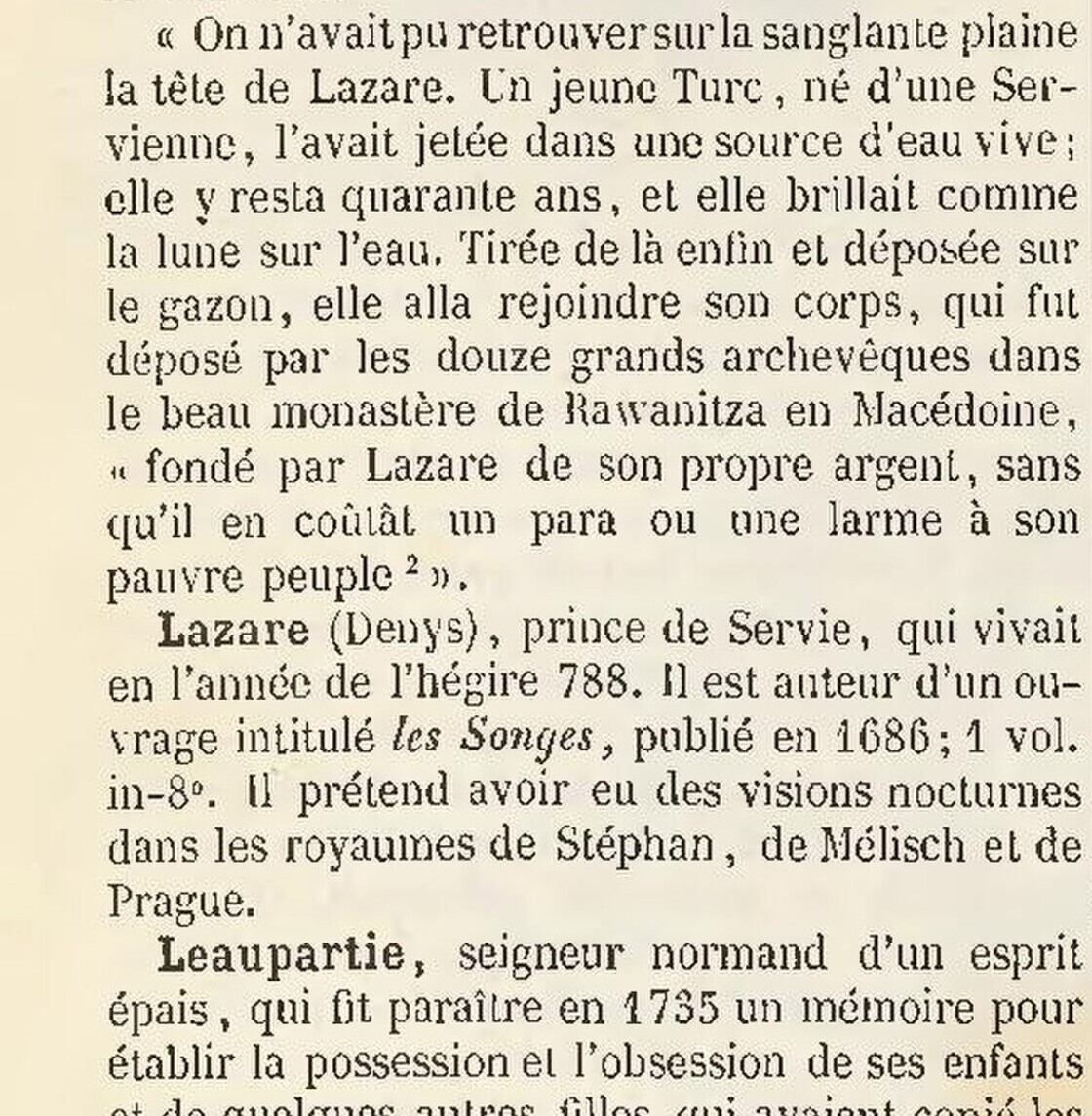
In the edition of 1863, Denis Lazar has a neighbour. Directly above him, on the same page 402, Plancy has an entry on a Serbian ruler who certainly lived: Lazar, whom he calls the tsar of the Serbs. The historical Prince Lazar Hrebeljanović ruled in central Serbia from 1371 and fell in June 1389 at the Battle of Kosovo, on the Field of Blackbirds, fighting the army of the Ottoman sultan Murad I. The Serbian Church venerates him as a martyr, and his death is remembered on Vidovdan, the feast of St Vitus.
Plancy’s entry on this Lazar retells the Serbian epic songs about the battle. The prophet Elijah asks the prince to choose between the kingdom of heaven and the kingdom of the earth. After the battle nobody can find Lazar’s head, because a young Turk born of a Serbian mother has thrown it into a spring. It lies there for forty years and shines like the moon on the water, and when it is finally drawn out and laid on the grass, it goes by itself to rejoin the body, which twelve archbishops lay to rest in the monastery of Ravanica that Lazar had founded.
Read one after the other, the two entries look like two princes of one house. But nothing in the second entry comes from the Serbian songs, and no source before Plancy mentions a Serbian prince named Denis who wrote about dreams.
When did Denis Lazar first appear?
The Dictionnaire infernal grew over forty-five years, so the next step is to look for the prince in the older editions. The first edition of 1818 has no entry on him at all. He appears in the second edition, printed in Paris in 1825 and 1826, in the third of its four volumes. There his entry is a little longer than in 1863. After the visions in the kingdoms of Stephan, Melisch and Prague, Plancy adds a judgement: “We see from this that he is a fanatic, as were in his time Cotter, Poniatouski and Drabicius.” These three names belong to visionaries of the seventeenth century, who return further down.
And at the foot of the page stands a footnote, the most useful line in the whole entry: “Lenglet-Dufresnoy, t. 4. p. 254”, that is, Lenglet Dufresnoy, volume 4, page 254, the place where Plancy had found his prince.
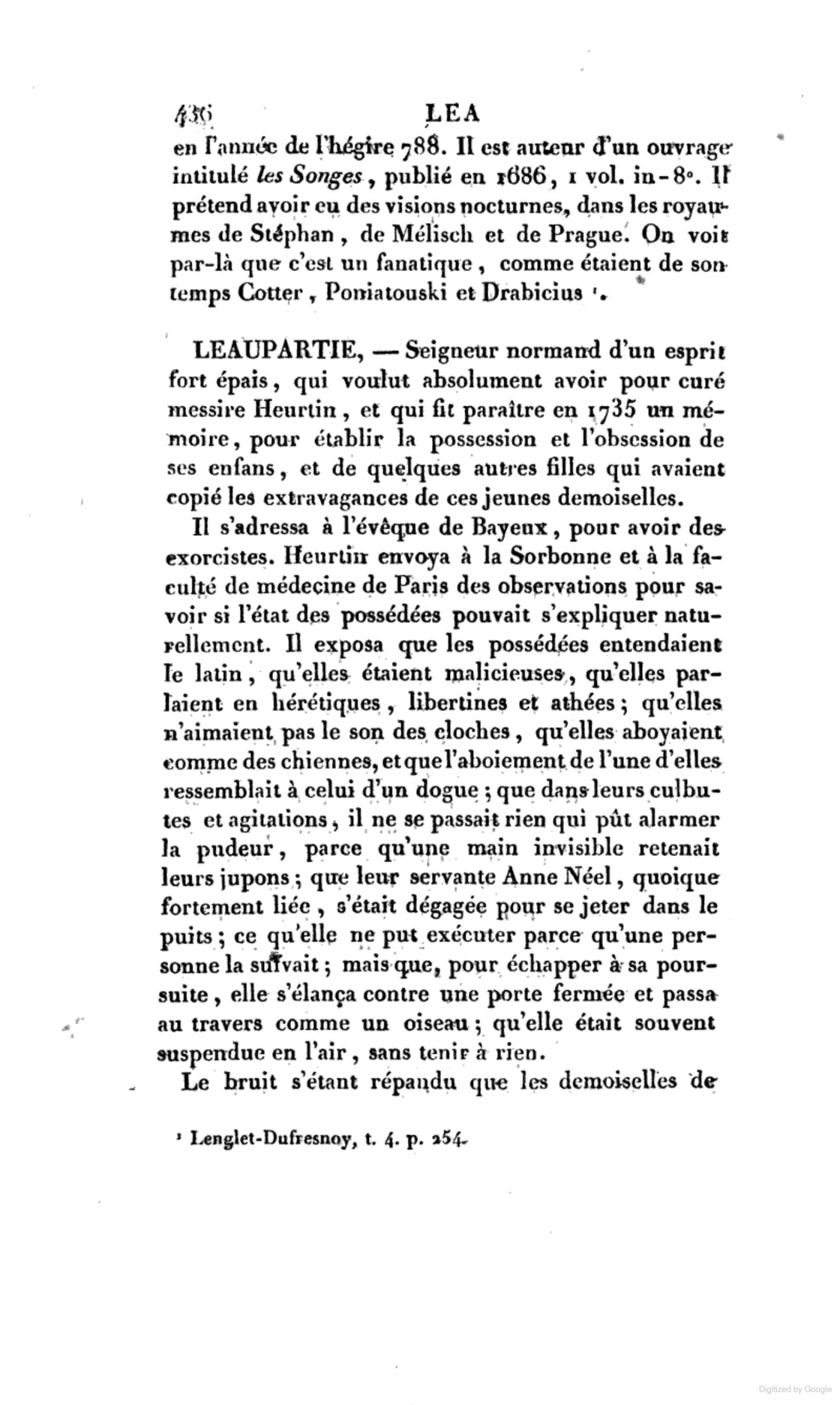
From the third edition of 1844 onward, the sentence about the fanatics and the footnote are gone, and with them the only clue that leads back to the source, so the entry keeps the short form it has in 1863.
Collin de Plancy wrote the first Dictionnaire infernal in 1818 as a freethinker who wanted to list the errors of superstition. Later in life he became a devout Catholic and reworked the book to agree with the teaching of the Church, so the edition of 1863 differs in tone from the one that made his name.
What is on page 254?
Nicolas Lenglet Du Fresnoy (1674–1755) was a French scholar who wrote on history, geography and alchemy and was locked up in the Bastille, the royal prison in Paris, more than once for what he published. In 1751 and 1752 he brought out a collection of old and new essays on apparitions, visions and dreams, the Recueil de dissertations anciennes et nouvelles sur les apparitions, les visions et les songes, in four parts. The fourth and last part contains a long list of authors who had written on spirits, visions and dreams, a bibliography of the subject arranged by theme, and Plancy’s “volume 4” means this fourth part.
Page 254 falls in the section on dreams. It begins with an English book on the interpretation of dreams from 1674, and then come two entries, one directly under the other:
Dionysius LAZARUS de Somniis, in-8°. 1686.
Visiones nocturnæ Stephani MELISCH Pragensis, quas super eam civitatem & Regnum Poloniæ, Regemque Sueciæ & Franciæ & aliis ann. 1655. 1656. 1657 & 1658. habuit …
The first line names a Dionysius Lazarus who wrote On Dreams, an octavo book of 1686. The second is a Latin book title: “The night visions of Stephan Melisch of Prague, which he had about that city and the kingdom of Poland, and about the kings of Sweden and France and others, in the years 1655, 1656, 1657 and 1658”, a pocket-sized book printed without a place, “but in Holland”, in 1659. Lenglet then adds a comment in French: “Here are 104 dreams that the author claims to have had, and as if he had been a prophet he applies them to various kingdoms. We see from this that he is a fanatic, as were in his time Cotter, Poniatowski and Drabicius. It is only a small booklet.”
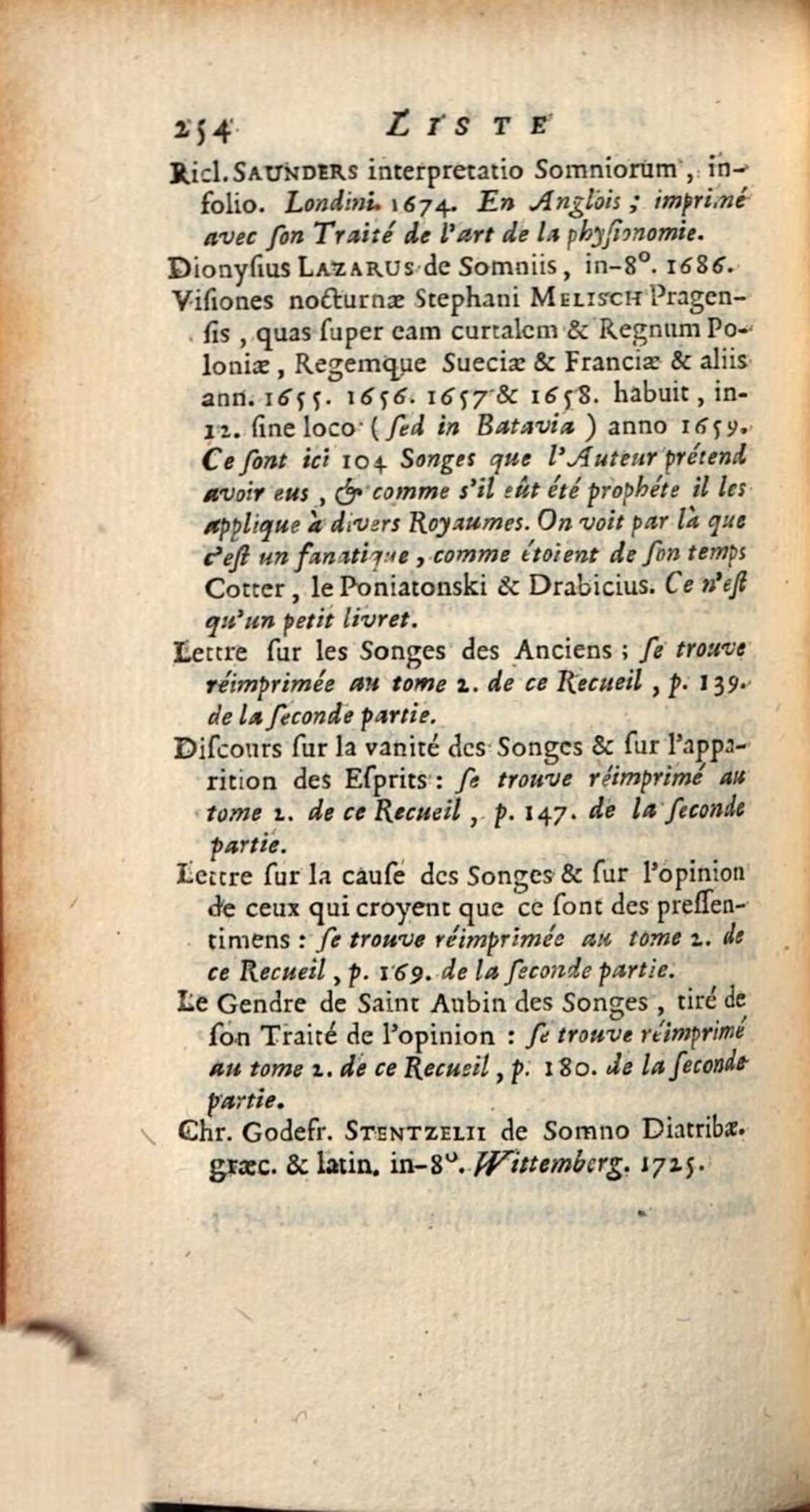
Set beside Plancy’s entry, almost every word can now be traced. “Lazare (Denys)” is Dionysius Lazarus in French. Les Songes is de Somniis, “on dreams”, and the octavo volume of 1686 is copied from the same line, although that date will turn out to be doubtful. The night visions are Melisch’s Visiones nocturnae. The kingdoms of Stephan, Melisch and Prague are the words Stephani Melisch Pragensis, which mean “of Stephan Melisch of Prague”, read as if they were three places where a prince had his visions. And the sentence of 1825 about the fanatic, with Cotter, Poniatowski and Drabicius, is Lenglet’s remark about Melisch, carried over word for word.
So the two lines on Lenglet’s page became one man in Plancy’s dictionary, although they name two different men who lived half a century apart, one in Venice and one in Poland.
Who was Dionysius Lazarus?
The book of the first line survives, but under a different date. In 1606 the press of the Rampazetto family in Venice printed a small Latin work called Tractatulus de somnijs, “a little treatise on dreams”, by Dionisio Lazari, who calls himself on the title page a citizen of Venice. He dedicated it to the Doge, the elected ruler of the Venetian republic, Leonardo Donà. A note printed in the margin of the first page says that he wrote it in his eighteenth year. One copy of this first edition, now in the city library of Augsburg in Germany, has been scanned and can be read online.
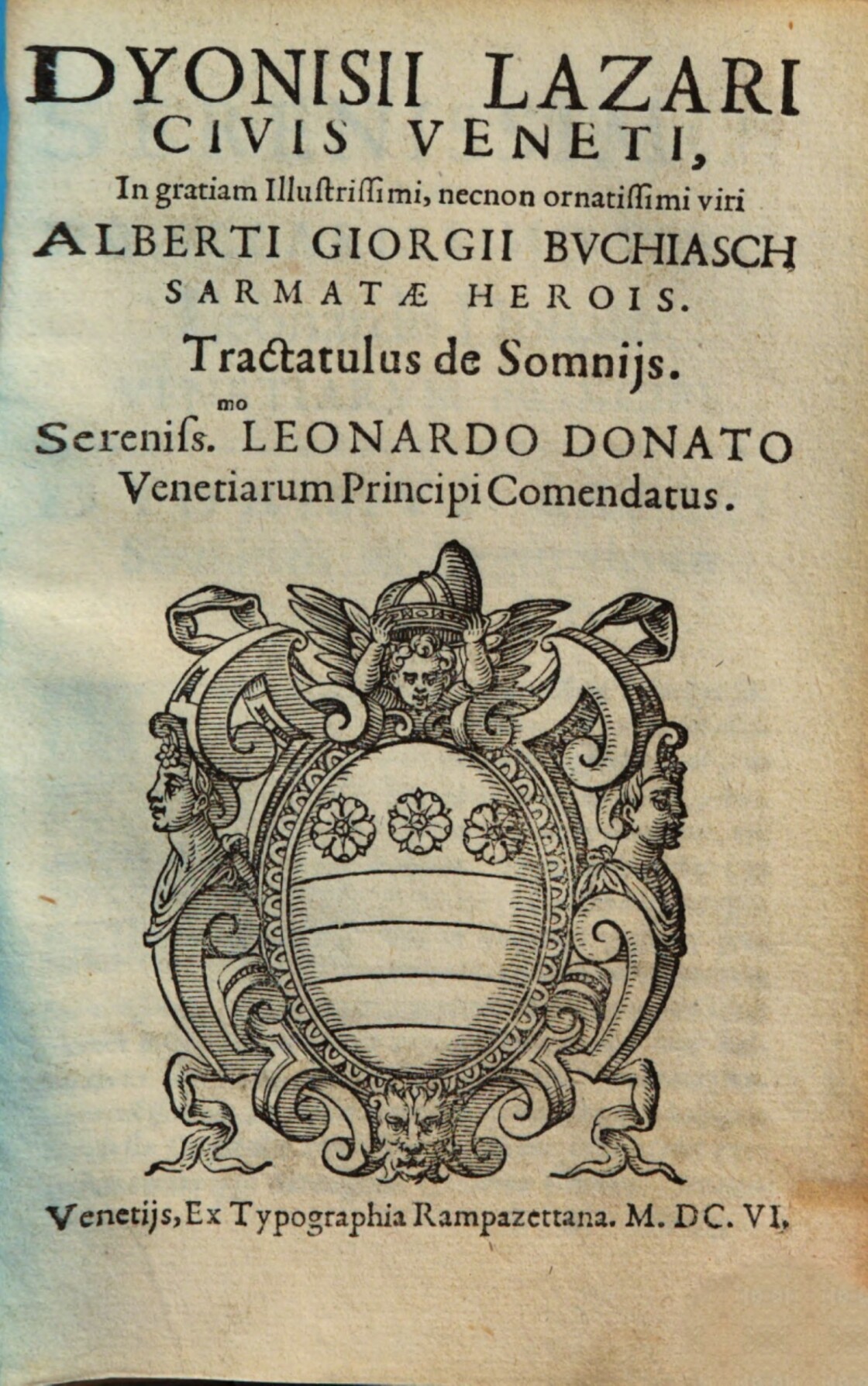
Lazari’s treatise follows the late Roman writer Macrobius, who divided dreams into four kinds: the ordinary dream, the phantom, the vision and the oracle. Some dreams deceive, Lazari writes, and some come true; some arise from nature, and others are sent by God through his messengers. Near the end he describes a stone that the Magi wore in a silver ring under the pillow so that it would show them the future in their sleep, and then he gives his own view: “but I think the teaching of the Magi false and empty of truth.”
A second edition came out in Rome in 1623. No edition of 1686 appears in any library catalogue that has been searched, so the date in Lenglet’s list may be a misprint for 1606, though that cannot be proved. Either way, the author of On Dreams was a young citizen of Venice, and nothing in his book links him to Serbia.
Who was Stephan Melisch?
The second line leads to a man who really did have night visions, and who believed they were about kingdoms. Stephan Melisch was a tailor, the son of a Prague burgher whose Protestant family left Bohemia after 1620, when the Catholic emperor defeated the Protestant rebels of Bohemia at the Battle of the White Mountain near Prague. Many of the exiles settled in Leszno, a town in western Poland where their church kept a school; its best-known teacher was the Czech theologian Jan Amos Comenius.
In 1655 the king of Sweden invaded Poland, and the Protestant burghers of Leszno let the Swedes in. At the end of April 1656 Polish troops loyal to their own king, John Casimir, took revenge and burned the town; Comenius lost his house and his manuscripts and fled to Amsterdam. Melisch’s visions run through these years. In one, dated Palm Sunday, the Sunday before Easter, 9 April 1656, a stranger leads him into a great palace where a king dressed in silver sits at a silver table with the king of Sweden and the German princes, and a cardinal smashes the Pope’s crown with his staff while the bystanders trample the pieces. Another, dated 19 May 1656, he records “when I was already amongst the scattered ones in Silesia”, the region across the border from Leszno.
The British historian Peter Burke, who has written on the history of dreams, quotes another of these dreams. Red foxes, each with one great tooth, come from the east and dance around a golden lion; a white eagle stands between two fighting men, and one of them cuts off the eagle’s head and gives it with the crown to the north, while its body goes to a red eagle and its wings to the east. Burke reads it as the dividing of Poland among its neighbours, Sweden, Prussia and Russia, during those years of war. He does not decide whether such visions are faithful records of real dreams or literary work; most likely, he suggests, they were dreams shaped by the Bible and by what their dreamers read, and then tidied up when they were written down for print, and he notes that this can be neither proved nor disproved.
According to the Comenius Museum in Uherský Brod, Comenius saw some of Melisch’s visions himself, translated them into Latin and added notes on which ones had come true, and this is the book of 1659 in Lenglet’s list. An English translation of twelve of them appeared in London in 1663, whose preface calls Melisch “a downright honest man … a stranger to Worldly Policy, & State affairs”. In 1665 Comenius printed a large collection of modern prophecies, Lux e tenebris, “Light out of darkness”, and in its list of sixteen visionaries Melisch comes last. The chief ones in that book were Christoph Kotter, a tanner in Silesia, Christina Poniatowska, a pastor’s daughter who fell into trances, and Mikuláš Drabík, a preacher who foretold the fall of the Habsburg emperors. These are the three names that Lenglet set beside Melisch and that Plancy later set beside his prince.
Melisch went on dreaming after the book of 1659. A London pamphlet of 1664, which calls him an inhabitant of Breslau (today Wrocław), the chief city of Silesia, prints his “115th Vision”, dated 15 June 1664: bloody rods like brooms come out of the stars in the east, and he cries out in the market place, but the whole town sleeps on and only the night watch hears him.
Why did Plancy make him a prince of Serbia?
Lenglet’s list says nothing about Serbia and gives no Islamic date. That part of the entry is Plancy’s own, and he never explained it. The most likely explanation, though it remains a guess, is that he took the name Lazarus for the one famous Lazar he knew, the Serbian prince of the Kosovo songs, and gave his visionary that prince’s title. French histories of the eighteenth century called Lazar the “prince of Serbia”, and the great French reference book on the Islamic world, Barthélemy d’Herbelot’s Bibliothèque orientale of 1697, dated his defeat at Kosovo by the Islamic calendar, to the year 791.
Plancy’s 788 is three years earlier and falls in Lazar’s reign, about 1386, but no source has yet been found that gives Lazar that number, so the date in the entry is still the one part of the puzzle without an answer.
What happened to the prince after Plancy?
Once Plancy had made him, the prince lived on in other books. In 1920 the Scottish writer Lewis Spence put him into his Encyclopaedia of Occultism: “A prince of Serbia who lived in the year of the Hegira, 788. He was author of a work entitled Dreams, published in 1686. He himself claimed to have had nocturnal visions.” Spence left out Stephan, Melisch and Prague, so his version no longer carries even the garbled trace of the real seer.
The American Encyclopedia of Occultism & Parapsychology, which took over many of Spence’s entries, keeps this one too, and its fifth edition of 2001 heads it “Lazare, Denys (ca. 622 C.E.)”, that is, about the year 622 of our era. The editors seem to have read “the year of the Hegira” as the year the Hegira began, so the prince moved back another seven centuries and became, as the entry itself points out, the author of a book published more than a thousand years after his time.
The Spanish translations of Plancy’s dictionary, printed from 1842 onward, kept the prince’s visions “in the kingdoms of Stefan, of Melisch and of Prague”, so in Spanish, too, the name of the tailor from Prague reads as the name of a kingdom.
What is left of the two dreamers?
Dionisio Lazari’s little treatise on dreams survives in a few libraries, and the Augsburg copy of 1606 can still be read page by page online, down to the stone under the pillow that he did not believe in. Stephan Melisch’s Latin book of 1659 is so rare that no scan of it has yet been found, and his own dates of birth and death are still uncertain. His English Twelve Visions of 1663 and the London pamphlet of 1664 survive, with the cardinal and the Pope’s crown, the red foxes and the white eagle, and the night in 1664 when he cried out in the market place and only the watchmen heard him.