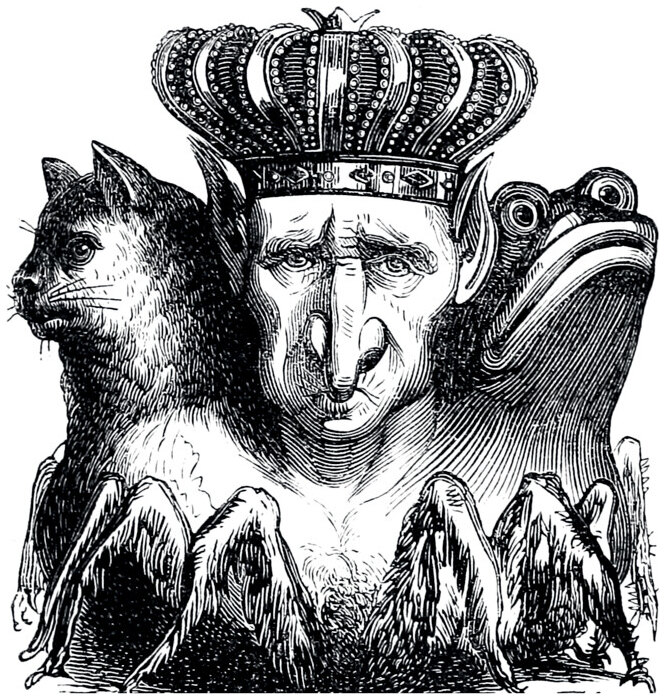
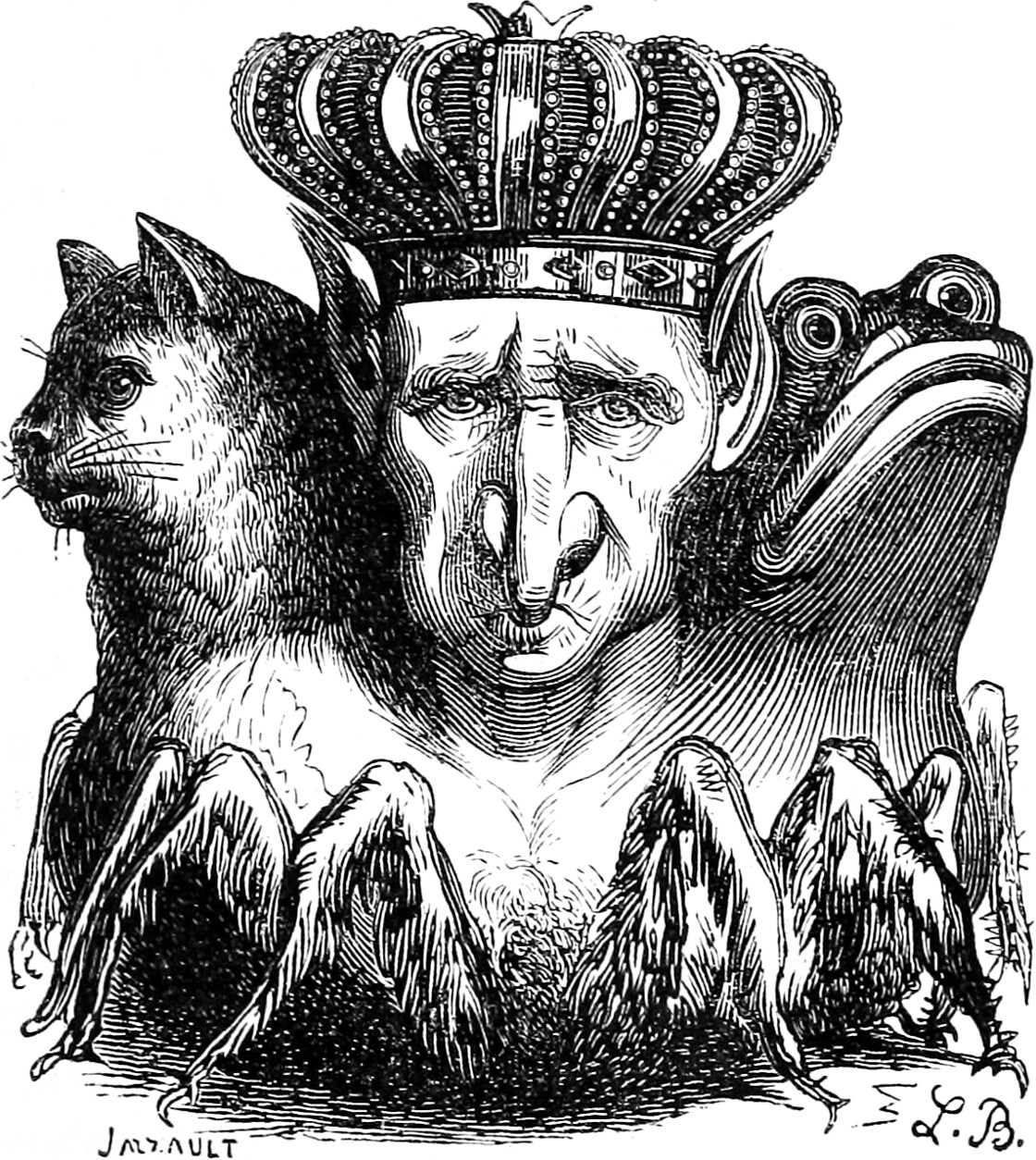
Open the English Wikipedia page on Bael, a demon whom a sixteenth-century list of demons names as the first king of hell, and the first thing you see is a picture: a man’s head under a heavy crown, with the head of a cat on one side and the head of a toad on the other, all three set on hairy spider legs. Click on to the other demons of those lists and the same happens: the page on Paimon shows a crowned king riding a camel, the page on Beelzebub a giant fly, and the pages on Asmodeus, Astaroth, Belphegor and Buer each open with a black-and-white engraving in the same finely cut style. Each of these pictures comes from one French book, printed in Paris in 1863. Who made them, and what kind of book were they made for?
What is the book behind the pictures?
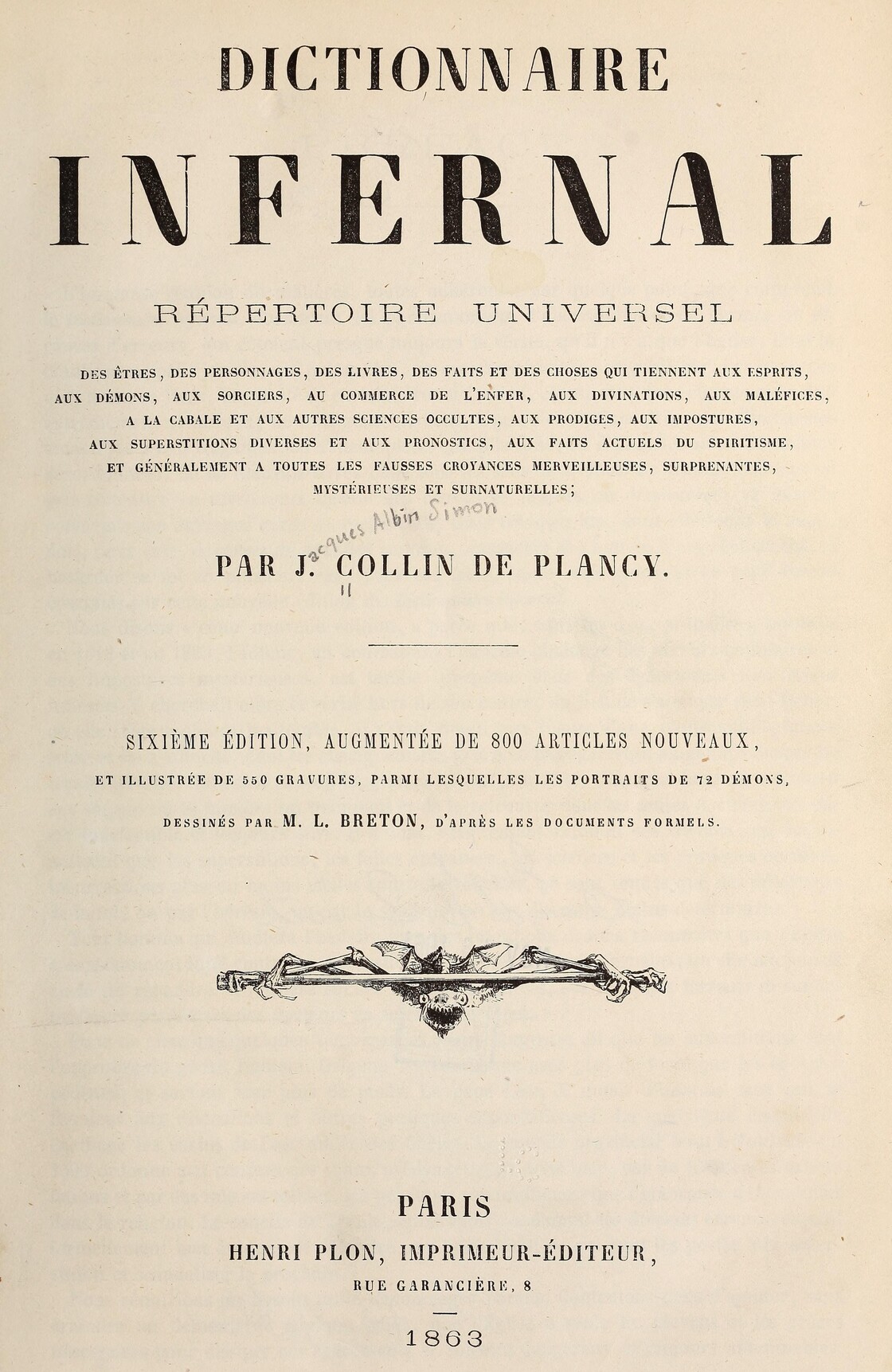
The book is the Dictionnaire infernal, the “infernal dictionary”, by Jacques Collin de Plancy. It sets out in alphabetical order what people believed about spirits and the devil: demons and sorcerers, ghosts and witches’ sabbaths, fortune telling, omens and the stories people told about them. The edition of 1863 was its sixth, and its title page sets out what it offers. It is a “universal repertory” of beings, people, books and facts connected with spirits, demons, sorcerers and the trade with hell, with divination and spells, with the occult sciences, with prodigies and impostures, with the “current facts” of spiritualism and its table-turning, “and in general with all the false beliefs, marvellous, surprising, mysterious and supernatural”.
Below that the title page names its selling point. This sixth edition, it says, is enlarged by 800 new articles “and illustrated with 550 engravings, among them the portraits of 72 demons, drawn by M. L. Breton after the formal documents”, by which it meant the written descriptions of each demon in older books. The publisher was Henri Plon, a printer in the rue Garancière in Paris.
A few pages earlier the same copy carries something unusual for a book about hell: a church approval. Pierre-Louis Parisis, bishop of Arras, Boulogne and Saint-Omer, writes on 26 December 1862 that he has read the report on the new edition of the Dictionnaire infernal, which the archbishop of Paris, Monseigneur Affre, had already approved in 1844, and that he has found in its additions “nothing that could harm faith or morals”.
A bishop’s approval meant that the Church had checked the book and found nothing in it against Catholic teaching. Why a dictionary of demons needed one, and why it could get one, the author explains in his preface, where he tells his own story.
Why does the preface apologise for the earlier editions?
The preface speaks of “the author” in the third person, as if someone else were telling his story. It calls the dictionary a pandemonium of errors, a gathering of every kind of false belief, and says that these errors nearly always lie close to some truth, so that only the Church can guide a reader safely through them. Then it explains why it calls this a new edition:
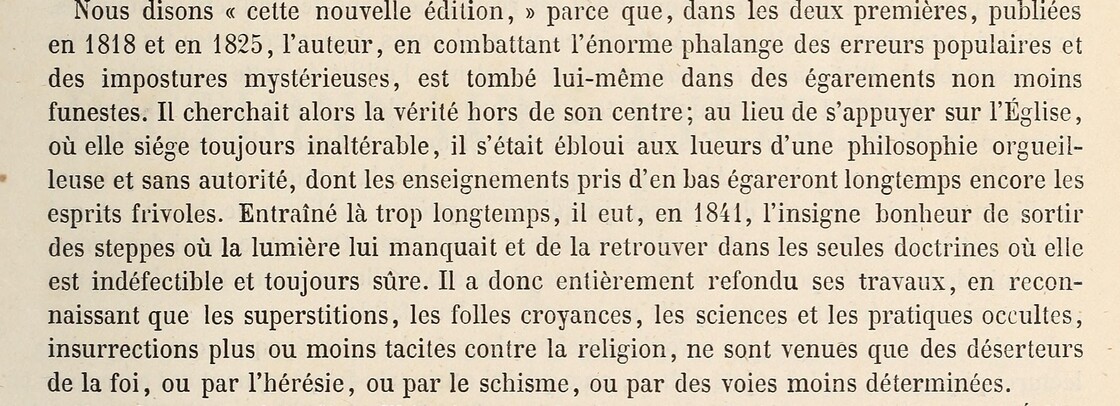
In the first two editions, published in 1818 and 1825, the author had fought “the huge phalanx of popular errors and mysterious impostures”, and in doing so “fell himself into errors no less fatal”. He looked for the truth away from its centre and “had been dazzled by the glimmer of a proud philosophy without authority”. Then comes a date: “Carried along there for too long, he had, in 1841, the great happiness of leaving the steppes where the light was missing to him”, the dark wilderness of his unbelief, and so “he has entirely recast his works”.
Who was Collin de Plancy?
Jacques Collin was born on 30 January 1794 in Plancy, a village in Champagne, and wrote under the name Collin de Plancy. The facts of his life come mostly from an obituary that the local historian Émile Socard printed in 1881 in the Revue de Champagne et de Brie. Socard also calls him a nephew of Georges Danton, the revolutionary leader, through his mother Marie-Anne Danton.
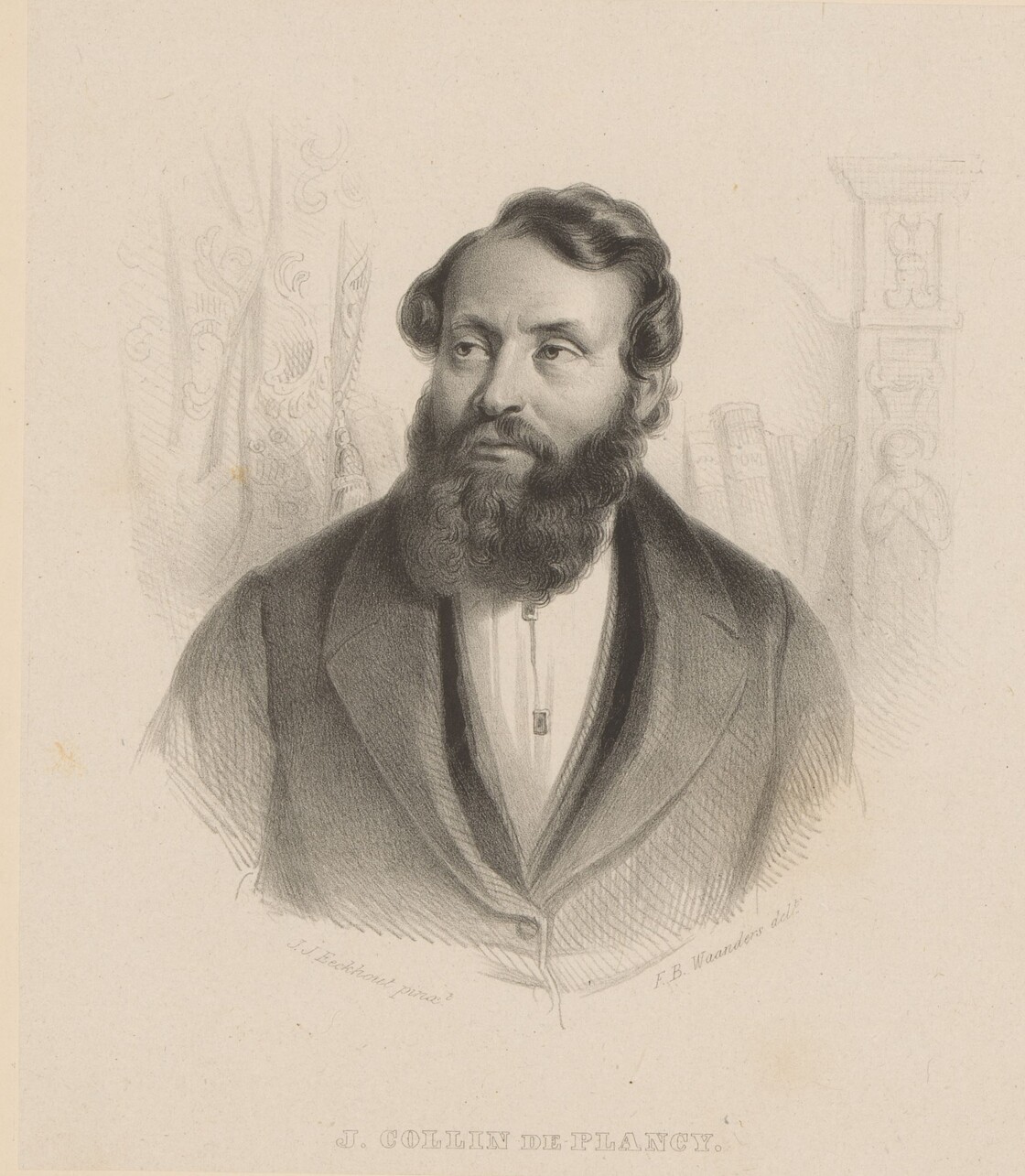
In a letter that Socard quotes, Plancy says that he lost the religious beliefs of his early youth in 1815, “in the reading of bad newspapers and bad books”. Three years later, in 1818, the first Dictionnaire infernal came out in Paris in two volumes. It was the book of a freethinker who collected superstitions to show what they were, and a second, larger edition followed in 1825 and 1826. Some of his books were placed on the Index, the Catholic Church’s list of forbidden books.
The preface of 1863 argues that unbelievers are the most superstitious people of all: they reject the dogmas of the Church, it says, and believe in ghosts, fear the number thirteen and Fridays, look for the meaning of their dreams and visit women who read the cards.
What happened in The Hague in 1841?
Plancy tells it himself in the letter Socard quotes. He was living in The Hague in 1841 and had been trying for eight years to find his way back to the faith of his childhood; he adds that since 1833 he had written nothing that was unfavourable to religion. On 30 May 1841 he was reading the Veni Creator Spiritus, a Latin hymn that calls on the Holy Spirit, and at its second line, mentes tuorum visita, “visit the minds of your own”, the faith he had been asking God for “came back to me all at once and whole”.
The same day he looked for a priest who had the power to hear his confession and forgive him, which was not every priest’s to give, because his books stood on the Index. He was sent to Father De Hasque, the head in Holland of the Jesuits, the Catholic order of priests founded by Ignatius of Loyola, and travelled to Kulenborg (Culemborg, a small town south of Utrecht), where he made a general confession of his whole life. After he had retracted his errors, he received his penance: to buy back, as far as his means allowed, every copy of the bad books he had written, to burn them as he came across them, “and then to rewrite them all in the Catholic sense”. He also promised to spend the rest of his life spreading good books.
Socard adds that every book Plancy published afterwards carried the approval of a bishop, and the first one he names is the Dictionnaire infernal.
What did rewriting a dictionary of hell look like?
One small entry shows it. In the first edition of 1818 the word Possédés, “the possessed”, is only a cross-reference to other articles. In the second edition, in volume four, printed in 1826, it tells a story from the village of Teilly, about twelve kilometres from Amiens in Picardy, in northern France, in 1816.
In the version of 1826 a young girl of Teilly was pregnant and, to cover it up, announced that three demons possessed her, named Mimi, Zozo and Crapoulet. Plancy adds that Crapoulet might have had something to do with the matter, since a young man of that name in the district had a reputation with the girls. She went through the streets on all fours; Mimi, she said, pushed her forward, Zozo pulled her back. Then “a son of Loyola”, that is, a Jesuit, “on the scent of good adventures and able to sniff out devils”, took charge of her and exorcised her: Mimi left without a sound, but Zozo was more stubborn and broke a church window as he escaped over the roofs. In the end an honest man of Teilly learned from her that she was pregnant and got her a place in the hospital. Plancy tells the whole case as a joke against the Jesuits and against anyone who believed the girl.
Zozo has his own headword in the Dictionnaire infernal from 1826 on: a demon who, with Mimi and Crapoulet, possessed a girl of Teilly in Picardy in 1816. The demon kept his entry through every later edition, even after Plancy had rewritten the story of the possession.
In 1863 the same village and the same three demons are still there, but the story has changed. A girl “wanted to pass herself off as possessed”; “an honest cleric warned the authorities, who recognised that this girl was ill”. She was taken into a hospital, and nothing more was heard of the possession. The pregnancy, the young man with a reputation and the Jesuit who sniffed out devils have all gone from the page, and in their place Plancy adds a lesson: in the past, too, one finds some frauds of this kind, and our forefathers, in good faith, were often able to put a stop to them, so that there were once “far fewer scandals than people tell”.
Whether anything happened at Teilly in 1816 we cannot say. We have found no record of the case outside the dictionary, so the girl, her three demons and her two endings exist for us only in Plancy’s two versions of her.
Where did the demon portraits come from?
The pictures belong to the new, Catholic book. The preface of 1863 says that the publisher illustrated it with 550 engravings, among them 72 portraits of demons, “drawn after the documents of Wierus and of the most curious demonographers”, the writers on demons, “by M. L. Breton”. Wierus is the Latin name of Johann Weyer, a sixteenth-century writer on demons whose Pseudomonarchia daemonum, the “false monarchy of demons”, is an inventory of the spirits of hell with their ranks and their looks. Plancy’s own entry on Bael says that Weyer begins his inventory with this demon, “the first king of hell”, who shows himself with three heads, one like a toad’s, one like a man’s and one like a cat’s, and teaches those who call him how to make themselves invisible.
Breton drew what such lists describe and filled in what they leave out: the text of Bael’s entry gives him three heads, a hoarse voice and sixty-six legions, and the picture adds the spider legs. The draughtsman whom the title page calls M. L. Breton is usually identified as Louis Le Breton (1818–1866), a French marine painter and engraver from Douarnenez in Brittany, although we have found no account of his life that mentions the commission. On the plates themselves the drawings are signed “L. B.” and the wood engravings “Jarrault”, the name of the craftsman who cut them into the block.
More than a century and a half later the engravings stand at the top of the pages where most people now meet these demons: they are the lead images of the English Wikipedia articles on Bael, Paimon, Asmodeus, Beelzebub, Astaroth, Belphegor and Buer, and they illustrate many of the demons in the Bestiary on this site, our encyclopedia of spirits and creatures. In 2022 Masayuki Doi, who designs the demons of the Japanese role-playing game Shin Megami Tensei V, told the magazine Digital Trends that his demon Amon “is strongly influenced by the woodblock prints featured in the Dictionnaire Infernal by Jacques Collin de Plancy”. The question at the end of Bael’s entry, “Is this the same as Baal?”, has its own long answer in Baal: How to Kill a God in Three Thousand Years, and Paimon, the demon the film Hereditary made famous in 2018, has his own story in Hereditary: The Real Paimon.
The preface of 1863 openly admits that the book was also meant to entertain. “We wanted to satisfy the taste of our time, which demands piquant reading,” it says, and its subjects allowed it to offer the oddities, surprises and thrills that the age was so hungry for.
Did the sceptic disappear from the book?
In 1818 the young freethinker had written an entry on Gastromancie, the old art of hearing spirits speak from someone’s belly, “what we call ventriloquism”, as he put it: the art of speaking so that the voice seems to come from somewhere else. When charlatans found sure ways of imposing on the people, he wrote, “ventriloquism must have been of great advantage to those who had the good fortune to possess it”. The Catholic edition of 1863 has an entry that the first edition did not have, on a woman named Marguerite. It tells a story that the French scholar Lenglet-Dufresnoy took from the Italian physician Girolamo Cardano. In Milan there lived a woman who told everyone that she had a familiar spirit, a demon that followed her everywhere and went away only two or three months a year, and she made a living from it. People called her into their houses. When they asked her to summon the spirit, she bent her head or wrapped it in her apron and called it in Italian, and it answered. Its voice came from far off, “as if it came out of some hole in the wall”, and when anyone went towards the place where the voice sounded, they heard it in another corner of the house. It was a thin murmur more than a voice, and the old woman then told the others what it had said. The women who had watched her said that the spirit bit her mouth, so that her lips were almost always sore, and nobody would give her lodging or keep company with her.
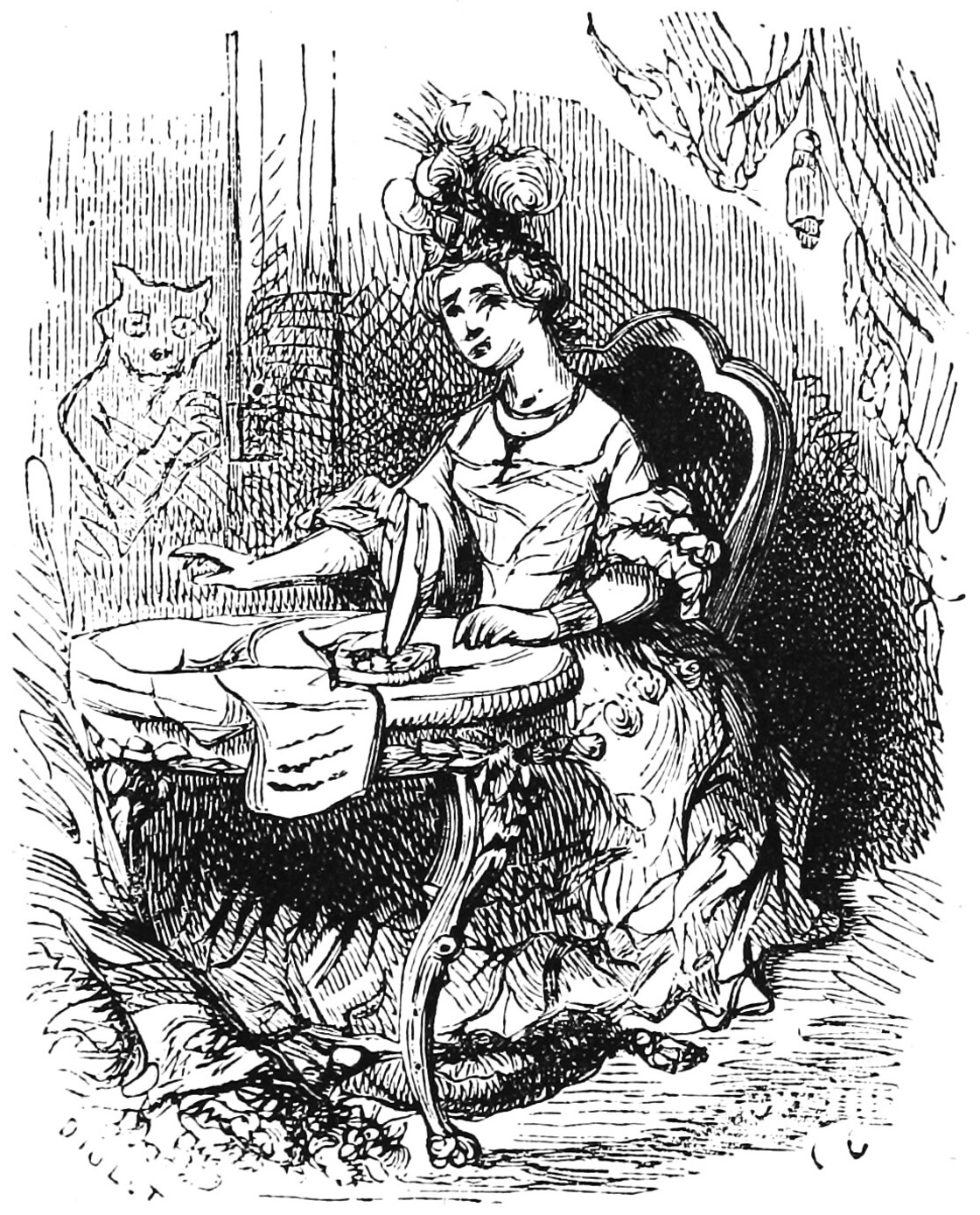
The book of 1863 gives the story a full page and a picture, and then ends the entry with one sentence by Plancy: “We need not add that this was a trick of ventriloquism.” The whole history of that trick, from the oracles of Greece to Marguerite, is told in The Voice in the Belly, and another of Plancy’s entries, a Serbian prince who never lived, is followed back to its source in Who Was Prince Denis Lazar of Serbia?.
On that page of the Catholic edition, approved by the bishop of Arras, a woman wraps her head in her apron, a thin voice answers from a hole in the wall, and the last word is the verdict the freethinker had given every belly-speaker in 1818.