She is wearing four hundred flowers and she is about to order a man burned alive. Dani Ardor, the American outsider played by Florence Pugh, has won the dancing competition and been crowned May Queen, and the white shift she arrived in has vanished under a swaying tower of blooms. The image is the one everyone remembers from Midsommar, Ari Aster’s 2019 folk-horror film, and the reason it unsettles is how documentary it looks, as if a folklorist had filmed it in 1910 and forgotten it in an archive.
Almost every ritual in the film has that quality, and every one of them is running the same trick. Aster built the Hårga, his fictional Swedish commune, from a research file his team said ran to about a hundred pages, drawing on real Swedish midsummer custom and a shelf of Norse and Scandinavian sources. Then he stitched the borrowed pieces into a cult that never existed. The seam between the two is the interesting part. Here is what the film took from the record, and what it built from nothing.
The Maypole Is Real, and Younger Than It Looks
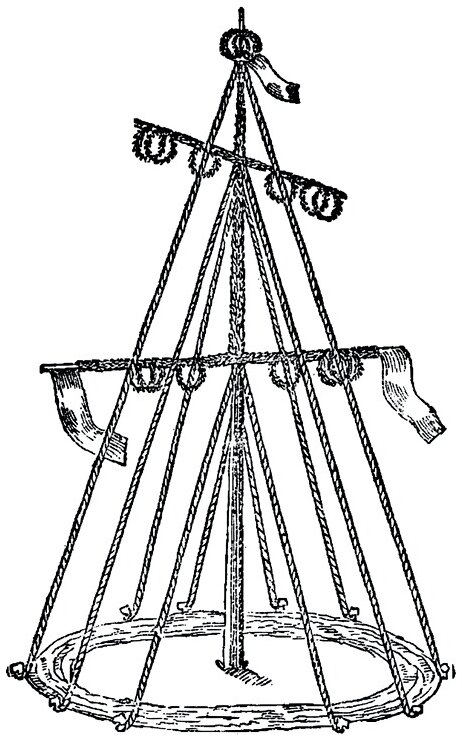
The midsummer pole the Hårga raise and dance around is a genuine Swedish object. It is called the midsommarstång or majstång, and the verb behind that second name, maja, means to dress something in greenery. It has nothing to do with the month of May.
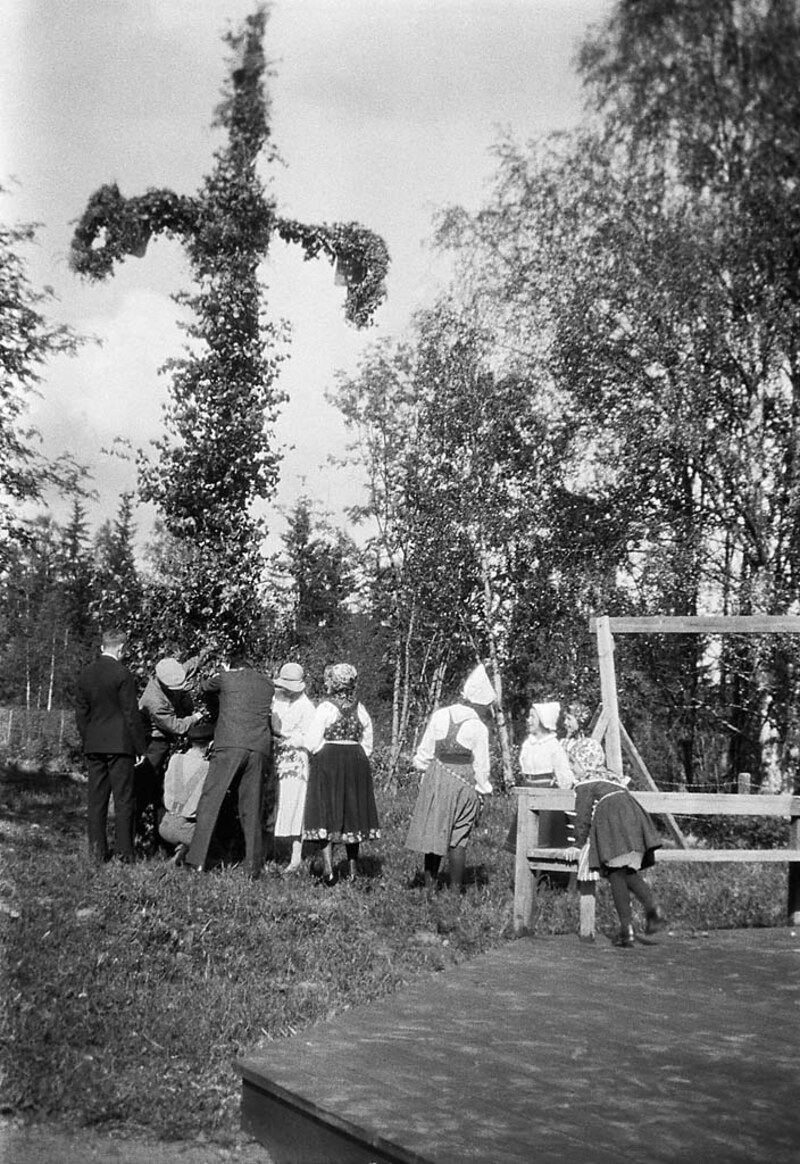
It is also an import. According to the Nordiska museet in Stockholm, the decorated pole most likely came to Sweden from Germany in the late Middle Ages. The distinctive shape the film uses, a cross hung with two leafy rings, spread through the folk-revival movement of the early 1900s, the same wave of national romanticism that tidied up a lot of “ancient” Swedish tradition into the form tourists photograph today. Even the ring dance the film stages, the hopping children’s song “Små grodorna,” is young. Its melody is a French Revolutionary military march, “La Chanson de l’Oignon,” that reached Sweden by way of a British joke at French soldiers’ expense.
Then comes the part the film leans on hardest, the part with the least evidence behind it. Midsommar presents its midsummer as a deep fertility rite, all swelling crops and sexual ceremony beneath the pole. The phallic maypole is so fixed in the popular imagination that it feels like common knowledge. Jonas Engman, an ethnologist at the Nordiska museet, says there is no evidence for it. In his words, research-wise there is nothing to suggest people ever associated the maypole with a phallus, and the interpretation itself is recent, traceable to the late 1800s under the influence of Freud and the new vocabulary of psychoanalysis. The “ancient fertility symbol” the film treats as bedrock looks more like a Victorian projection onto a medieval German party decoration.
Seven Flowers Under the Pillow
One of the film’s quieter touches is real, and the film even gets the texture right. Swedish midsummer carries a genuine divination custom: a young woman picks wildflowers in silence, without speaking and without looking back, and places them under her pillow so she will dream of the man she will marry.
The one number worth getting right is the count. Popular retellings say seven. Both the Nordiska museet and Isof, the Swedish state institute for language and folklore, give it as seven or nine, varying by region, with seven the more common. Seven and nine are the two recurring magic numbers of Swedish folk belief, which is why the custom settled on them. The flower crowns are real too, as is the convention of white dresses, though the white is a modern aesthetic rather than an old rule.
The midsummer holiday is not pinned to the solstice. Since 1953, the Swedish public holiday floats on the Friday between 19 and 25 June, set for the convenience of the work week, so the celebration drifts a few days away from the sun’s actual high point on the 20th to 22nd.
Hårga: The Village That Danced Itself to Death
The commune’s name is not decoration. Hårga is a real village in Hälsingland, the Swedish province where the film is set, and it owns one of the country’s grimmest pieces of folklore. The legend of the Hårgalåten tells of a fiddler who arrives and plays a tune no one can stop dancing to. A sharp-eyed onlooker notices his cloven hoof and understands too late who he is. The young people of Hårga dance up the hill called Hårgaberget and keep dancing as their shoes wear through, then their feet, then the flesh of their legs, until the legend leaves only skulls turning on the bare rock. It was first written down in 1785, and folklorists hold the story to be older than that record.
Aster took the name on purpose. He has said he prefers to tether a film to something real, and then named the danger of doing exactly that. In his words, it is always more fun to tether it to something tangible, but then you run the risk of the real thing being confused for whatever you have done. So he borrowed the village and its dance-to-death motif and built his own commune on the spot, careful to keep the two separate. The crowning of a May Queen through a last-woman-standing dance is the film’s fusion of that Hårga legend with the separate May Day tradition of the flower queen. Neither tradition includes a fire that ends with nine corpses.
The Temple at Uppsala
The film’s climax, a nine-day festival that comes once every ninety years and ends with nine human offerings burned inside a yellow temple, rhymes with a real and famous text. Around the 1070s, a German cleric named Adam of Bremen described the pagan temple at Uppsala in his history of the archbishops of Hamburg-Bremen. In Book IV he reports a great festival held every nine years, at which the people sacrificed nine males of every living creature, and hung the bodies in a sacred grove beside the temple. A note attached to the text, a marginal scholion, adds the detail that readers have fixed on ever since: a Christian, it says, told the author he had seen seventy-two bodies hanging there together, men among the dogs and horses.
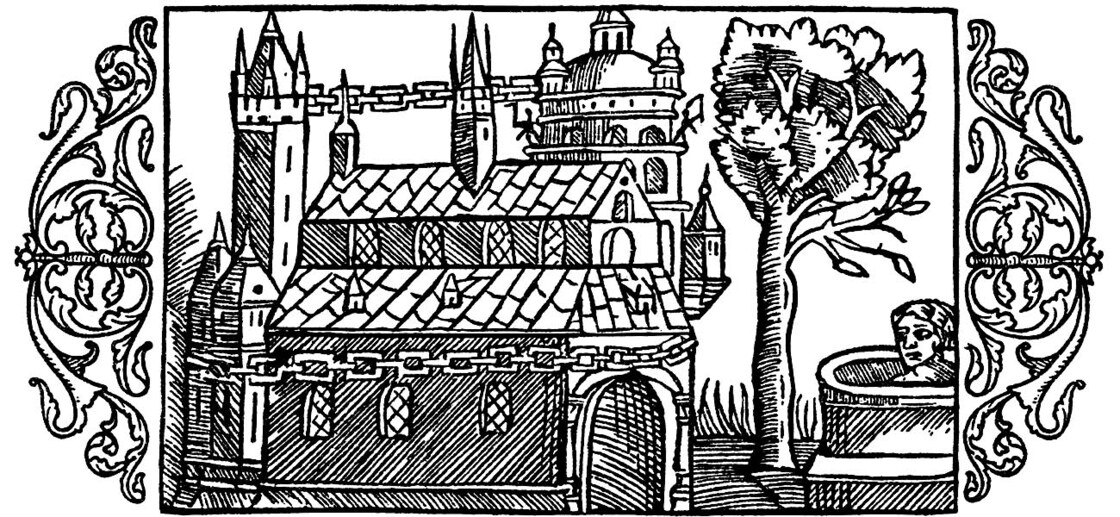
It is a vivid passage, and the film inherits its problems along with its imagery. Adam never went to Uppsala. He wrote in Hamburg from second and third-hand reports, as a hostile Christian whose church was trying to convert the north, and the most extreme detail in the whole account, the human bodies in the grove, sits in a marginal note and rests on an unnamed Christian’s word. The Norse scholar Rudolf Simek notes that Adam’s sources are of widely varying reliability even as the temple’s existence is not in doubt. Andy Orchard puts it more bluntly, that it is unclear how much of the description rests on fact rather than lurid fiction. A second medieval writer, Thietmar of Merseburg, reports a near-identical nine-year sacrifice at Lejre in Denmark, ninety-nine men and ninety-nine horses, which is one reason the nine-year cycle feels so well attested. Both accounts are outsiders writing about a paganism they had every reason to discredit, and the spades have not backed them up. Excavation has confirmed Gamla Uppsala as a major cult and royal centre, with a great timber hall and monumental rows of posts, but no one has ever found the grove of hanged victims.
The closest thing to physical evidence for northern ritual killing lies elsewhere and earlier. The bog bodies of Denmark, men like Tollund Man and Grauballe Man, were laid in the peat around two thousand years ago, many in late winter or early spring, several of them hanged or with their throats cut after a final meal. Most archaeologists read them as ritual deaths. They predate Adam’s Uppsala by a full thousand years. They are a window onto Germanic ritual killing in general, not a receipt for the specific cult the film stages.

The Hårga build their world out of runes, but the alphabet is not historical. Production designer Henrik Svensson invented a 16-rune system for the film, “made-up modifications,” in his words, of the Elder Futhark: eight positive runes, four unbalanced, and four he called “really bad.” Each Hårgan’s name is built from one to five runes scaled to their age. Decoding an on-screen rune into a real historical meaning does not work, because the letters were altered on purpose.
The Ättestupa: A Cliff That Never Was
The single hardest scene to watch is also the one with the least history behind it. Early in the film two elders of the Hårga, both turning seventy-two, are carried to a clifftop and leap. One survives the fall, broken on the rocks below, and an elder ends him with a heavy mallet. The rite is named on screen: the ättestupa.
The word is real, but the ättestupa, the cliff from which the old and the infirm supposedly threw themselves or were thrown so as not to burden the living, is treated by historians as a legend rather than a fact of the pagan past. There is no source from the period that records it as a custom, and no skeleton at the bottom of any cliff to confirm it. Its single medieval appearance is in the Icelandic Gautreks saga, and the tone there is comic. A miserly family throws itself off the ætternisstapi one member at a time over losses as trivial as a broken cart, each of them expecting to land in Odin’s hall. The word for that cliff occurs in no other Old Norse text. The modern Swedish term spread later, after the antiquarian Olof Verelius printed the saga in 1664, when scholars of the 1600s and 1700s began attaching the name to real inland cliffs and the idea of an old custom hardened into something that felt remembered.
This is where the film and the scholarship pull hardest against each other. Svensson, the production designer, has said the cliff scene was based on historic practices in Sweden. A 2026 article in the journal postmedieval takes up this exact knot, the saga, the folklore, and Aster’s film. It sits with the scholarly consensus, which runs the other way from Svensson: the ättestupa is a legend that later centuries hardened into a false memory, not a custom anyone practised. The film treats a 13th-century joke as ancestral law, and that mistake is the engine of the whole sequence.
The Production: A Breakup Becomes a Cult
For all its Hälsingland setting, Midsommar was filmed in Hungary, in and around Budapest, where the commune was built from nothing on a budget of about nine million dollars. The cast that wanders into it, Florence Pugh’s Dani, Jack Reynor’s Christian, the friends played by William Jackson Harper, Will Poulter, and Vilhelm Blomgren, were performing Swedishness on a Hungarian field.
The deeper invention is the reason the film exists at all. Aster set out to make a breakup film, and said as much to Vice. He called Midsommar his breakup movie, one that felt as big, consuming, and cataclysmic as breakups tend to feel. The Hårga are a machine for dramatising a dying relationship, a community that absorbs a grieving woman and gives her the family her boyfriend cannot. When Aster reached for a folkloric frame to hang that on, he read a great deal and took what he liked. The May Queen and her power to bless the crops come from James Frazer’s The Golden Bough, the Victorian compendium of dying-and-reborn vegetation kings that Aster consulted. The oracle Ruben, bred through deliberate inbreeding to keep his mind “unclouded,” and the scripture the Hårga call the Rubi Radr and describe as emotional sheet music, were both made for the film. In Aster’s own line about the village, everything in it was created strictly for that film.
A Forgery in Broad Daylight
Midsommar works because it lies the way a good forger lies, with real materials. The maypole still goes up on Swedish lawns every June, and the seven-flower charm is one grandmothers pass down. Hårga is an actual village with a grim legend fixed to its name, Adam of Bremen set down that grove of hanging bodies in the eleventh century, and the ättestupa is a word the Swedish dictionary lists. Aster took those genuine fragments and assembled a religion out of them, and the assembly is fiction. The film feels true because every thread in it traces back to something a person once believed or wrote down, and it feels wrong because the pattern those threads make was invented in a writers’ room.
The horror sits in the gap. We are watching a culture that never existed, performed with the conviction of one that did, on a field in Hungary, by actors crowned with the flowers of a custom whose oldest meaning the experts cannot agree on. The film’s daylight has no shadows to hide in, and neither does its folklore. Everything is shown, nothing is quite real, and the difference is as wide as a 13th-century joke mistaken for a law.
Related Articles
- Hereditary and the Real King Paimon, Aster’s earlier film, and the genuine demonology of the Ars Goetia it draws its crowned king from.
- Folk Horror: The Films Built on Real Folklore, the Wicker Man lineage that Midsommar belongs to, and the traditions underneath each film.
- The Fern Flower and Kupala Night, the Slavic midsummer, the same solstice under a different sky, hunting an impossible bloom on the shortest night.
- Bog Bodies: Punishment or Sacrifice?, the real, physical evidence for northern ritual death that the film’s grove of corpses can only gesture at.