The shaman ritual in The Wailing is built on a real Korean kut, the ceremony a Korean shaman holds for a family, but its deadly goal was mostly made up. The drummers and assistants around the actor were real disciples of a practising shaman, and real shamans supervised the music. The film’s art director said, though, that a kut which hurls a harmful force at an enemy to kill him is something almost no shaman can perform, so the crew invented much of it. A real kut, as one anthropologist followed it in 1992, takes a whole day of costumes, drumming, bargaining and tears, while gods and dead relatives speak through the shamans to a family in trouble.
Is the shaman ritual in The Wailing real?
The Wailing is a South Korean horror film from 2016, written and directed by Na Hong-jin. Its Korean title, Gokseong, is the name of the mountain village where it takes place. A Japanese stranger arrives in the village, and soon a sickness drives villagers to kill their own families. A clumsy local policeman, Jong-goo, watches his young daughter Hyo-jin fall ill with it.
The family calls in a shaman named Il-gwang, played by Hwang Jung-min. The critic Brian Eggert describes him as “a well-dressed shaman who drives a shiny new SUV.” Il-gwang claims the stranger is a demon and performs a death-hex ritual to kill him, with drummers, burning totems and a goat sacrifice. At the same time the stranger holds his own private ceremony, and the film cuts back and forth between the two, until Jong-goo stops the ritual halfway and rushes his daughter to the hospital.
The Korean name for such a ritual is kut, also spelled gut. A shaman is called a mudang, and a shaman whose body the gods take over is sometimes called a mansin.
What did the filmmakers borrow from real shamans?
The film has two kut scenes, one by day and one at night, and the producer, Im Min-seop, told the Korean film magazine Cine21 how they were made. The crew shot them over several days of drumming in an inhabited village in Hamyang, in the south of the country, and held a feast for the villagers first to win them over.
To stage the rites, the production worked with a family of shamans from the southeastern city of Ulsan, whom the director had consulted ever since he wrote the script. The assistants and musicians around Il-gwang on screen were that shaman’s real disciples and players.
Hwang Jung-min prepared at a kuttang, a commercial shrine in the mountains where shamans hold their rites. He watched a real kut there and learned the movements in rehearsals. On set, once a kut began, the crew ran it from start to finish without cutting, with several cameras rolling, and the consulting shamans said his movements, eyes and body rhythm were better than those of most trained shamans.
Hwang told The Korea Times: “I just let my body do the acting and felt as if I was really performing exorcism. It was a funny feeling.” The director added that “a shaman who was helping us told me Hwang looked like he was doing it for real.”
The music came from the same family. The music director, Jang Young-gyu, said the kut music was arranged under the shamans’ supervision, and because they came from Ulsan, it mixes the byeolsin-gut, a village rite of the east coast, with other kinds of kut. Real shaman musicians played on set, and the music was played and recorded again after filming.
Il-gwang’s robe in the five traditional colours follows an ordinary shaman’s robe in its cut. But the costume designer, Chae Kyung-hwa, had it made of dyed hemp instead of the usual silk, so that it would look rough and stiff. The shop that sews robes for real shamans warned her several times that one must not make a shaman’s robe from that cloth.
What did the film invent?
The film’s art director, Lee Hu-kyung, explained in the same Cine21 feature that Il-gwang’s kut follows Korean folk belief at its core, while the details around it mix rituals from several countries. What the crew made up was mostly the purpose of the rite.
That purpose turns on a Korean word, sal. In Korean shamanism and in geomancy, the old art of choosing good sites for houses and graves, sal means a harsh, harmful force that damages people, living things and objects. Shamans hold rites to lift sal from someone who suffers from it, while Il-gwang’s second kut does the opposite and hurls sal at an enemy to kill him. Lee said such a kut “is said to exist, but almost no shaman can perform it, so much of it was invented.”
To show killing on screen, the crew added animal carcasses, chunks of meat and the driving-in of stakes. Lee pointed out that the stake looks like a jangseung, the carved wooden post that guards the entrance of a Korean village, and he called it a hint at a hidden side of Il-gwang, which the film reveals later.
The stranger’s ritual mixes Japanese and Nepalese practice. The director travelled to Nepal, met practising shamans there and filmed their rituals for the crew. The stranger’s drum, his drumstick and the bells he hangs up were brought back from Nepal. The fire he lights in his room, burning one by one the things that might bring misfortune, came from a Japanese Buddhist rite.
Na Hong-jin said he could not handle the film’s religious theme “through reading or studying”, so “I met a lot of religious leaders to seek advice.” He also chose to leave the ending open: “It is up to the audience to interpret the film.”
What does a real Korean kut look like?
To see what the film took and what it changed, it helps to follow a real kut from start to finish. One detailed account comes from Laurel Kendall, an anthropologist who spent nearly two years observing Korean shamans in the 1970s. She calls the kut their most elaborate ceremony, describing its core pattern:
“In kut, the shaman puts on the costumes of the gods, dances to rapid drum beats, and when the music stops, speaks and mimes in the god’s persona, sometimes angry and demanding, sometimes comic, usually offering promises of good fortune before departing to another flourishing of drum beats and dancing.”
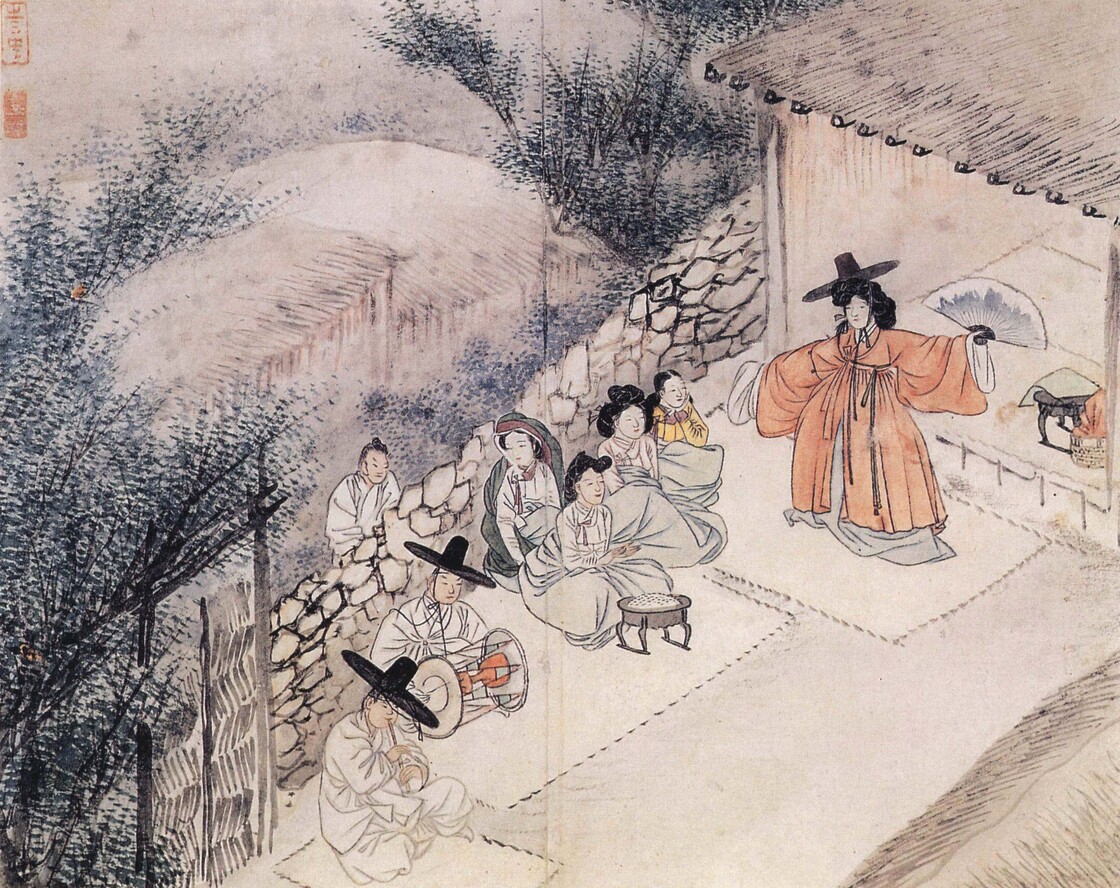
Then another shaman dresses as another god, and so on, until all the gods and ancestors of the family that paid for the kut have appeared. In the 1970s these kut lasted all night in village houses crowded with neighbours and relatives, but the drum and the dance go back much further: the painting below, by Shin Yun-bok, shows a shaman dancing in a Korean house in the early 1800s.
Years after that first fieldwork, in May 1992, Kendall and the filmmaker Diana Lee went with three shamans to a kut for a woman whom Kendall calls Mrs. Yi. Kendall tells that kut from beginning to end in her 2009 book Shamans, Nostalgias, and the IMF, and it shows what a kut is for.
Who was the kut for?
Mrs. Yi was 34 years old, had two children and lived in Ansan, a city near Seoul, and she was ill and ached all over. Her husband had built and sold houses until he lost everything, so now he stayed at home while she cleaned and cooked for other families, and they lived in debt.
To pay for the kut she borrowed nearly four thousand dollars. She had never held a kut before, her mother had not either, and her mother-in-law went to church. “I’m only doing this because I am desperate,” she told Kendall. She waited until her husband was out of the house before she left for it.
The three shamans were a senior shaman whom Kendall calls Yongsu’s Mother, her apprentice, nicknamed Babe, and a third shaman called Okkyŏng’s Mother. Married Korean women are often addressed as the mother of their child. They drove to a kuttang in the mountains, a one-storey building with several rooms around a courtyard, where the shrine room was hung with paintings of the gods.
The shamans dressed in billowing skirts and jackets with curved sleeves. They would divide the kut into three main parts among themselves and stop only for lunch and short breaks. Yongsu’s Mother began by singing to drive away pollution, anything ritually unclean, and to invite the gods.
What did the gods say?
Babe dressed as the Mountain God and spoke of money flowing out of the family. Each god who followed said the same thing: if the family had held a kut earlier, all would have been well.
Next a slaughtered pig’s head had to be balanced on a trident, a three-pronged fork, because a head that stands upright is the sign that the offering is accepted. Mrs. Yi could not get it to balance at first, so the shamans set her to bowing before the tray, and when the head finally stood, Babe told of a vision of an ancestral grandmother who had honoured the Seven Stars. Such an ancestor, Kendall explains, comes to merge with the deity she worshipped once she has died.
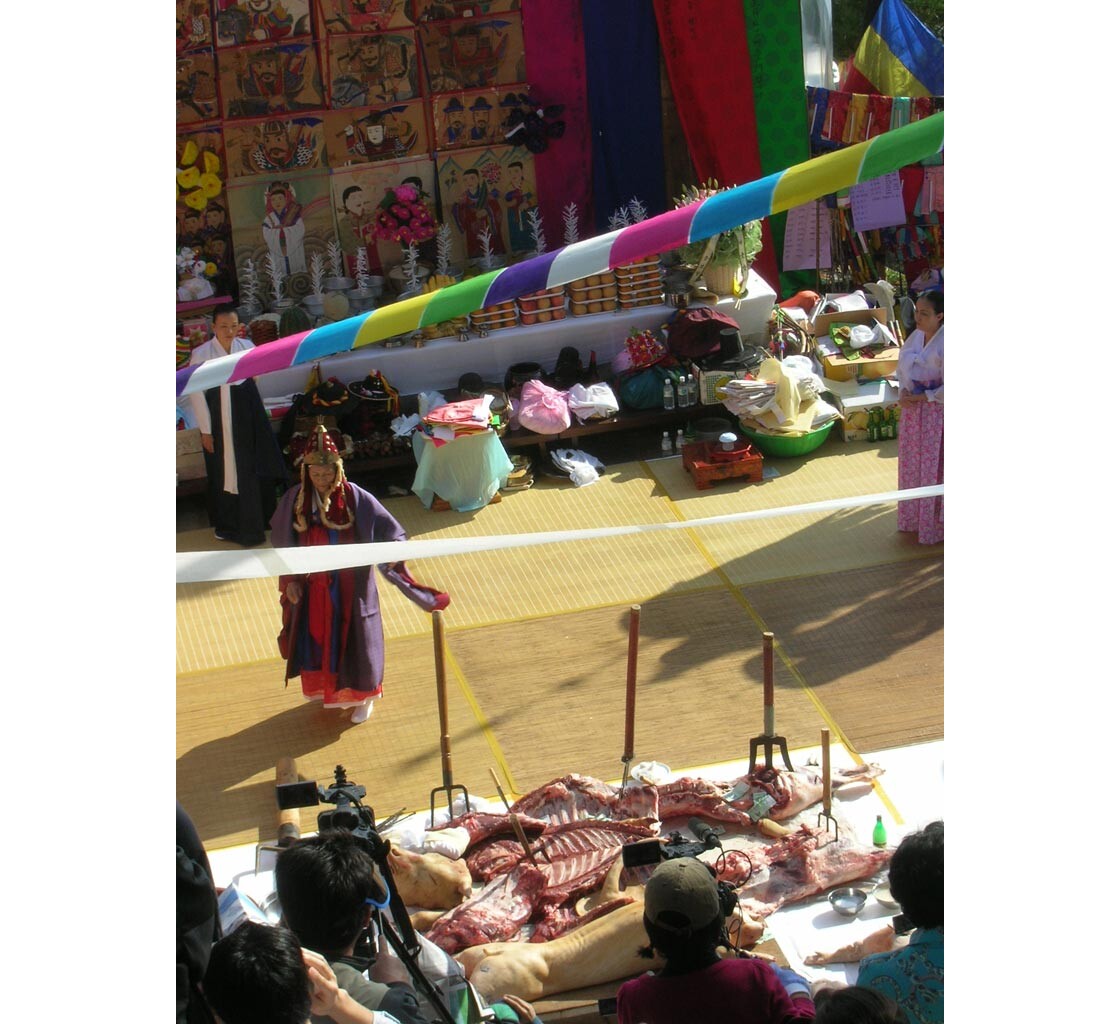
Then the Seven Stars spoke through the shaman to Mrs. Yi: “Your head aches all the time.” A warrior spirit came next and offered her coloured flags to choose from. She drew a white flag, the colour of the heavenly spirits, and the shaman told her: “You saw a woman in white in a dream. That’s who it was.”
Mrs. Yi struggled to follow, because the drum and cymbals of her own kut were loud and drums from a kut in the next room pounded through the wall. Kendall adds that “the language of kut has its own idioms and uses many archaic terms”, and that a woman at her first kut usually cannot understand what the shamans say.
How do the dead speak in a kut?
During a short break, the third shaman asked the client about her deceased relatives. She then donned a yellow robe to summon the dead.
Mrs. Yi’s own father had hanged himself. He came through the shaman weeping: “Why did Father die? There wasn’t any property. There wasn’t any money.” Her dead mother followed, grieving over the hardships that had led to his suicide. The shaman rubbed Mrs. Yi’s hair and shoulders and half held her, and Mrs. Yi, in Kendall’s words, “sobs without restraint, as she is meant to do.”
For each deceased relative, the shaman tore a strip of cloth to symbolise the soul’s release from torment. Departing ancestors assured the client that her fortunes would improve. Later, the shaman recalled that her own throat had tightened while channeling the father, mirroring his death by hanging.
Isabella Bird, a British travel writer, described the same moment in the 1890s. In the household kut, she wrote, “deceased parents and ancestors appear in the mu-tang”, her spelling of mudang, and an eyewitness described the shaman’s acting of them as “both ‘pathetic and ludicrous.’”
Then the ritual turned into broad comedy. The senior shaman took the role of the Official, a greedy bureaucrat spirit who sneered at the offerings. She dragged the client across the floor, extracting banknote after banknote until the woman ran out of cash. Spectators gathered in the doorway to watch. The client laughed, having learned to reply: “Next time, I’ll give you more.”
Is a kut an exorcism?
A kut does include a driving-out, and in Mrs. Yi’s kut it came at the very end. Yongsu’s Mother sent off “wandering ghosts and noxious influences”. She sat Mrs. Yi on the edge of the veranda, pelted her with scraps of food, tore cloth “to release the hold of the dead”, and brandished her knife “until she is satisfied that Mrs. Yi is clean.”
The driving-out took only a short part of the day, while the long hours before it went to feeding the gods, listening to the dead and bargaining over money. In the gods’ telling, Mrs. Yi’s troubles came from neglect: the family had forgotten its gods. The next day Yongsu’s Mother put it in plainer words. “You don’t have money and then you fret about it until it makes you ill.” Kendall reads Mrs. Yi’s illness as both at once: worry and frustration, and the neglect of household gods and ancestors.
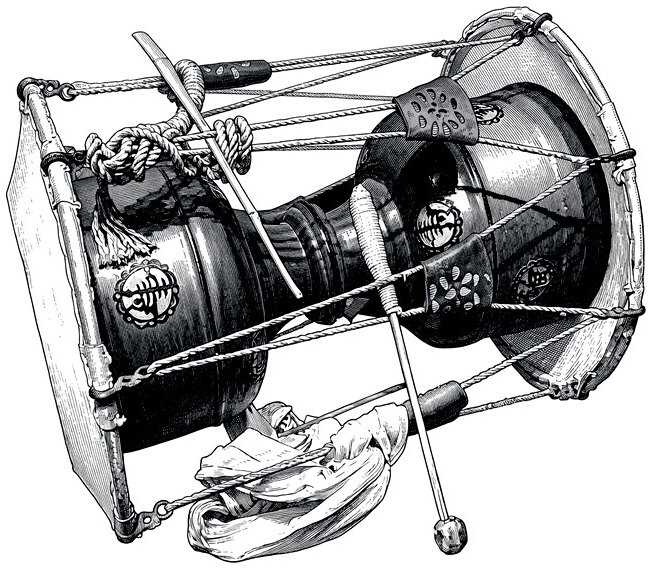
A hundred years earlier, Isabella Bird watched a kut held for a sick man in the city of P’yŏngyang, in what is now North Korea. Three old women played for the shaman, “two of whom beat large drums, shaped like hour-glasses, while the third clashed large cymbals.” The shaman wore rose-pink silk and a gauze robe with trailing sleeves. One of the drummers scattered food to the four winds for the spirits, saying: “Do not trouble this house any more, and we will again appease you by offerings.” Bird writes that the rite lasted fourteen hours, until four in the morning, “when the patient began to recover.”
Bird wrote as a Christian traveller and called every spirit a demon, but she noted a division of labour: the blind male sorcerers, the pan-su, were the “Master of the Demons” who drove spirits off “or even bury them, while the mu-tang supplicates and propitiates them.” In her account, the mu-tang pleads with spirits and feeds them so that they leave. Il-gwang’s kut tries to kill, and that is the part the film’s art director said was largely invented.
For more on how other faiths drive out spirits, see Exorcism Across Religions and Cultures.
Do Koreans still hire shamans today?
The historian Donald L. Baker wrote in 2010 that there are no reliable figures for how many shamans work in South Korea, but estimates run from 40,000 to 100,000 or more. If the higher figure is right, he adds, the country has more shamans than Buddhist monks or Christian pastors.
Baker explains the name mansin as “ten thousand spirits”, for the many spirits such a shaman can channel. Through these shamans, he writes, Koreans “plead with spirits to stop afflicting them with physical, financial, or personal problems,” or talk again with relatives who have recently died, and as incomes rose, more Koreans could afford such expensive rituals.
Where the rituals happen has changed. By the 1990s, Kendall found, most kut around Seoul were held in commercial shrine halls in the mountains, where the noise bothered no neighbours, and everyone went home by late afternoon. Il-gwang with his new SUV belongs to that world, and the film’s costume designer told Cine21 that she modelled his flashy blue suit on successful male shamans, who arrive at department stores in a Mercedes.
Holding a kut away from home is older than the commercial mountain shrines. In the 1890s Isabella Bird noted that in Seoul the household kut was held “at the demon shrines outside the city walls, and not in private houses.”
The kut in The Wailing sits among other films that draw on living belief, in 30 Folk Horror Films Built on Real Folklore. For the Siberian peoples who gave the world the word “shaman”, see The Original Shaman.
What did Mrs. Yi take home?
When the gods had gone, the shamans packed up and Babe gave Mrs. Yi her instructions. She was to take some white rice cake home and set it in the inner room for the grandmother who had worshipped the Seven Stars. She was to bow three times and say, “You are the grandmother who helped us from long ago,” and then say to the Officials, the money-hungry gods she had met that day: “Twelve Officials, make us rich.” Mrs. Yi wrote the instructions down.
Babe filled plastic bags for her with the leftover fish, meat and rice cake. Mrs. Yi looked overwhelmed, Kendall writes, perhaps wondering whether so much food would make her husband suspicious.
Within minutes the van was packed. On the way home Kendall asked whether she felt relieved. Mrs. Yi said she did not know what she felt. During the kut she had been heavy-hearted about everything that had gone wrong in her life, “but the ancestors understood her feelings and had given her encouragement.”