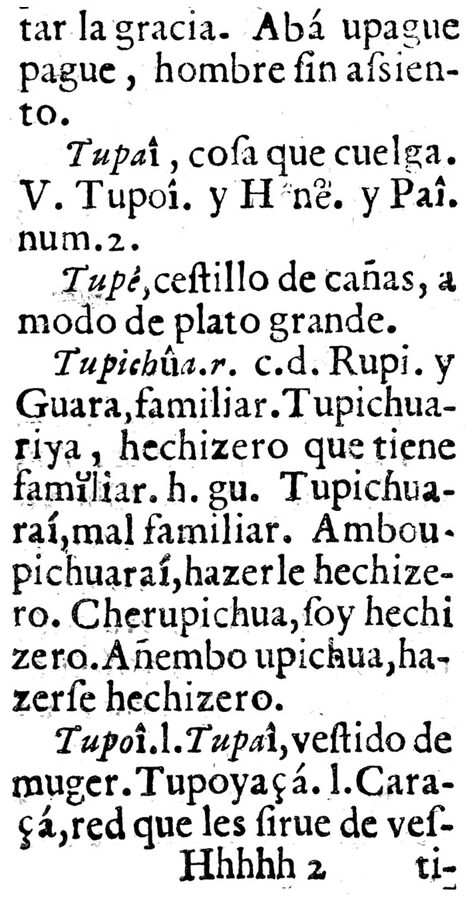
In 1639 a Jesuit priest named Antonio Ruiz de Montoya published a dictionary of Guaraní in Madrid. He had lived in the mission villages of Paraguay for more than twenty years. In this dictionary stands the word tupichúa. Montoya translated it with a single Spanish word: familiar, meaning a spirit that serves a sorcerer.
Montoya’s Spanish-to-Guaraní volume of 1640 shows how he understood the word: under the Spanish heading “familiar” it gives tupichuára for “familiar demon”.
The words that grow out of tupichúa on the same page show how close the spirit stood to the person who kept it. Tupichuariya is “a sorcerer who has a familiar”, tupichuaraí is “an evil familiar”, and cherupichua, built on the same root, is translated “I am a sorcerer”. Even the verb for becoming a sorcerer, añemboupichua, is made from it. Earlier in the book, on folio 261, comes the entry for paye, the Guaraní healer and shaman, whom Montoya calls an “Indian sorcerer”. At the end of it he writes down a sentence in both languages: Abápaye otupichuaraí omboeharãmo oguerecó, “the sorcerer has his familiar as his teacher.”
Function
The paye was the Guaraní healer and shaman. People turned to him during illness or when contacting the unseen world. In 2003 the archaeologist Jorge Roberto Ogdon explained paye as “the one who knows magic”. He noted that a true paye was born with the gift rather than trained, though an elder guided the novice through fasting and purifications.
Ogdon described the tupichúa as nature spirits. Like the spirits of the dead, they stayed in constant contact with the shaman. They served as assistants who carried out his missions. The shaman reached them through chant, accompanied by music and dance. Each purpose had its own song. A ñe’engara called the spirits to work for good. A purahéi vaí, or “bad song”, sent them to cause harm. A third chant, the mba’e pochý, turned harm away.
The harm they caused took the form of sickness. Ogdon noted three causes of illness in Guaraní tradition. First were hostile shamans who could insert a foreign object into a victim’s body. Second was an inner struggle between an animal soul and a divine soul. Third were the spirits of nature, including the dead and animals.
These nature spirits attacked invisibly when a person’s soul grew weak. The Guaraní viewed health as harmony with community and nature, a state called aguyje. Illness meant the loss of that balance.
To cure the patient, the paye fought spirit with spirit. He sang to the beat of the mbaraka, a gourd rattle, calling his helper spirits before entering a dream trance. Upon waking, he sucked the sickness out or blew over the patient’s head. In severe cases, he used private, secret chants to summon more fearsome spirits.
Appearance
None of the sources describes what a tupichúa looks like. Montoya gives only the word and its derivatives, and Ogdon describes the spirits by what they do, which is to work unseen and to attack invisibly. The illustration at the top of this entry is therefore the oldest record of the name itself: the column of Montoya’s 1639 dictionary in which Tupichûa appears with its translation, “familiar”, photographed from the John Carter Brown Library’s copy and cleaned to black on white with no redrawing.
Cross-Cultural Connections
Both writers used the European term “familiar” to explain these spirits. Montoya listed the word under “demon” in 1640. Centuries later, Ogdon also compared them to the animal companions of European witches. This comparison reflects how outside observers understood them, leaving the original Guaraní concept partly obscured.
Montoya’s dictionary highlights an important difference. In Europe, a familiar was usually a servant. In Guaraní belief, the tupichúa was the shaman’s teacher. This role resembles visionary figures like Thom Reid, a spirit who taught herbal cures to a Scottish healer in 1576. The shifting European meaning of helper spirits is traced in The Voice in the Belly.
Spirits that serve a magician appear in many other cultures, and in several of them the helper is made rather than met. The Greenlandic tupilaq is built by a shaman from bones and brought to life by chanting, the Estonian kratt is put together from hay and old tools, and the Malay toyol is a dead infant kept in a bottle. The tupichúa, as Ogdon describes them, already live in nature, and the paye’s art lies in calling them with the right song.
Modern Survival
In 2006 Paraguayan writer Ramiro Domínguez documented modern folk medicine in rural Paraguay. He noted that fear of ojeo, the evil eye, remains common. Healers connect this condition directly to the tupichúa. When an infant is born with sudden illness or deformity, families often suspect an unseen curse. The healers trace that attack back to the same spirits Montoya recorded four centuries ago.