Around 1557 the French traveller Jean de Léry visited a Tupinambá village on the coast of Brazil. The villagers held a captured woman prisoner before a feast. Léry went up to her and urged her to pray to Toupan, the local name for Tupã. In his book of 1578, Léry noted that Toupan did not mean God to her people. It simply meant thunder. The woman laughed and asked what he would give her if she prayed.
Today Tupã is the Guaraní word for God in Paraguay. Yet old records disagree on what Tupã meant before Christian times. Early accounts link the name to thunder, a wandering spirit, and the voice heard from ritual rattles. Only later did Tupã take on a human form.
Appearance
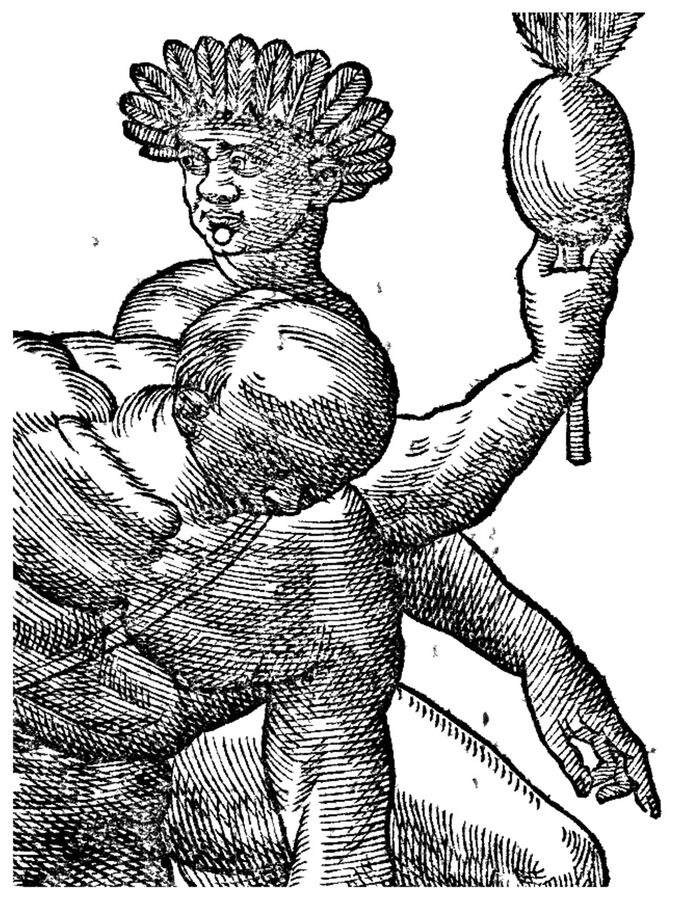
The Tupinambá whom Léry and the earlier traveller André Thevet met in the 1550s left no description of Tupã’s body. The Franciscan friar André Thevet visited the coast in 1555. An interpreter told him that Toupan was a restless spirit who wandered constantly and spoke to village prophets. Instead of statues, each household kept a pierced gourd rattle mounted on a wooden staff. Red feathers crowned the staff. Families revered this rattle as “their Toupan”. When prophets arrived, they called on the spirit inside to reveal news of the dead and enemy plans. The name belonged to the unseen voice, and the rattle served as its mouthpiece.
Léry saw these rattles, called maraca, shaken during dances to invoke the spirit. His 1578 woodcut appears above. It shows a man wearing a feather crown and a lip plug while lifting the rattle as another dancer bends forward.
A body for Tupã himself appears only in the 20th century. A physical description of Tupã emerged only in the twentieth century. The ethnographer Curt Nimuendajú lived among the Apapocuva Guaraní in Brazil from 1905 to 1907. In his 1914 study, he wrote that Tupã sits in the far west on a bench shaped like a dugout canoe. He is short and stocky, with wavy hair and a flat head. In his lower lip he wears an ornament of yellow tree resin, which flashes as lightning.
Function
In Apapocuva tradition, Tupã has a single celestial task. The creator Ñanderuvuçu fashioned the world and fathered Tupã with his wife Ñandecy, making Tupã their youngest son. Whenever the mother calls from the east, Tupã travels to her. Tupã sits in his canoe-bench with two helpers on the rim. The bench rolls across the sky from west to east. Its rumble makes the thunder, while his lip plug flashes as lightning. When he arrives and speaks with his mother, the bench stops rolling. People on earth then see silent lightning on the eastern horizon.
Tupã’s helpers could appear as storm birds. Apapocuva healers wore the bird’s tail feathers in their headdresses to draw rain clouds. Tupã also shaped daily life. When a baby was born with wavy hair, healers recognized it as Tupã’s child. Families promptly carved a miniature wooden bench for the infant. Without it, they believed the child’s soul would fly back to Tupã. If a ghost troubled a village, a healer could capture it in a dance and give it to Tupã to carry away.
Among the Mbyá Guaraní, Tupã holds a wider role. The anthropologist Irma Ruiz recorded that four divine pairs govern the cosmos. The creator god Ñamandu brought the other three into being, including Tupã. Tupã lives in the west and crosses the sky from west to east, against the course of the sun. He brings rain, thunder, and lightning from the world’s western edge.
Cross-Cultural Connections
The Jesuit missionaries who settled the Guaraní in mission villages from the early 17th century needed a word for God, and they chose this one. The Jesuit missionary Antonio Ruiz de Montoya published a Guaraní dictionary in 1639. Under Tupã, he offered a pious word derivation: tu as a cry of wonder and pã as a question, translating it as “What is this?” He defined the word as “the name they applied to God”. Mission vocabulary soon adapted the title: churches became Tupã’s houses, and the Virgin Mary became Tupãcy, Tupã’s mother. Montoya moved weather terms elsewhere, recording thunder simply under words for rain clouds.
Léry and his companions had tried to make the thunder into God eighty years earlier on the coast. When the French told the Tupinambá that the thunder they feared was the God who had made heaven and earth and who showed his power by making them shake, the Tupinambá answered that a god who frightened them like that was worth nothing.
Nimuendajú viewed Tupã with caution. Missionaries had spread the name as “God” far beyond Guaraní territory. Earlier scholars suggested that priests had invented the thunder god entirely. Nimuendajú disagreed. He saw Tupã’s canoe-bench and resin lip plug as genuinely Indigenous motifs. He also noted that Tupã remained a secondary figure in Apapocuva myth. To Nimuendajú, Montoya’s translation was likely an effort to obscure older meanings. He suggested instead that the syllables echoed thunder: tu for its rumble and pa for its crack.
Tupã’s west-to-east ride and his gift of rain set him beside other thunder powers of South America, among them the Inca Illapa, whom the Inca priests asked every July to send his waters. In the same 1639 dictionary as Tupã stands the tupichúa, the helper spirit of the Guaraní healer, which Montoya translated as a spirit that serves a sorcerer.
Modern Survival
In modern Paraguay, Tupã remains the church word for God. The nation’s patron saint is worshipped as Tupãsy Ka’akupe, or Tupã’s mother. Popular modern writings often call Tupã a supreme sun god who created light. Earlier sources tell a different story. In older traditions, light belongs to the creator father, while Tupã governs only the thunder from the west.
How high Tupã stood before the missionaries came is a question these records leave open. A Mbyá man whom Irma Ruiz recorded in 1983 pointed out on a drawn map where the four gods live, two in the east and two in the west with Tupã, and said, as his father and his father’s grandfathers had said, that God lives along the edge of the world and not in the sky.