Between 1960 and 1966 the anthropologist Hugo Nutini examined 47 infant corpses in rural Tlaxcala, east of Mexico City. In every house the family blamed a tlahuelpuchi, a bloodsucking witch who had come in the night. On 39 of the small bodies Nutini found bruises and purple spots on the chest, the back or the neck. He later wrote up the cases with his colleague John M. Roberts in Bloodsucking Witchcraft (1993), and the two men explained those bruises without the witch.
Appearance
The tlahuelpuchi belongs to the Nahua, the Indigenous people of central Mexico who speak Nahuatl, the language of the Aztecs. By day she is a person of the village. In the belief Nutini and Roberts recorded in Tlaxcala, most tlahuelpuchis are women, and so are all of the most powerful and bloodthirsty ones. They are born with the power, and they learn what they are at puberty. Nothing can take the power away afterwards.
Villagers described her body in detail. A tlahuelpuchi is fat, because blood is very nourishing, and she limps, because she has taken off her legs so often. She has squinting eyes, a long nose and a squeaky voice, and she gives off a faint smell of blood. In everyday life, Nutini and Roberts write, she seems ordinary. Villagers saw her as quick-tempered (geniuda, quick to anger), dominant and possessive. A wife who ruled her husband could therefore come under suspicion.
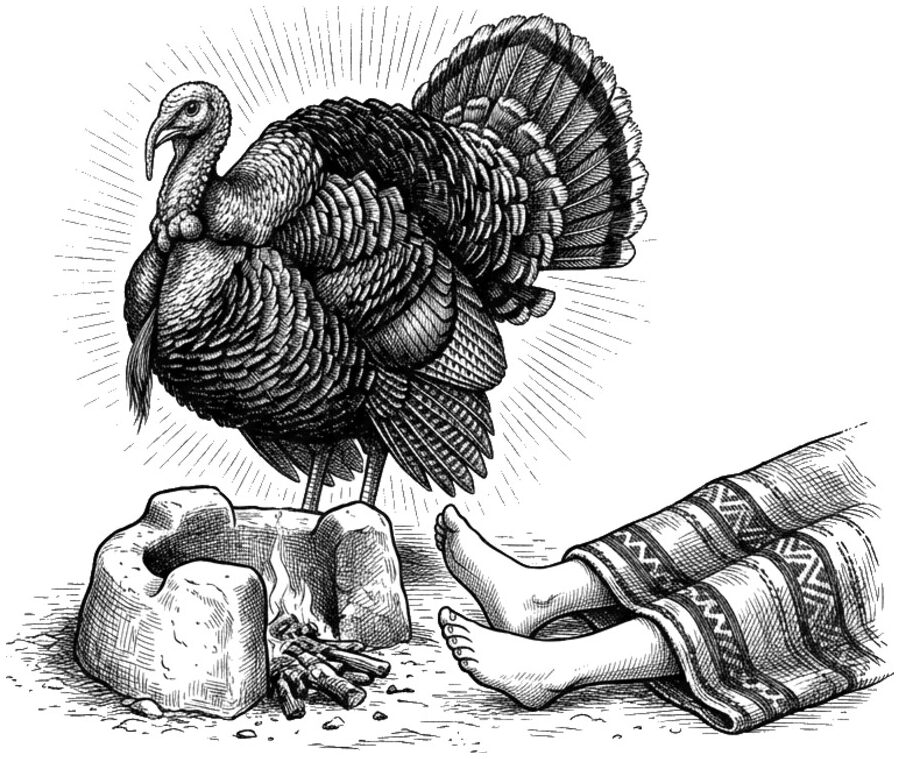
In many Nahua villages, the witch waits until her household sleeps. She jumps over the hearth fire, detaches her legs and lays them by the hearth. Then she turns into an animal and flies out. In Tlaxcala the animal is usually a turkey: in three quarters of the 300 legends Nutini and Roberts gathered there, she goes out as one. At night she also gives off light. When she returns she vomits the blood she has drunk into a cooking pot.
The name may itself describe that glow. It goes back to the Nahuatl tlahuipuchtli, and its meaning is uncertain. The Mexican historian Alfredo López Austin translated it as “glowing brazier”. Roberto Martínez González, a historian of Nahua religion, reads it as “glowing smoke” or “glowing haze”, or, taking the second half in another sense, as “glowing young person”. In the Florentine Codex, an encyclopedia of Aztec life written down in the sixteenth century, the same word also names glowing insects.
Function
The tlahuelpuchi has to drink human blood at least once a month, and she hunts most often in rainy and cold weather. She prefers babies between three and ten months old. She can also harm adults. Nutini and Roberts record that she puts her victims into a deep sleep. She can make a sleeper walk to a cliff edge and jump, and she hears any words spoken about her. Each witch defends her own hunting ground, but all of them are bound by oath to help one another and to spare each other’s close kin.
Villagers usually placed the witches somewhere else. Villagers usually located tlahuelpuchis in other towns rather than their own. Two regional settlements, Olintla and Hueytochco, were widely feared as homes of witches.
Against her, households used metal amulets. In Tlaxcala, the tlahuelpuchi was said to fear metal by nature. In Xiloxoxtla, a Nahua village in Tlaxcala, people also set a mirror or a bowl of water at the door, because the witch is frightened by her own reflection. Onion and garlic were held to be foolproof. To stop a witch caught in the act, a man threw a rebozo (shawl) over her, while a woman threw a hat. Across the region, villagers also believed turning your clothes inside out would kill her.
Such accusations could end in a real death. Nutini and Roberts report one killing of a person accused of being a tlahuelpuchi, which Nutini says he witnessed. It came at a moment of crisis, after several infants had died on the nights before without any cause anyone could name. Martínez González, who compared the reports from many Nahua regions, calls it the only known killing of this kind.
What Nutini Found in the 47 Deaths
Nutini questioned every household using a set questionnaire. Seven deaths occurred in a single 1960 cluster investigated alongside the state medical officer. The bruises on 39 bodies were classic signs of oxygen starvation: 31 died of asphyxia and six of suffocation. In 16 cases the mother also had a dark bruise on one breast, never on both, and in 12 of them it was the left breast.
Nutini understood that pattern only in 1974. Rural Tlaxcalan mothers usually nursed their babies at night lying on their left side. The bruise on the breast came from strong pressure against the infant’s mouth and face, and the authors concluded that “infants die of asphyxia by being smothered at night when they are being breastfed.” Such deaths came most often in the coldest months, when mothers nursed under heavy blankets and could doze off. Five other infants had choked. Local parents rarely burped babies to release trapped air, laying them flat on their backs in tight cribs.
Nutini and Roberts noted that these deaths might sometimes reflect intentional or unintentional infanticide. Records showed that twice as many girls died as boys. It also gives the background: as late as 1965, 45 percent of the children born in rural Tlaxcala died before the age of five.
Only 18 of the 47 babies had been protected in any way, and villagers told Nutini that most of the time it was too much trouble to remember the nightly precautions. Onion and garlic, the protection everyone called foolproof, were not used for any of the 47 children before their deaths, only afterwards. Nutini and Roberts argued that a truly foolproof ward would destroy the witch’s role as an explanation. Anthropologist Barry Isaac took this further: if an infallible charm failed, the community would have blamed the parents instead of the witch. The parents themselves, the book records, invariably felt acute guilt, and three in four fell ill afterwards with complaints the authors call psychosomatic, bodily illness with a mental cause.
Cross-Cultural Connections
A sorcerer of this name appears in the earliest written sources on the Aztecs, though he looks different there. In the sixteenth century, the Spanish friar Bernardino de Sahagún compiled an encyclopedia of Aztec life known as the Florentine Codex. Its Nahuatl text says of the nahualli, the sorcerer who could take on animal form, that he “was a tlahuipuchtli, one who removes his legs”. A girl born on the day One Rain of the Aztec calendar, the same work says, would become “one who removes her legs”. A later Franciscan chronicler, Gerónimo de Mendieta, adds fire: such sorcerers, he writes, appeared as fires on the mountain and then at once somewhere else. To repel them, informants placed black obsidian glass in a bowl of water behind the door. The reflection drove the sorcerer away, a custom echoed by modern door mirrors.
Martínez González found the bloodsucking in one place only, in the Spanish column of Sahagún’s tenth book, while the Nahuatl texts never mention it: “El Naoalli propiamente se llama brujo que de noche espanta á los hombres é chupa á los niños” (the nahualli is properly called a witch who frightens people at night and sucks children). He reads it as a Spanish addition. The colonial friar Bartolomé de las Casas compared indigenous lore to European tales of nocturnal birds that suck infant blood. That bird was the Roman Strix. Martínez González concludes that the Spanish projected the strix onto Aztec sorcery, creating the modern tlahuelpuchi. Nutini and Roberts reach a similar view from the other side: they count her monthly need for blood and her wholly negative image among traits “definitely of European origin.”
The removed legs remain unexplained. Martínez González notes that a missing foot marks the Aztec night-god Tezcatlipoca. Removing legs may have signaled ritual transgression, though its exact meaning remains unknown. The closest parallels come from much farther away. The Filipino Manananggal detaches her torso to fly and feed. In Trinidad, the Soucouyant sheds her skin and travels as a fireball. In the tlahuelpuchi, the manananggal and the soucouyant alike, the witch is a living woman who leaves part of herself behind at night. The Balkan Vampir, with whom the tlahuelpuchi is most often compared, is a dead man who returns from his grave to drink blood.
Modern Survival
By the time Nutini and Roberts published, the belief had nearly gone. Between 1972 and 1982, reports became rare as families grew reluctant to discuss them. Modern medicine and electricity reached the villages, making the witch obsolete as an explanation for infant death. Nutini opened the book with the sentence “This book is about culture loss and decay.”
Elsewhere the witch lives on under related names. In 2006 Martínez González described the belief as spread across Mexico, among Indigenous people and mestizos alike, and listed tlahuelpuchi, tlahuilpuche, tlacique and plain bruja (Spanish for witch) among her names. Whether the belief also shielded grieving families from suspicion, as Barry Isaac suggested, has no settled answer. His argument rests on a striking detail: onion and garlic were considered infallible shields, yet in all 47 deaths, families put them out only after the child had died.