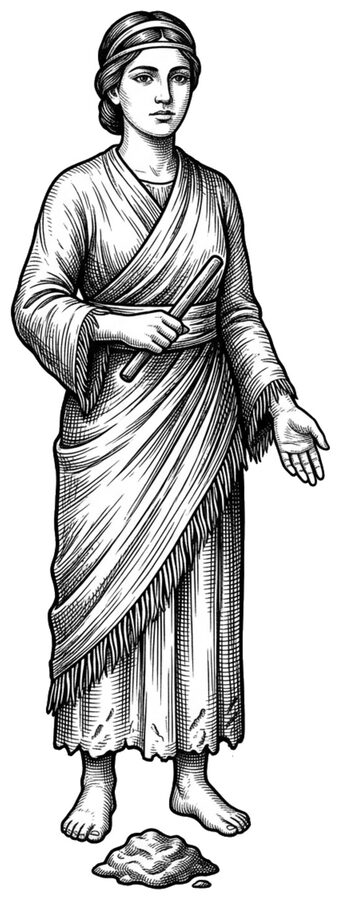
A king lies dying in his city, and the failing crops bring famine. High above, El, father of the gods, calls an assembly with a question: “Who among the gods can expel the sickness, drive out the disease?” No god answers.
El asks seven times. Each time, the gods stay silent. El tells them to sit down, and he takes the work into his own hands. He fills his palms with earth, pinching off a piece of clay. From that clay comes Shatiqatu, a healer made for a single patient.
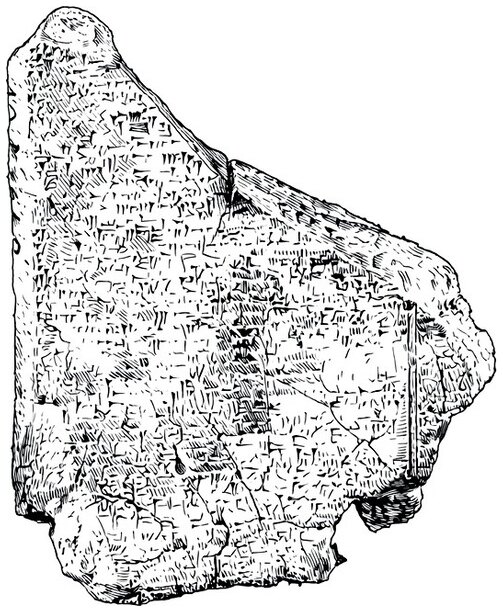
The story comes from Ugarit, a Bronze Age port near modern Latakia in Syria. Since 1929, excavators there have unearthed thousands of clay tablets. Among them is a poem about King Kirta, copied around 1200 BCE before the city was destroyed. Shatiqatu appears on the third tablet of this poem, and nowhere else in ancient literature.
Appearance
The poem states that she is female and shaped from earth. Right after El pinches the clay, eight lines are lost, hiding the moment of her creation. El then takes a cup and speaks to her, calling her “the Expeller.” Further instructions are broken away, and the next legible lines show her setting out.
Scholars still debate whether she had wings. Early translations read one damaged line as “towns she flies over a hundred,” suggesting a winged guardian like the Mesopotamian demon Pazuzu. However, specialist Theodore J. Lewis argues that the flying verbs describe sickness and death taking flight as she enters.
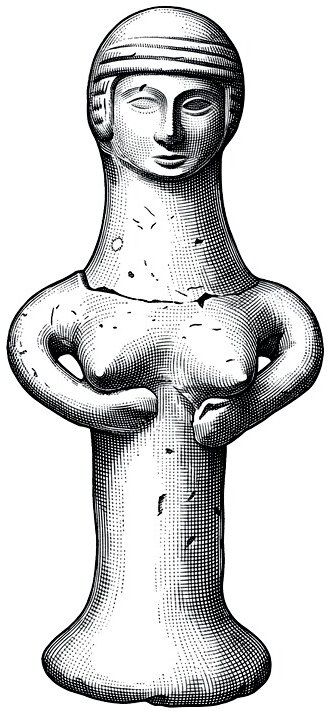
Archaeologist Paolo Matthiae suggested she might match the winged female sphinxes found on Syrian cylinder seals. Lewis counters that the poem describes her in purely human form. The illustration here follows that reading, showing a woman in Bronze Age Syrian dress beside her clay mound.
Function
To understand her cure, one must understand Kirta’s crisis. Kirta had lost his whole family. El guided him in a dream to win a new wife, Lady Hurriya, who bore him heirs. On his journey, Kirta promised costly gifts at a shrine of the goddess Asherah—and then failed to pay.
His wasting illness is widely read as divine punishment for this broken vow. As the king withers, drought and famine grip his land.
Her name says what she is for. Lewis translates it as “she who causes evil to pass away” or “she who causes illness to pass away”. He connects it to a verb in Akkadian, the language of Babylonia, that Mesopotamian texts use for averting evil, disease and misfortune. Coogan and Smith simply translate the name as Expeller.
El sends her with a spoken command: “Death, be broken! Expeller, be strong!” Shatiqatu enters the deepest room of the palace. Using a wand or staff, she unties a knot representing the disease lodged in Kirta’s head. Loosening the knot lifts the sickness.
She washes the sweat of fever from his body and restores his appetite. The poem declares El’s formula fulfilled: Death is broken, and Shatiqatu is strong. Many scholars read “Death” here as the god Mot himself.
Cross-Cultural Connections
Shaping beings from pinched clay is an ancient motif. In the Epic of Gilgamesh, the goddess Aruru pinches clay to create the wild man Enkidu. Translators rely on that parallel to reconstruct the broken lines in Kirta: El’s pinched clay almost certainly produces Shatiqatu.
She also reflects Mesopotamian protective magic, where practitioners shaped figurines to repel evil. At Ugarit, El acted as the divine patron of this healing craft.
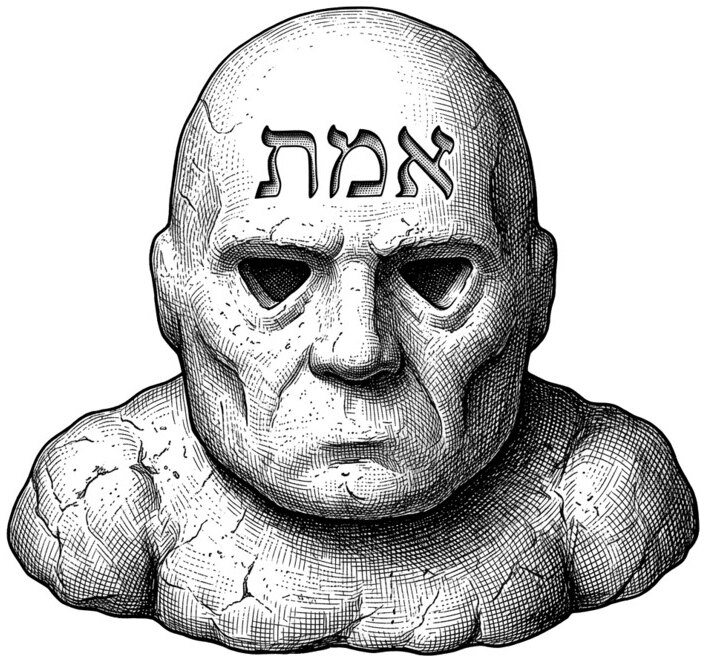
The most striking parallel reaches forward to the Golem, the clay figure animated to protect a community. Scholars Edward Greenstein and Tawny Holm compare Shatiqatu directly to this tradition. Both are shaped from soil for a single protective mission, though Shatiqatu acts with divine independence rather than under human commands.
Her exact nature remains debated. Most scholars classify her as a minor goddess or an apotropaic spirit—a being made to drive away harm. Scholar Baruch Margalit argued the episode was a satire: an over-complicated god building an artificial deity for work an ordinary exorcist could handle. Other specialists reject the parody theory, seeing the scene as proof of El’s supreme creative power.
Modern Survival
No offering list from Ugarit mentions her, and no temple or prayer for her is known. Lewis considers it possible that she was never worshipped and was invented by the authors of the poem for this one story. Between the fall of Ugarit and the excavations that began in 1929 she survived only in the clay of the third Kirta tablet. Today she lives in translations, in two long articles by Lewis, and under three or four spellings, which is why the same healer is called Sha’taqat in Ginsberg’s English, Shataqat in Coogan and Smith, and Shatiqatu in most recent work.
The poem shows the cure working at once. As soon as Death is broken, Kirta raises his voice and calls to his wife: “Listen, Lady Hurriya: slaughter a lamb so that I may eat, some mutton for my meal.” Hurriya does so, and the king eats. One day passes, and on the second Kirta goes back to his throne room and sits down on the royal throne.