In 2019 archaeologists in Egypt found pieces of a life-size statue at an ancient Red Sea harbour. The statue was dressed in the crown and beaded kilt of Osiris, the Egyptian god of the dead. Yet it was identified as Sebiumeker, a little-known god from the neighbouring kingdom of Kush in modern Sudan.
The carving stood at a temple gate built under the Roman emperor Tiberius. Its mix of Egyptian regalia and a foreign deity reopened an old puzzle about who Sebiumeker really was.
Kush lay south of Egypt along the middle Nile. From about 300 BCE to 350 CE, its capital was Meroe. In temples there, colossal statues of Sebiumeker guarded entrances, paired with the hunter god Arensnuphis across the doorway. At the Red Sea harbour, his partner was instead the goddess Isis.
That statue raises two questions. What did Sebiumeker mean to his worshippers? And why do his carvings borrow so heavily from Egyptian gods like Osiris and the sun god Atum?
Appearance
Sebiumeker first appears at Musawwarat es-Sufra, a royal and religious centre in the Butana plain of central Sudan. There King Arnakhamani, who ruled around 235 to 218 BCE, built a temple for Apedemak, the lion-headed god of Kush, now called the Lion Temple. Its outer walls are carved with scenes of the king standing before rows of gods, and on the back wall he stands before Apedemak and Sebiumeker. According to the Berlin archaeologists who excavated and rebuilt the temple, it is the oldest place where Sebiumeker is shown.
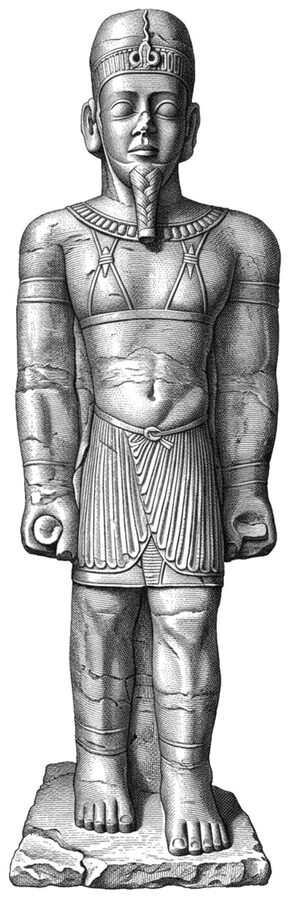
In these carvings Sebiumeker is an ordinary man in shape, without an animal head. The archaeologist Angelika Lohwasser describes his dress in her survey of the gods of Meroe. He wears the Double Crown, the tall crown of Egyptian pharaohs, encircled by a distinctive wreath. He also wears a short kilt and a bead collar. In his hands he holds the ankh, the looped cross for life, and a long sceptre of power. Kushite sculptors showed him with bare shoulders and fists clenched against his thighs.
His name comes from the Meroitic language. The ending mk is the local word for “god”, combined with an ancient stem read as sbe or sbo. Unlike gods adopted from Egypt, Sebiumeker originated in Kush itself.
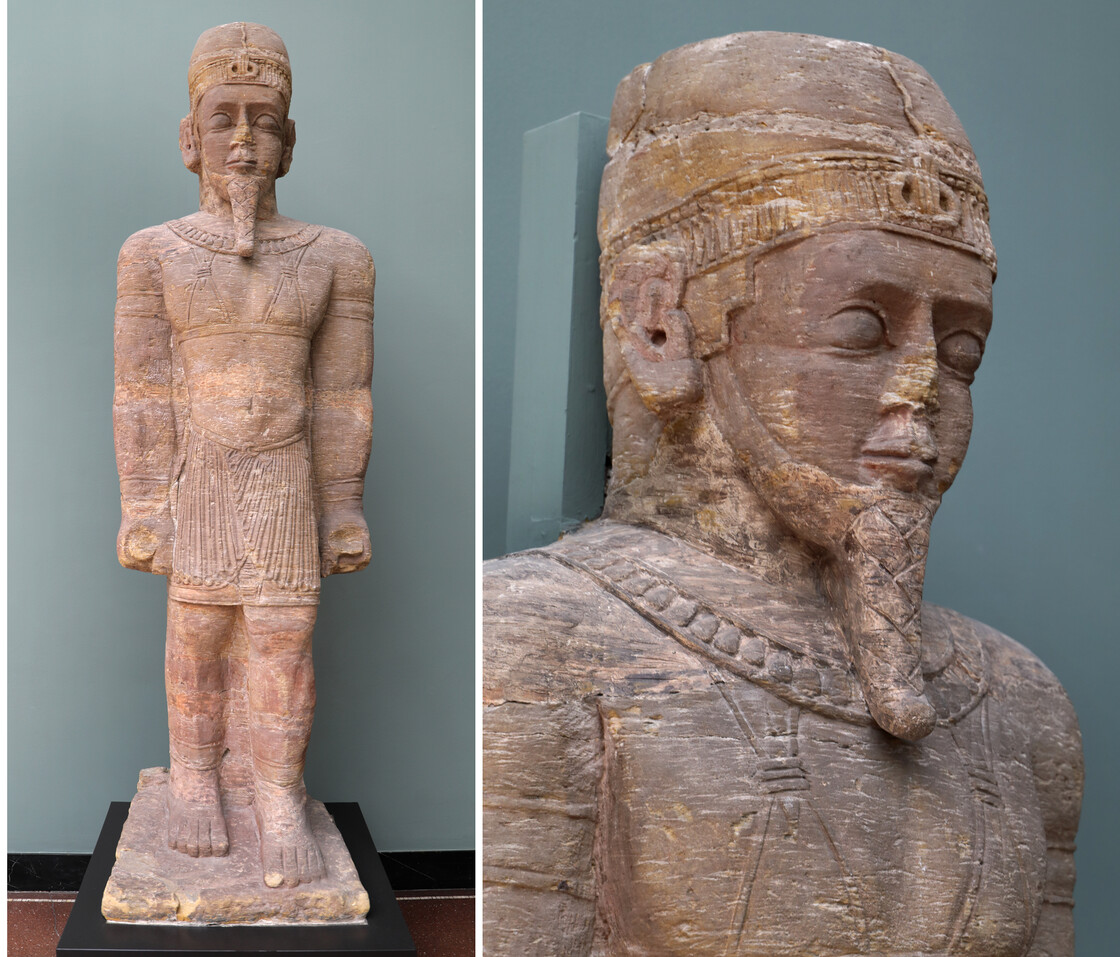
The best-known statue of the god was at first taken for someone else. In the early twentieth century, excavators at Meroe found the broken pieces of two colossal statues reused in a column base. They first mistook them for a king and queen. Later research identified them as the twin guardian gods, Sebiumeker and Arensnuphis.
Today Sebiumeker stands in the Ny Carlsberg Glyptotek in Copenhagen, while Arensnuphis is in the National Museum of Scotland in Edinburgh. Scholars date the pair between the late first century BCE and the first century CE.
Function
Sebiumeker’s best-known task was guarding temple doors. Lohwasser counts about half a dozen places where he and Arensnuphis appear as a pair, at Musawwarat, at the town of Naqa and at Meroe itself, as statues beside entrances or as carvings at doors. Archaeologists read the pair as a division of sacred space. Sebiumeker protected the left half of the temple, while Arensnuphis guarded the right. Arensnuphis wore a long robe and a tall four-feather crown, acting as a god of hunting and protection.
Török also suggests why such statues stood at the door. He found no evidence that the two gods had temples or priests of their own in the south of the kingdom, but they were placed again and again as giant guardians in front of the temples of other gods. In his reading, the pair took over the place that colossal statues of kings had once held in the religion of ordinary people.
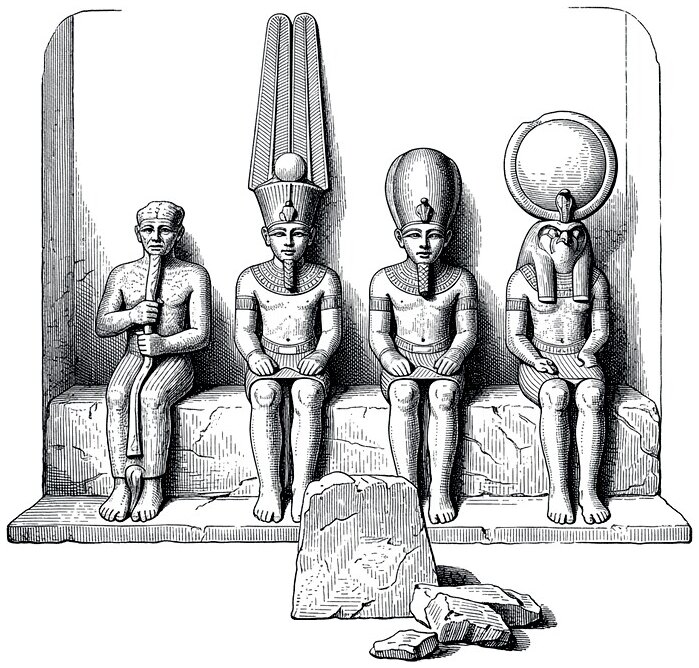
The gods at the door also helped make a king. At the Lion Temple, King Arnakhamani receives his coronation robes from four deities: Amun, Apedemak, Arensnuphis and Sebiumeker. Hieroglyphs carved beside Sebiumeker state his blessing: “I give you the lifetime of Re in heaven” and “the years of the sun, the months of the moon in joy.” Re, or Ra, was Egypt’s premier sun god.
He may also have had a small temple of his own. Wenig identified a small building at Musawwarat, numbered IIA, as a temple of Sebiumeker, although Török marks the identification with a question mark. Lohwasser notes that in this building Sebiumeker is shown with a goddess who appears nowhere else, and she takes her to be a goddess of Kush like him.
Cross-Cultural Connections
Scholars have tried to understand Sebiumeker through the Egyptian gods he resembles, and they do not agree. The first comparison is with Atum. Sebiumeker’s gear closely mirrors Atum, the Egyptian creator god of Heliopolis who personified the setting sun. Both carry the ankh and sceptre and wear the Double Crown. Based on these symbols and his solar hymns, scholars often describe Sebiumeker as a creator god.
Yet language experts caution against seeing him merely as an Egyptian import. Though his artists borrowed Egyptian crowns and sceptres, his core identity remained Kushite.
The second comparison is with Osiris, the Egyptian god of the dead. Lohwasser points out that the Lion Temple gives Sebiumeker a hymn, a song of praise, that Egyptian temples often address to Osiris. In 2005 the Egyptologist Jochen Hallof went further and argued that Sebiumeker was the Kushite counterpart of Osiris, although Kaper notes that this view has not won general acceptance. This argument draws on reliefs from Philae, an island near Egypt’s southern border. In a shrine dedicated to Arensnuphis there, Osiris appears alongside him on equal footing. Where temples in Kush paired Arensnuphis with Sebiumeker, this Egyptian shrine paired him with Osiris.
Török sees a wider pattern behind both readings. In the third century BCE, priests in Kush revived native deities, including Apedemak, Arensnuphis and Sebiumeker. They equipped them with Egyptian crowns and temple hymns, often guided by Egyptian scribes. The exact reasons why particular Nubian gods were matched with specific Egyptian counterparts remain debated.
Modern Survival
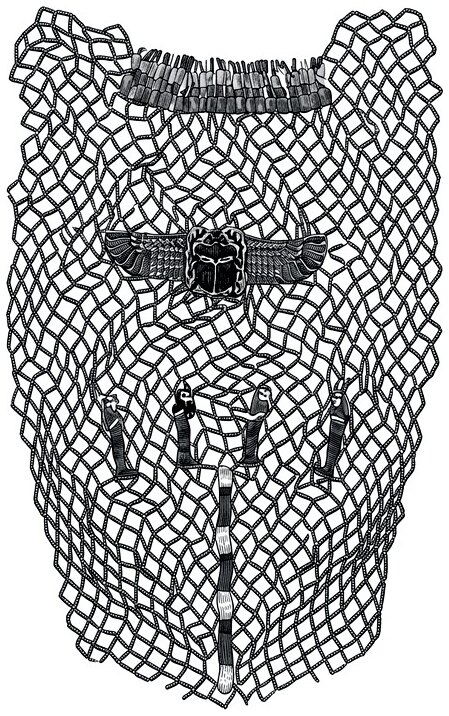
The statue from Berenike is the newest piece of evidence. The Berenike statue wears the atef crown: a tall white helmet flanked by ostrich plumes and fronted by seven cobras. On the torso, the protective Eye of Horus sits flanked by two falcons. The kilt bears a diamond beadwork pattern, mimicking the protective shrouds explored in Faience for the Afterlife.
While every decorative detail points to Osiris, no life-size stone statues of Osiris existed in Roman Egypt. Instead, the posture with bare shoulders and rigid arms at the sides matches Sebiumeker guarding temple portals in Kush.
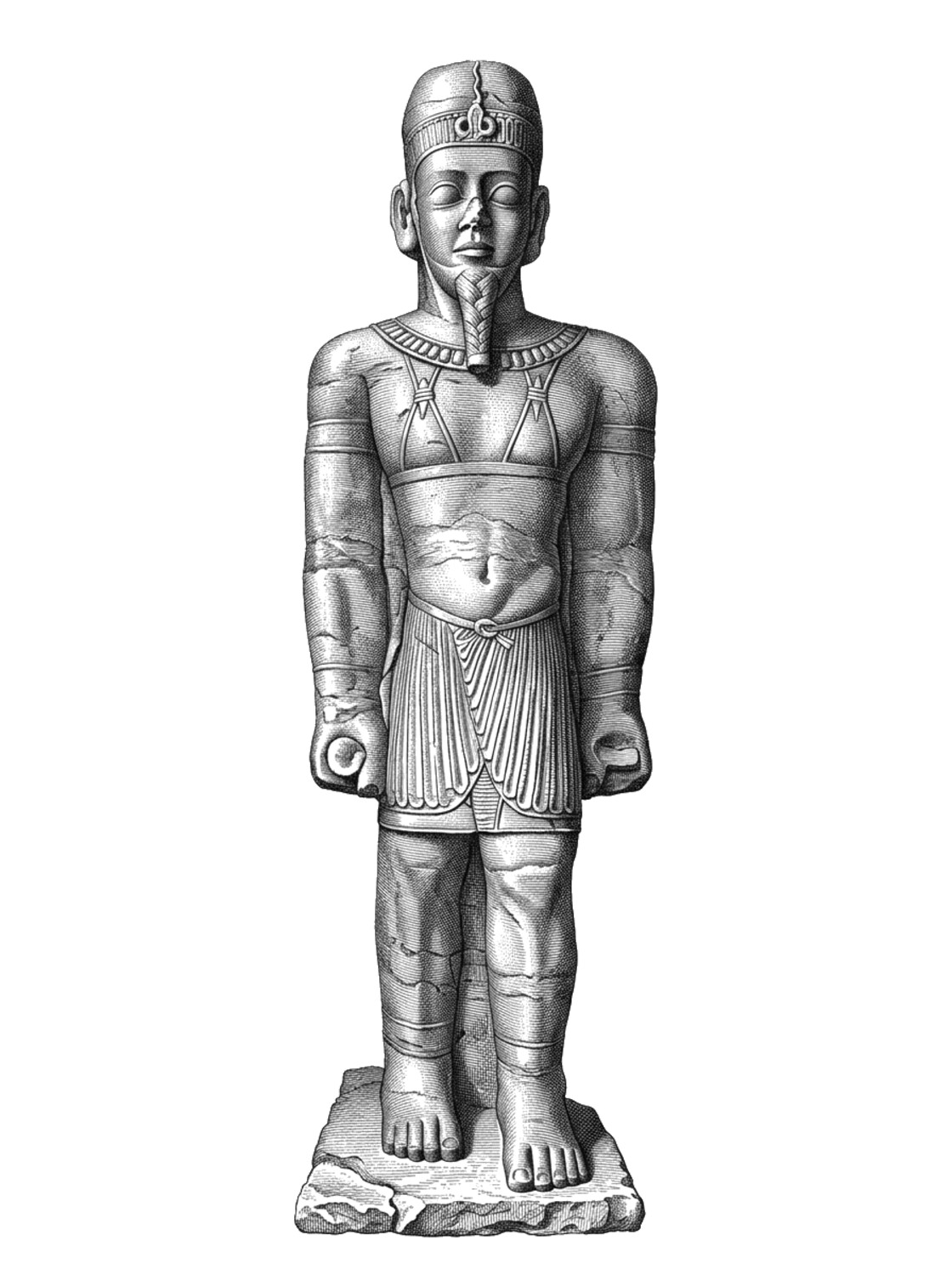
Why would a god of Kush stand in an Egyptian harbour? Kaper’s answer is trade. Berenike was a bustling Red Sea hub handling trade with India. Digs in the temple uncovered an Indian coin, a stone Buddha head and dozens of pottery shards from Nubia. A merchant from Kush likely dedicated the gateway statues to honour Isis.
To travellers from Meroe, the statue represented their guardian Sebiumeker. To local Egyptians, the same figure appeared as Osiris.
Popular reference works describe Sebiumeker in other terms. Wikipedia and the World History Encyclopedia call him a supreme god of procreation and fertility, and Archaeology magazine in 2023 called him “a god of fertility and procreation”. The scholarly studies used for this entry, by Török, Lohwasser and Kaper, do not describe him that way, and we could not find the ancient text behind the claim.
One detail of the Berenike statue still has no explanation: the god stands with his right leg forward. Egyptian and Kushite statues almost always stride forward with the left foot. The Berenike statue appears to place its right leg forward instead, a stance with virtually no known parallels from the New Kingdom onward. The lower legs remain missing, leaving the mason’s motive an unresolved riddle.