The Compendium · Symbol.

Razryv-trava

The Slavic Herb That Breaks Iron and Locks

Razryv-trava is the herb of Russian and Ukrainian folk belief that makes locks, fetters and iron fly apart at a touch. The folklorist Alexander Afanasyev recorded in 1868 how to find it: mow wild ground on the night before St John's Day until your scythe snaps, then throw the cut grass into a river and take the one stalk that swims against the current.

Razryv-trava

Razryv-trava is a magic plant of Slavic legend that shatters iron and unlocks any gate. The surprise is how seekers tried to harvest it. An old Russian recipe tells you to mow wild ground at midnight with an iron scythe until the blade snaps on the herb’s stem. You throw every cut stalk into a river, and the true plant swims against the current. Folklorist Alexander Afanasyev recorded this midnight test in 1868.

The name means “the bursting herb” (razryv rupture, trava grass). It belongs to the midsummer feast of Ivan Kupala on 24 June, when all plants supposedly reached peak power. Vladimir Dal defined it in 1882 as a fairy-tale herb that shatters locks and yields buried treasure. Dal also preserved the scythe test as a proverb: “On whichever grass the scythe breaks on St John’s night, that is razryv-trava.” Another account says seekers gathered it by day, watching for the one stalk that stayed afloat.

Appearance

In the stories the herb is hard to see and harder to find. Legends describe the herb with cross-shaped leaves and a flower of fire. This fiery blossom opens at midnight on Kupala and lasts only five minutes. Dal measured its bloom in prayers: it fades in the time it takes to recite three prayers. Devils were said to haunt the secret spots and take the life of anyone who reached it.

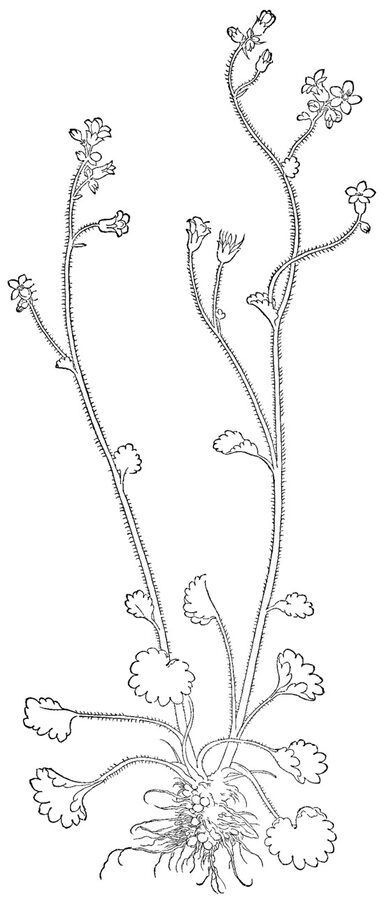
Dictionaries tied the name to real plants. Dal listed razryv-trava as saxifrage (Saxifraga, literally rock-splitting perennial), matching another folk name, lomi-kamen or “break-stone”. Dal also applied the name to touch-me-not (Impatiens), whose seed pods burst open when touched.

The woodcut above shows the saxifrage from Leonhart Fuchs’s herbal of 1542, labelled Saxifraga maior seu alba. Dictionaries linked the myth to this humble plant. The legendary herb, with fiery blossoms and explosive force, remains entirely in folk belief.

Function

The herb shatters whatever holds things shut. Locks fall apart at its touch, and threw into a forge, it prevents a smith from welding iron. Folklorist Apollon Korinfsky wrote in 1901 that iron, steel, gold, silver, and copper burst into pieces before it.

Prisoners spoke of it as a way to cut through iron grilles without a saw. Treasure seekers begged village wizards for stalks to open sealed vaults. Obtaining it required holding one of two other midnight plants: the glowing fern flower or the demon-taming root of plakun-trava (purple loosestrife). Thieves had a darker practice: they sliced open a finger, tucked the herb inside, and let the flesh heal. A mere tap of that finger snapped any padlock, though a touch against living flesh was said to kill on the spot.

One historical outlaw supposedly carried it. Semyon Garkusha, born around 1739 in the Polesia borderlands, plundered rich landowners and escaped prison repeatedly. Legend claimed bullets glanced off him because he carried razryv-trava. His luck ended in 1783 when a baker informed on him. Sentenced to 280 lashes and lifetime labour, he vanished from records, proving the plant could not break every chain.

A second way to gather the herb relied on birds. You plugged a woodpecker’s nest hole with iron. Seeking to free its brood, the bird fetched razryv-trava to spring the plug, dropping it onto linen waiting below. The motif is ancient. In the first century, Pliny the Elder noted that shepherds wedged woodpecker holes shut, only for the birds to dislodge the wedge with a magic root.

Cross-Cultural Connections

The herb carried names across Europe. Serbs called it raskovnik (unforging herb), while Germans knew it as Springwurzel (spring-root). In an 1849 grimoire attributed to Doctor Faust, the spirit Dirachiel offers spring-root alongside seeds that grant invisibility.

Jacob Grimm recorded the German variant: when a bung blocked a woodpecker’s nest, the bird returned with a root that blasted the wood free like a cannon shot. Grimm suspected the real root was caper spurge (Euphorbia lathyris). In Italian lore this spurge was called sferracavallo because a horse stepping on it supposedly shed its shoe.

In a footnote Grimm set beside the woodpecker story a rabbinic legend about the shamir, a thing that could split rock, which King Solomon wanted for cutting the stone of his buildings. Solomon had a bird’s nest with chicks in it covered with crystal, the bird fetched the shamir to break through, and when Solomon’s messenger shouted, the startled bird dropped it and the messenger took it away.

Afanasyev interpreted these tales as solar myth. He saw the plant as the flower of Perun, the thunder god whose lightning splits rock. In his view, the blocked nest was winter’s frozen cloud, while the woodpecker’s herb was the lightning that shattered the sky. For Afanasyev, myth came first, and seekers only later tried to match it to real weeds.

Other writers were sceptical. Sergei Maximov noted in 1903 that because the bloom vanished during three short prayers, it was simply a fairy-tale excuse for empty hands. Folklore leaves open whether people embellished real exploding seed pods or invented the miraculous key out of thin air.

Modern Survival

The herb stayed in Russian literature after the folklorists. The writer Pavel Zasodimsky published a literary fairy tale called Razryv-trava in 1895, and the poet Ivan Morozov gave the same title to a book of poems in 1914. On 11 June 1917, between the February revolution that ended the rule of the tsar and the October revolution of the Bolsheviks, Marina Tsvetaeva wrote a short poem about her country that ends with the herb:

And through the villages, the willows, the trees, and weeping-herb, and bursting-herb… You will not carry the Russian burden. Move along, good sir!
The Sources

Every statement in this entry rests on these.

  • Afanas’ev, Aleksandr N. Poeticheskie vozzreniia slavian na prirodu (The Poetic Views of the Slavs on Nature), vol. II. Moscow, 1868, pp. 396-399 (Internet Archive poeticheskievozzrenijaslavjannaprirodut64)
  • Dal’, Vladimir I. Tolkovyi slovar’ zhivogo velikorusskogo iazyka (Explanatory Dictionary of the Living Great Russian Language), 2nd ed., vols. III-IV. St Petersburg and Moscow, 1882, entries ‘razryvat’’, ’trava’, ‘prygat’’ and ’lomat’’ (Russian Wikisource)
  • Korinfskii, Apollon A. Narodnaia Rus’: Kruglyi god skazanii, poverii, obychaev i poslovits russkogo naroda (Folk Russia). Moscow, 1901, chapters ‘Ivan Kupala’ (p. 311) and ‘Zlye i dobrye travy’ (pp. 625-627) (Russian Wikisource)
  • Maksimov, Sergei V. Nechistaia, nevedomaia i krestnaia sila (The Unclean, the Unknown and the Holy Force). St Petersburg, 1903, chapter ‘Klady’ (Treasures), pp. 168-169 (Russian Wikisource)
  • Aleksandrovich, E. ‘Garkusha, Semen’, in Russkii biograficheskii slovar’, vol. 4 (Gaag - Gerbel’). St Petersburg, 1914, pp. 234-235 (Russian Wikisource)
  • Alexinsky, G. ‘Slavonic Mythology’, in New Larousse Encyclopedia of Mythology, trans. Richard Aldington and Delano Ames. London: Hamlyn, 1959, new edition 1968, section on Kupala
  • Pliny the Elder, Natural History, book 10, chapter 20 (modern numbering 10.40), trans. John Bostock and H. T. Riley. London: Taylor and Francis, 1855 (Perseus Digital Library)
  • Grimm, Jacob. Teutonic Mythology, trans. James Steven Stallybrass, vol. III. London: George Bell, 1883, pp. 973-974 (Internet Archive teutonicmytholog03grim_0)
  • Tsvetaeva, Marina. ‘A tsarit nad nashei storonoi…’ (poem dated 11 June 1917), in Stikhotvoreniia 1917 goda (Russian Wikisource)
  • Fuchs, Leonhart. De historia stirpium commentarii insignes. Basel, 1542, p. 747, ‘Saxifraga maior seu alba / Hoher Steinbrech’ (Biodiversity Heritage Library, doi:10.5962/bhl.title.63882)

Protections

  • Dal records that razryv-trava thrown into a smithy stops the smith's work, and Afanasyev adds that no smith can then weld or forge iron
  • According to Afanasyev, a thief's finger with the herb healed into it opens any lock, and it kills a person it touches
  • Korinfsky writes that nobody gets the herb without first holding the fern flower or a root of plakun-trava dug up with bare hands
  • Dal says its bloom lasts only as long as it takes to say the Lord's Prayer, the prayer to the Mother of God and the Creed

Pass this entry on: Pinterest · Facebook · by Letter · Copy the Address


Questions from Readers

I. What is razryv-trava?

Razryv-trava (Russian разрыв-трава, ’the bursting herb’) is a magic plant of East Slavic folk belief. Vladimir Dal’s dictionary of 1882 calls it a fairy-tale herb before which locks and bolts fall apart and treasures give themselves up. According to Afanasyev (1868) and Korinfsky (1901), its touch breaks iron, steel, gold, silver and copper, and thrown into a smithy it stops the smith from forging. It was sought on the night of Ivan Kupala, the feast of St John on 24 June.

II. How do you find razryv-trava?

Afanasyev recorded two methods in 1868. In the first, you mow wild ground at midnight before St John’s Day until the iron scythe breaks, gather all the grass cut at that spot and throw it into a stream: ordinary grass floats downstream, razryv-trava swims against the current. In the second, you block the hole of a woodpecker’s nest with iron or a nail and spread linen underneath, and the bird brings the herb to open its nest. The New Larousse Encyclopedia of Mythology gives a variant in which the herb is gathered by day and is the stalk that floats on the surface.

III. Is razryv-trava the same as raskovnik?

They are close relatives. Afanasyev lists raskovnik as the Serbian name of the same lock-breaking herb, from the verb raskovati, and Springwurzel (spring-root) as the German one. The South Slavic raskovnik has its own lore, so the Russian razryv-trava of Dal, Afanasyev and Korinfsky and the Serbian or Bulgarian raskovnik are best read as neighbouring versions of one belief.

IV. What real plant is razryv-trava?

There is no single answer. Dal and the Larousse identify it with saxifrage (Saxifraga), whose Latin name means stone-breaker, and Dal records lomi-kamen, ‘break-stone’, as another folk name. Dal also gives the name razryv to the touch-me-not, Impatiens. Jacob Grimm thought the German spring-root was caper spurge, Euphorbia lathyris. Afanasyev held that the herb was first a creation of the imagination and that people only later looked for it among real plants.

V. Is razryv-trava real?

The plants that carry the name are real, while the lock-breaking herb itself is known only from stories and beliefs. Sergei Maximov wrote in 1903 that because its bloom lasts only as long as three prayers, there was good reason to call it simply a fairy-tale herb. Afanasyev read it as an old poetic image of lightning. The belief itself is well documented: people told of it in prisons, treasure seekers asked village wizards for it, and the outlaw Semyon Garkusha was said to own it.

From Our Workshop


Further Reading in Our Pages

The Fern Flower The Mandrake Under the Gallows

Back to the Compendium ☞