In chemistry, precipitation is what happens when a solid suddenly forms inside a liquid and settles out of it. In the 1880s a small circle of people in British India used the same word for something stranger: letters, and sometimes pictures, that appeared on paper without anyone holding a pen. They believed these letters came from men they never met, teachers living somewhere in Tibet. To them, precipitation meant that a writer composed a letter in thought, and the words then appeared in ink or pencil somewhere else with no hand holding a pen.
Because every letter was physical handwriting on paper, skeptics could inspect it under a lens. That made precipitation one of the most closely tested occult claims of the Victorian age.
The man who received the letters was A. P. Sinnett, the editor of The Pioneer, an English-language daily paper published at Allahabad in northern India, today’s Prayagraj. They came to him through Helena Blavatsky, a Russian-born writer who had founded the Theosophical Society in New York in 1875. The Society taught that wise men lived hidden in the East and had mastered unseen mental forces. Blavatsky called these teachers the Masters, or Mahatmas, a Sanskrit word meaning “great souls”. Sinnett glossed their pupils as chelas. Starting in 1880, Sinnett sent letters to two of them, named Koot Hoomi and Morya.
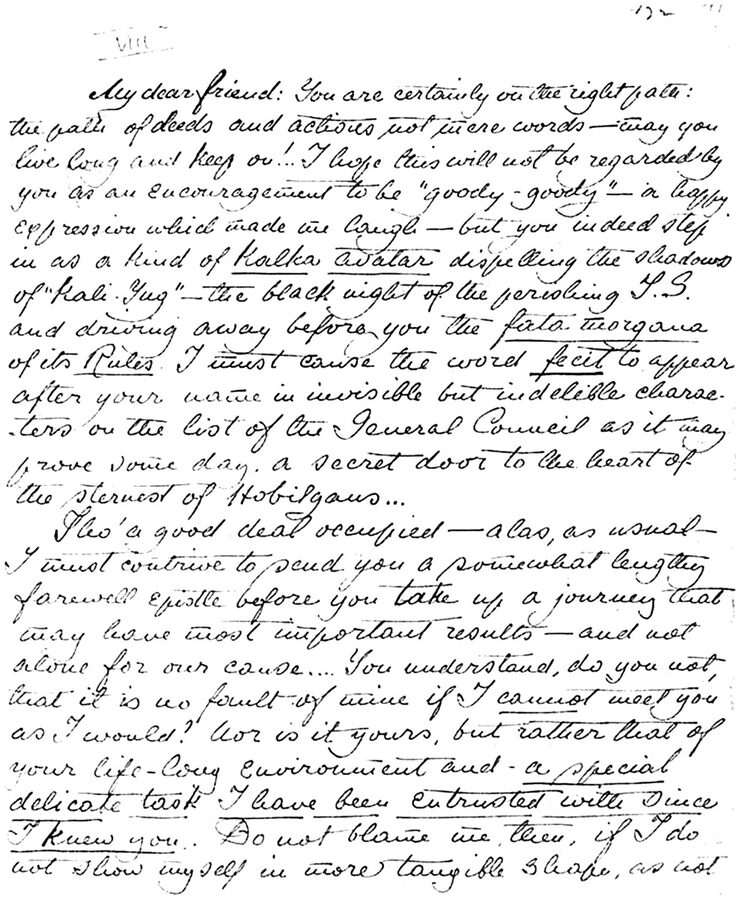
He handed his letters to Blavatsky, and the replies arrived through her or appeared in locked drawers. In 1881 he published long extracts in The Occult World. The original sheets survive today in London. The image at the top of this page shows the opening page of one such letter, received in February 1881.
Appearance
The Koot Hoomi letters are written in a fluent, slanting hand that Sinnett learned to recognise, in ink on ordinary paper, with words underlined for emphasis. The letters from Morya came in a quite different hand, usually in red ink. Some of the most puzzling pages were written in blue pencil.
Sinnett described one of those blue-pencil messages in The Occult World. A friend of his had written a long letter to Koot Hoomi and sent it to Sinnett, asking him to read it, seal it and pass it on through Blavatsky, who was then staying at his house in Allahabad. Sinnett gummed and sealed the stout envelope himself and gave it to her. When he came home to dinner a few hours later, she told him what had happened in the meantime. Koot Hoomi, she said, had already taken the letter from her “by his own methods” and read it, and then it had come back. She had been talking to a visitor while holding a blue pencil. Suddenly she noticed that the paper under her hand was the returned envelope. Across it she had written without noticing: “Read and returned with thanks, and a few commentaries. Please open.”
Sinnett examined the envelope and found his wax seal intact. Inside lay his friend’s letter, along with an answer from Koot Hoomi that used pencil numbers to comment on each paragraph.
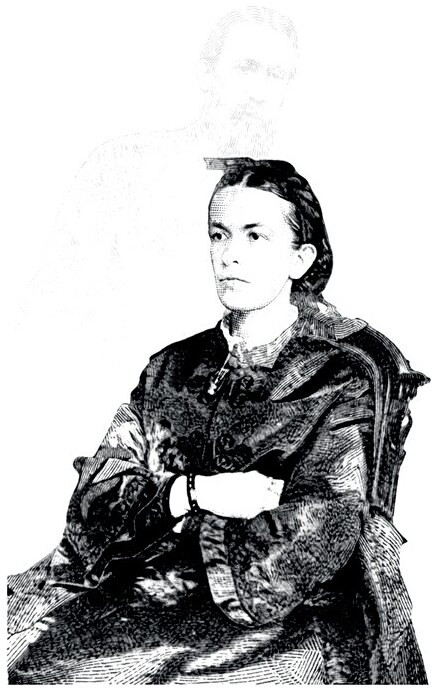
Precipitation could make pictures as well as words. Sinnett had long hoped for a portrait of Koot Hoomi, and on one visit Blavatsky asked him for a piece of thick white paper, which he marked so that he would know it again. She left it in her scrapbook on the drawing-room table, where it stayed blank through a day, a night and the next morning, when Sinnett’s wife looked and saw nothing on it. After breakfast they opened the scrapbook and found a profile of a face on the marked sheet. The face itself was left white, with only a few touches inside it, and all the paper around it was covered in cloudy blue shading. Blavatsky told him that an adept with no artistic training could still make such a picture by “realizing very clearly in his imagination the result he wishes to produce, and then precipitating the colouring matter” to match it.
Function
Sinnett naturally asked how it was done, and he warned his readers that the answer would be thin. The forces the adepts used, he wrote, were of a kind ordinary science knew little about, and some of the methods were secrets of initiation that an occultist must not reveal. So nobody in his book says what happens at the moment the ink arrives on the paper, and what he could print were the comparisons Koot Hoomi gave him. In one letter Koot Hoomi told him to remember that “these my letters are not written, but impressed, or precipitated, and then all mistakes corrected.” Sinnett wrote back to ask whether precipitation went faster than ordinary writing. Koot Hoomi answered that it saved hardly any time at all, because he still had to read every word Sinnett sent him and still had to compose his reply:
I have to think it over, to photograph every word and sentence carefully in my brain, before it can be repeated by precipitation.
He explained the comparison. First, a photographer must bring the sitter into focus before coating the glass plate. If focus fails, the legs appear huge and the head tiny. In the same way, Koot Hoomi wrote, the adept had to fix every letter in his own thoughts before letting it show on paper.
He could say little more, he added. When science learned how fossil leaves left their prints in stone, he could explain the rest. “We but follow and servilely copy Nature in her works,” he added.
Lithophyl meant a leaf print in stone, built from the Greek words for rock and foliage. Noah Webster’s 1828 dictionary defined it simply as fossil leaves. Because such leaf shapes settled into stone without tools, Koot Hoomi used the word as an image for writing that landed on paper untouched.
For Sinnett, the point of precipitation was proof. The adepts’ powers could not yet be explained from first principles, he wrote, so their existence could only be established by piling up evidence, and a letter inside an envelope he had sealed himself was evidence he could check. He told a second envelope story to answer the obvious objection that Blavatsky had simply opened the first one, the way mediums who answered sealed letters were said to do. He wrote a note to Koot Hoomi, closed it in an ordinary gummed envelope and gave it to her. She stepped into her room for less than thirty seconds, came out saying that “he”, meaning Koot Hoomi, had already taken it, followed Sinnett to his office and lay down on a couch. About ten minutes later she got up and pointed to the pillow under her head, and there lay his envelope, still closed, with Koot Hoomi’s name crossed out and Sinnett’s written over it. Inside, on the blank back page of his own note, was the answer in Koot Hoomi’s hand. Sinnett called this as complete a mechanical proof “as any conceivable test could have yielded”, and pledged his word that he had described it exactly.
The letter that quoted a Spiritualist
The claim was tested in public in 1883. On 1 September of that year the London Spiritualist weekly Light printed a letter from Henry Kiddle of New York, an educator who had become a Spiritualist. Spiritualism, the movement from which Theosophy had split, held that the dead speak to the living through mediums, people who sat with others at séances and passed on what the spirits were said to say. Kiddle read The Occult World and had a shock. In one of Koot Hoomi’s letters he found lines lifted word for word from his own lecture at Lake Pleasant in August 1880. A Spiritualist paper had published that speech a year before Sinnett’s book appeared. The shared lines included the old saying that ideas rule the world. Kiddle said he had sent Sinnett the printed pages with the borrowed part marked and had received no answer, and he asked whether Koot Hoomi was a myth.
Koot Hoomi’s explanation came to Sinnett in a private letter written in December 1883, which Sinnett was told to share only with a few trusted friends. It is printed today as Letter No. 93 in The Mahatma Letters, and it is the fullest account of precipitation he ever gave. He had composed the letter, he wrote, “while on a journey and on horseback”, after a ride of forty-eight hours, half asleep. He sent it in thought to one of his pupils, “a young chela not yet expert” at precipitating, who “had to transcribe it from the hardly visible imprint” that reached him. So half of it was left out and the rest more or less distorted. When the pupil asked whether his master wanted to check it, Koot Hoomi answered, by his own account, “anyhow will do, my boy”. About two months earlier, he explained, he had turned his attention to the Spiritualists’ summer camp meetings, and lines from Kiddle’s speech had stayed in his memory. He remembered Kiddle’s sentences sharply, so they printed bright and clear. His own commentary around them remained blurred in his tired mind. The young pupil skipped the faint lines, leaving Kiddle’s speech standing alone as Koot Hoomi’s own thought. Koot Hoomi then sent Sinnett what he called the restored text, copied “with my own hand this once”. In it, Kiddle’s lines are introduced as things the Spiritualists were saying, and Koot Hoomi’s objections follow.
The Case Against the Letters
By then the Society for Psychical Research, founded in London in 1882 to investigate claims of telepathy, ghosts and mediums, had set up a committee on the Theosophists’ wonders, and it named precipitation as one of them: “what is called ‘precipitation’ of handwriting and drawings on previously blank paper”. In 1884 the Society sent a young Cambridge scholar, Richard Hodgson, to India for three months. Its report filled two hundred pages of its Proceedings in December 1885.
The committee took up the Kiddle letter first. It noted that Kiddle had written to Light again in September 1884, showing that the restored text still left out some of the borrowed sentences, and that these came earlier in the letter than the ones Koot Hoomi admitted. “The proof of a deliberate plagiarism aggravated by a fictitious defence,” the committee wrote, “is therefore irresistible.”
Hodgson then went after the handwriting itself. He had examined in India the writing said to have been precipitated by Koot Hoomi, by Morya and by one of their pupils, and he concluded that all of it had been written by hand. In his view the Morya letters were Blavatsky’s, and of the Koot Hoomi letters one was by Damodar K. Mavalankar, a young Indian who worked at the Society’s headquarters near Madras, and the rest were Blavatsky’s. Back in London he checked dozens of letters lent by Sinnett. From them, he argued that Koot Hoomi’s handwriting slowly developed out of Blavatsky’s normal script.
The investigators also consulted an outside expert, the handwriting examiner F. G. Netherclift. Hodgson reported that Netherclift at first concluded that the Koot Hoomi samples sent to him “were not written by Madame Blavatsky”. Hodgson thought this was because the samples were late ones, written after she had had years of practice, so he sent them back together with Sinnett’s series, starting with the earliest letter. Netherclift then decided that all of them “were without doubt written by Madame Blavatsky”.
Cross-Cultural Connections
Sinnett set precipitation against the séance room himself. Spiritualist mediums offered “direct writing”, messages that appeared with no visible writer, and some offered answers to letters sealed in envelopes. In the preface to The Occult World he wrote that he had received direct writing many times “in sealed envelopes of my own”, but that it had been “created or precipitated by a living human correspondent” and owed nothing to the dead. Blavatsky maintained that spirits never returned to rooms. Instead, she blamed the kamarupa, an empty psychic shell cast off after death. Her full argument is told in Why Theosophists Did Not Believe Spirit Messages From the Dead.
Koot Hoomi drew the same line in his Kiddle letter. A pupil with the temperament of a medium, he wrote, could be used by his master as “a sort of psychic printing machine”, but a chela “acts consciously”, while a medium does not. The words he chose for his own work came from the newest machines of the day: the photograph, a “mental telegraphy” between two brains, a printing press. Sinnett had explained the astral bell, the silver note that rang in the air around Blavatsky, in the same way, as a “telegraphic call-bell” between initiates. Victorian Spiritualists had used the telegraph as their picture for talking with the dead long before, the story told in The Spirit Telegraph.
Modern Survival
Most of the letters Sinnett received survive. The executrix of his estate deposited them in what is now the British Library, where they are kept as Additional Manuscripts 45284 to 45286, bound in three heavy volumes. In 1923 A. Trevor Barker published their text as The Mahatma Letters to A. P. Sinnett, and Theosophists still read it as the first teaching of their movement, and still use the word precipitation for the way it was delivered.
In April 1986, the Society’s journal published a rebuttal by Vernon Harrison, a paper and print examiner who had run research for the banknote firm Thomas De La Rue. He later expanded it into a book.
Harrison examined the letters in the British Library under a pocket lens. He found Koot Hoomi’s script fully formed as early as October 1880, with none of the slow evolution Hodgson claimed. He also spotted several distinct hands among the pages, fitting the claim that adepts dictated to pupils. Harrison found no clear proof that Blavatsky penned them, concluding: “I do not know who wrote the Mahatma Letters.” He called Hodgson’s case against her “not proven”, borrowing the third verdict of Scottish courts, which declares neither guilt nor innocence and only says that the charge was not made good.
There was one thing in the volumes that Harrison could not explain. Much of the blue-pencil script had an odd look under magnification. Harrison noticed regular, striped lines like small clouds in a mackerel sky, as if produced by an automated scanner. Attempts to have the inks of the letters tested at a university without damaging them led nowhere, and since then the pages have been strengthened by enclosing them in archival tissue. “To me,” he wrote of the striped blue letters, “the reason for this method of production remains a mystery.”