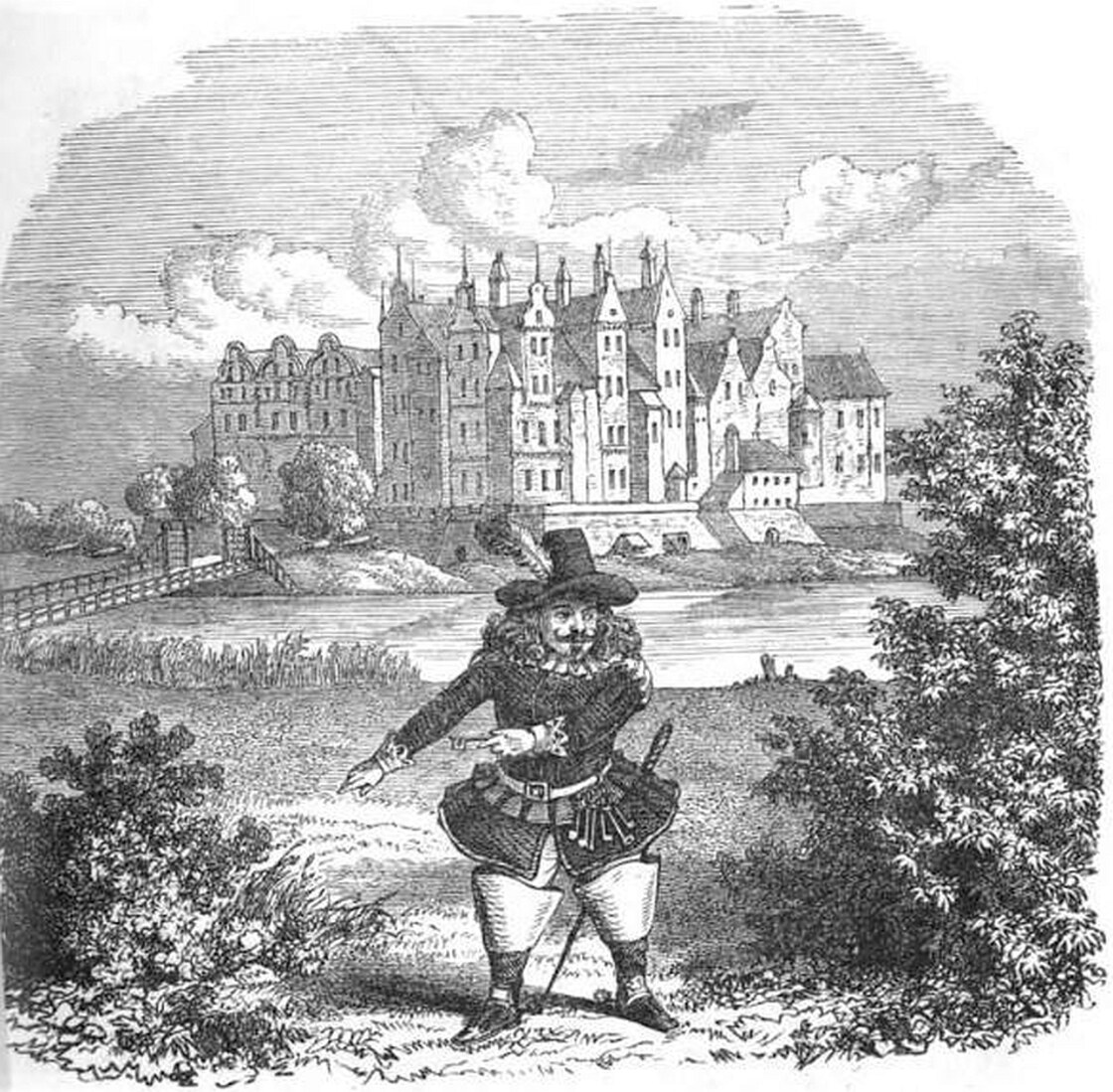
Schwerin Castle in northern Germany is said to have its own house ghost. On 12 November 1747, a local writer recorded what a servant had seen there decades earlier. The footman had grown so used to a little man in the corridors that he held a candle right to its face. The little man stood still and let himself be inspected. One evening, as the footman lit the duke’s way across a dark gallery, the duke shivered. “Daniel, my hair is creeping,” he said. The footman asked, “Don’t you see what company we have?” The duke told him to be quiet and insisted that he saw nothing.
This report is the oldest written record of the Petermännchen, or “Little Peter-Man.” He remains the most famous spirit of Mecklenburg, a coastal region in northern Germany. The castle stands on an island in Lake Schwerin. A 19th-century folklorist later published the 1747 text together with eight popular legends about the spirit.
Appearance
The 1747 report describes an old man. He was tiny, with a wrinkled face, a long white pointed beard, short curly hair and a skullcap. He wore a long black coat down to his feet and broad shoes. He never spoke. One morning before sunrise, servants saw him grab a roasted leg of lamb from their table. He ran off laughing loudly, and the meat was never seen again. When someone cursed him, loud banging shook the ceiling all night.
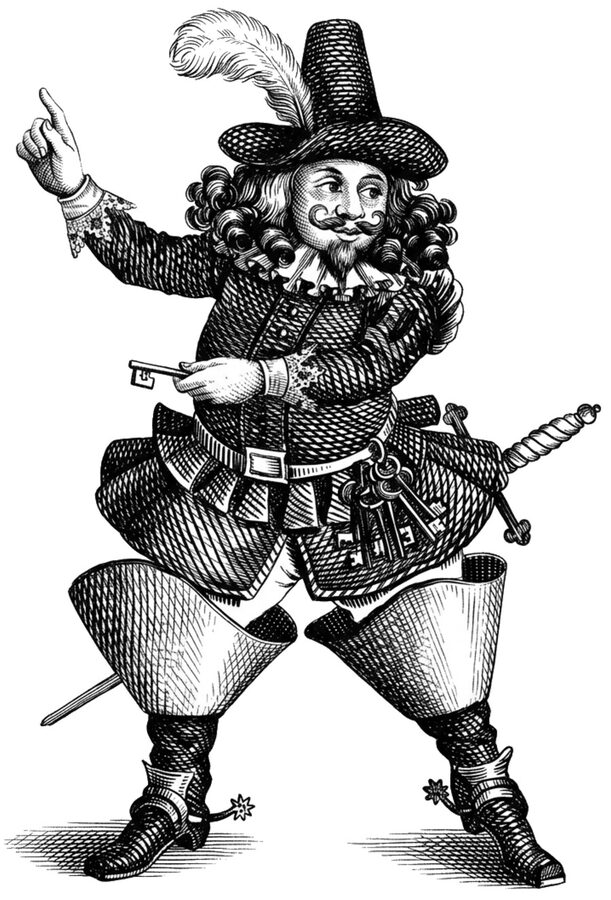
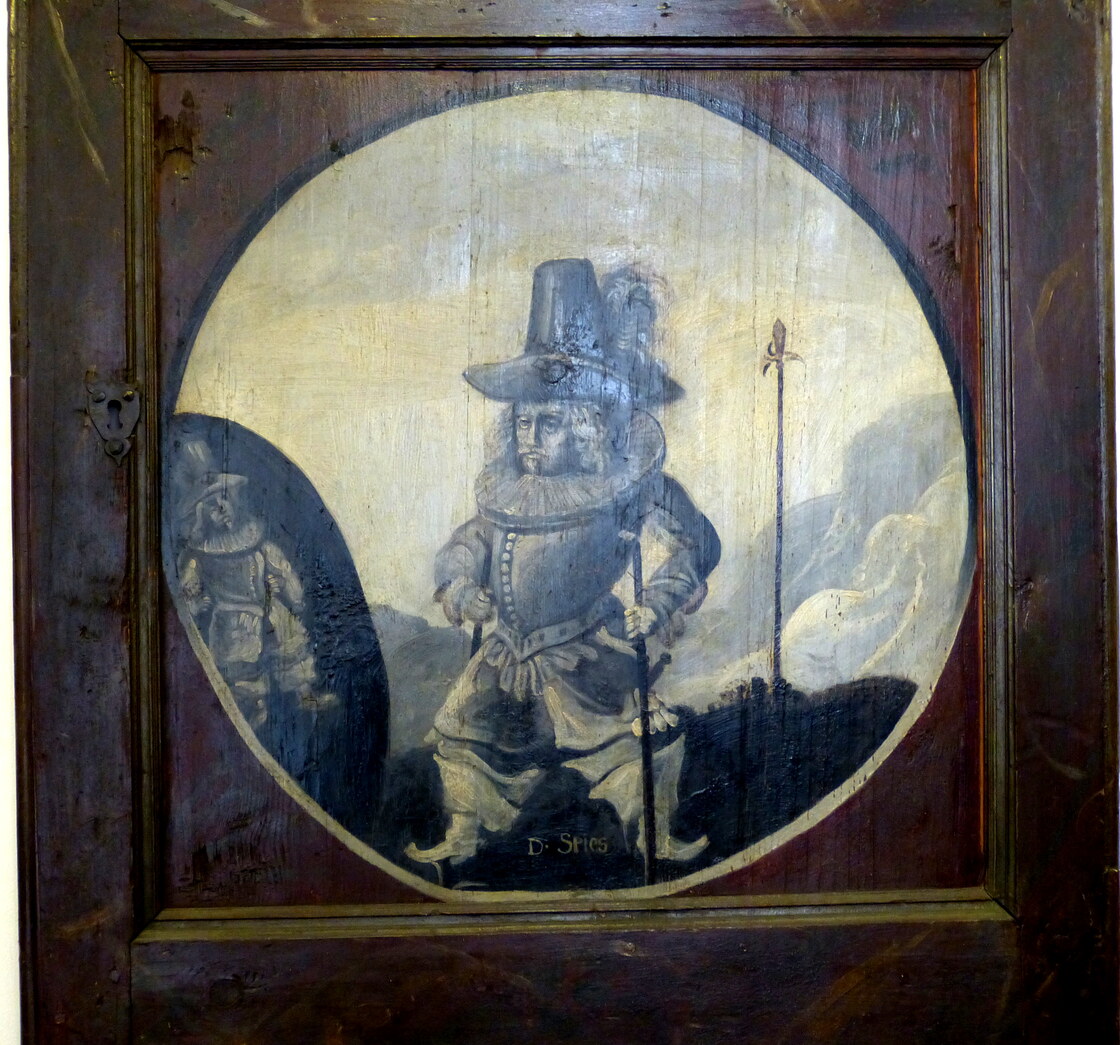
The figure that Schwerin remembers looks different. A painted 17th-century cupboard door in the castle shows a different figure. The little man wears a soldier’s outfit with a pleated neck collar, a tall feathered hat and wide boots, leaning on two staffs. Around 1823, an engraver added a ring of keys at his belt, curled moustaches and a sword. Later tales usually include these keys, a lantern and his weapon.
His clothes also carried a message. In the version that Adalbert Kuhn and Wilhelm Schwartz printed in their Norddeutsche Sagen in 1848, the Petermännchen usually went about in grey, but when a war was coming he dressed in red, and when someone was going to die he wore coal-black. The Mecklenburg archivist Wilhelm Gottlieb Beyer noticed in 1867 that the oldest report already gives him a black coat, while other tellers saw him in white, and he read the colour as a sign of mourning or joy in the castle.
Function
Folktales treat the Petermännchen as a guardian with strict loyalty. He tolerated no rulers except the rightful dukes. In 1628, during the Thirty Years’ War, the imperial commander Wallenstein took the duchy. When he tried to sleep in Schwerin Castle, the ghost pinched and tormented him until he fled to another town. A French general who occupied the castle in 1806 reportedly met the same fate.
He watched the servants as closely as the lords. He watched castle guards closely. Once, a guard admired the ducal treasures on night duty. The little man appeared and urged him to take whatever he liked. The honest guard refused. Pleased by his loyalty, the spirit led him deep underground through locked doors to clean a rusty sword. The soldier polished away almost every spot. As he rubbed the final speck, thunder crashed and he fainted. He awoke at the gate with three heavy bars of solid gold in his pockets.
The other tales follow the same pattern of reward and punishment. Other legends repeat this pattern of reward and revenge. When an innocent servant was jailed for stolen jewels, the spirit brought him food and secretly emptied the real thief’s pockets in public. When a corrupt official locked away a young woman, the ghost knocked him senseless and guided her home with gold. He also woke guards who dozed off on duty, pinching their cheeks just before the inspection rounds arrived.
Mockery was the one thing he did not forgive. Disrespect was dangerous. In the 1747 report, the footman grew irritated with the slow-moving figure on the cellar stairs. “You toad, get out of the way, or I’ll hit you with this bottle,” he snapped. The spirit delivered a slap that knocked him out cold for half an hour. His head stayed swollen for days. Around 1800, a court baker mocked the ghost stories. The next morning, his wife’s locked diamond brooch lay completely disassembled into tiny heaps of pearls and enamel. No jeweler could reassemble it.
One legend calls him an enchanted prince. He asked a night sentry to wrestle him three nights in a row to break the spell. If freed, an ancient sunken city would rise from the lake while modern Schwerin sank beneath the water. The guard wrestled him twice. When a fellow soldier noticed the bruises, the duke heard the story and transferred the guard far away. Another local motif claims the spirit sits under the lake until his beard wraps three times around a stone block.
The omens of 1897 and 1913
The colour code did not stay in the 19th-century books. The city of Schwerin tells that in 1897 a court musician named Karl Meyer saw the Petermännchen dressed in black, standing on the iron bridge between the castle island and the castle garden. Two weeks later, on 22 September 1897, the torpedo boat S 26 capsized in a sudden storm near the mouth of the Elbe, and its commander, the 26-year-old Duke Friedrich Wilhelm of Mecklenburg-Schwerin, a son of Grand Duke Friedrich Franz II, drowned with part of his crew. In December 1913 a fire destroyed a large part of the castle, including its Golden Hall, and according to the same city account one of the young princesses later said she had seen the little man moving through the flames in red. Both sightings are known from the city’s own telling, which names no record written at the time.
Cross-Cultural Connections
German folklore knows many household spirits called kobolds. These small beings perform chores but take revenge when insulted. A 19th-century regional historian linked the Petermännchen to Hödeken, the famous castle spirit of Hildesheim recorded by the Brothers Grimm. Hödeken wore a large hat pulled over his face and warned nobles of danger. Like the Schwerin spirit, he guarded sleeping watchmen and punished anyone who mocked him. When a kitchen boy threw dishwater at him, Hödeken killed the boy in his bed.
Local origins remain unclear. Villagers from nearby Pinnow claimed the dwarf once lived in a local hill called Petersberg before moving to the castle. Others tried to connect him to the Puk, an ape-like spirit said to have helped local friars chop timber overnight. Some antiquarians speculated that the ghost descended from pagan Slavic deities displaced during the medieval conquest of the island. None of these theories have written evidence before the 18th century.
The colour code puts the Petermännchen beside other spirits that announce a death to a ruling family. The house ghost of Castello di Collalto in Italy appears in white for a joy and behind a black veil for a disaster. In Ireland the Banshee, a supernatural woman, wails a funeral lament at the door before a death in the family, and in Berlin the White Lady of Berlin Palace, one of the many Women in White of European castles, was said to show herself before deaths among the Hohenzollern, the family that ruled Brandenburg and Prussia. The old German word Schrat, another name for such a household dwarf, travelled into Estonian and South Slavic folklore, where it became the Kratt and the Škratelj.
Modern Survival
The Petermännchen is now part of the castle itself. Around 1856, when the castle was being rebuilt in its present form, the sculptor Heinrich Petters made a statue of him for the façade of the inner courtyard. The village of Pinnow put him on its coat of arms in 2001: a little man with red hair and beard in a blue coat and red riding boots, holding a silver stilt in each hand, probably a reading of the two long staffs on the old cupboard door. In 1979 the passenger ferry across Schwerin’s Pfaffenteich lake was named after him, and since 2023 the pedestrian light in front of the castle has shown his figure in place of the usual little man.