The Romans believed their household gods were refugees. Most ancient deities were tied to a rock, a spring, or a temple. The Penates were different: they moved whenever their family moved. In Roman legend, they crossed the Mediterranean from burning Troy to Italy, carried by the prince Aeneas.
On the night Troy falls, Aeneas dreams of the fallen hero Hector. The ghost stands over his bed, covered in dust and blood. Hector warns him that enemy fighters already hold the walls. Then he hands over what the city cannot save for itself: “Troy entrusts to you her holy things and her Penates. Take them as companions of your fate, and seek great walls for them.”
Later that night the fire reaches the house. Aeneas lifts his old father Anchises onto his shoulders, takes his small son by the hand, and gives his father one more load to carry. “You, father, take the holy things and our ancestors’ Penates in your hand,” he says. “It is wrong for me to touch them, coming from fresh killing, until I wash in running water.” Aeneas carries his father, and the father carries the gods.
Function
The Romans themselves explained the name in two ways. Roman scholars linked the name to penus, the household food store. They also linked it to penitus, meaning “deep inside,” because these spirits guarded the innermost rooms. Ancient writers placed them right beside Vesta, the goddess of the hearth fire.
Their worship happened at the table. Worship centred on the dinner table. After the main course, the dining room fell silent. A portion of the meal was placed into the hearth fire, and an attendant announced that the gods were pleased. In this way, the guardians of the food supply received a share of every family meal.
The Penates are often named in one breath with the Lares, the other Roman household gods, guardian spirits of the house and its land, and both were honoured in the same home. One difference runs through the whole story, though. A Lar belonged to a place, while the Penates belonged to the people who kept them, so when a family moved, its Penates went with it. They were portable gods. While other spirits stayed behind in empty houses, the Penates travelled with the survivors of a ruined city until they built new walls.
Rome had public Penates too, the gods of the whole Roman people, and Roman writers traced them back to the ones Aeneas carried. The town of Lavinium, south of Rome, held their main sanctuary. Whenever Roman magistrates took office, they travelled to Lavinium to offer sacrifice to the Penates and to Vesta together.
The dream on Crete
The Penates do more than travel in the Aeneid. During their voyage, the Trojan refugees landed on Crete, hoping to settle. A sudden plague struck the colony, drying up the crops. Anchises told his son to consult the oracle of Apollo on Delos for guidance.
That night the Penates come to Aeneas themselves. They appeared before Aeneas in his sleep, lit by full moonlight through the window. They spoke for Apollo himself, saving him the journey to the oracle. They remind him that they followed him when Troy burned and crossed the sea under his command, and they promise his descendants an empire. Their message was blunt: Crete was the wrong shore. They ordered him to sail west to Italy, the ancestral homeland of his family line.
Aeneas insists that this was no ordinary dream. Aeneas saw their veiled hair clearly in the moonlight. He woke in a cold sweat, poured wine on the hearth, and went to his father. Anchises realized his mistake: their ancestors came from Italy, not Crete. So they left Crete.
The images that walked back
According to Roman legend, Aeneas first placed the images at Lavinium. His son Ascanius later founded a second town nearby, Alba Longa. He built a new temple there and transferred the statues. That night, the doors remained locked and the roof undamaged, yet the statues vanished. Morning found them back on their original pedestals in Lavinium. The citizens carried them back with sacrifices, but the statues walked back a second time.
The Albans did not want to live apart from their ancestral gods, and they did not want to go back to the town they had left either. The people conceded defeat. They left the images in Lavinium and sent six hundred families back to tend their shrine. Greek observers tried to translate their role, calling them gods of the family line, protectors of property, and guardians of the inner court.
Appearance
What the Penates looked like was partly a secret, because the holy objects in the shrine at Lavinium were hidden from ordinary visitors. One early account claimed the secret objects in Lavinium were bronze messenger staffs and a Trojan clay jar. Later writers scolded anyone who asked. In their view, secret sacred objects were neither to be inspected nor described.
Other images of the Penates stood in public view, and those he described. Other images stood in plain sight. A small, shadowy shrine on the Velia hill near the Roman Forum displayed public statues of the Penates. Visitors saw two seated young men holding spears, carved in an archaic style as armed soldiers.
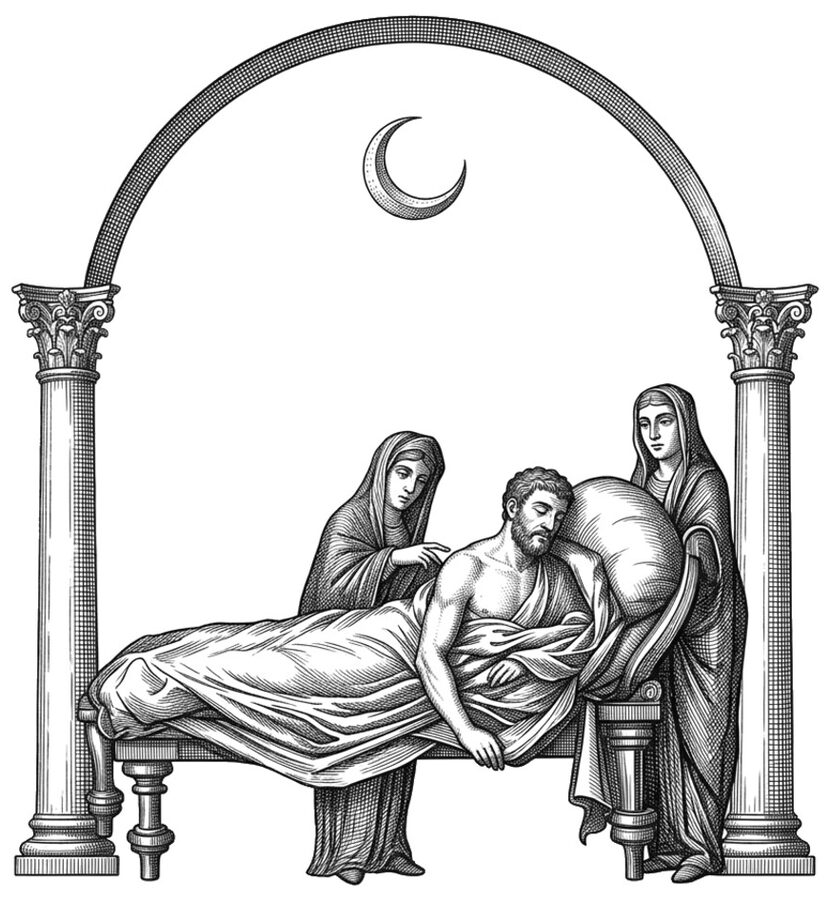
The oldest surviving painting of the Penates is a different picture again. A fourth-century illustrated manuscript of Vergil preserves an early portrait of the dream. Aeneas sleeps on a couch beneath an archway. Two figures in dark mantles with veiled heads stand beside his bed, labelled DI PENATES. The painter followed Vergil’s “veiled hair” closely but gave the night sky a thin crescent, where the poem has a full moon. The ink drawing at the top of this entry was made after that painting.
Who were they?
The Romans themselves did not agree on which gods the Penates actually were, and Macrobius collected their answers. One Roman scholar, Nigidius Figulus, asked whether the Penates of the Trojans were Apollo and Neptune, the two gods said to have built Troy’s walls. Other Roman scholars traced them to the Aegean island of Samothrace, claiming the Trojan kings brought them from there before Aeneas took them to Italy.
Philosophers went further. They argued that the Penates gave humans their breath, body, and rational mind, equating them with Jupiter, Juno, and Minerva. Others identified them with the mystery deities of Samothrace, whose true names were never spoken aloud. Macrobius himself added that Vesta was either one of the Penates or at least their companion.
These conflicting reports never aligned into a single doctrine. Armed youths, bronze wands, and sovereign deities like Apollo and Neptune lived side by side in Roman tradition. What united them was their journey: every account insisted that Aeneas carried them out of Troy.
Cross-Cultural Connections
Inside the Roman house the Penates had neighbours. The hearth they fed belonged to Vesta, and Vesta’s own round temple in the Forum, the city’s public hearth, had an inner store that was also called the penus, opened to women only during her June festival, the Vestalia. The family’s dead belonged to the household as well, but they were handled very differently from the Penates. At the Parentalia in February, families carried offerings of salt and grain outside to the tombs. In May, the restless dead, the Lemures, were driven from the house with payments of black beans. The Penates were the household’s gods who stayed inside and were fed at the family table; the dead were visited outside or sent away.
The Greek writers who met these gods tried to name them with their own words. The five Greek titles Dionysius lists translate them into the Greek house, from the god of the family line to the god of the front court. Cassius Hemina’s identification with the Great Gods of Samothrace ties the household gods to a cult whose rites, Dionysius says, were still performed on the island in his day and whose gods’ particular names were kept secret. Whether that link is older than the Roman scholars who wrote it down, the sources do not say.
Modern Survival
The Penates outlived their worship in the languages that grew out of Latin. Already in Latin the word could simply mean “home,” and French still uses it that way: someone who regagne ses pénates is going home, usually with a smile. In English, “Lares and Penates” came to mean a person’s household goods.
The older sense of gods who could be stolen did not disappear either. In 1646 the English physician Thomas Browne wrote a long book on popular errors, Pseudodoxia Epidemica. He noted that Rome kept its true sacred name secret so enemies could not summon its Penates away through incantations. Magic traditions held that guardian spirits only responded to their true secret name. This mirrored the ancient Roman anxiety: gods who can travel can also be stolen.