A grimoire is a handbook of ritual magic, a book that tells its reader how to call up spirits and make them serve. One of the best known is the Grimorium Verum, the “True Grimoire”, written in French, and among the demons it lists is a minor spirit called Morail. The book says of him only one thing, that he “has the power to make every sort of person invisible.” The text survives in handwritten copies and in a print from around 1817. In that print, his name sits above a drawn sign used to summon him.
Directly below his mark lies an invisibility spell. It calls for seven black beans and a dead man’s head. The magician buries the head and waters it with brandy. Soon a spirit appears to ask for the bottle. Beans picked from the skull are said to turn anyone unseen. Whether that spirit is Morail himself, the page never says.
Appearance
The title page claims the book was printed in Memphis in 1517 by “Alibeck the Egyptian”. Scholar A. E. Waite called this claim fraudulent in 1911 and placed the text in the mid-eighteenth century. Modern editor Joseph H. Peterson dates the main printed edition to around 1817 and its French manuscript source to about 1709.
The book ranks its demons strictly. Three chief rulers stand at the top, each served by two officers. Below them follow eighteen lesser spirits under a duke named Syrach. Morail is the sixteenth on this list.
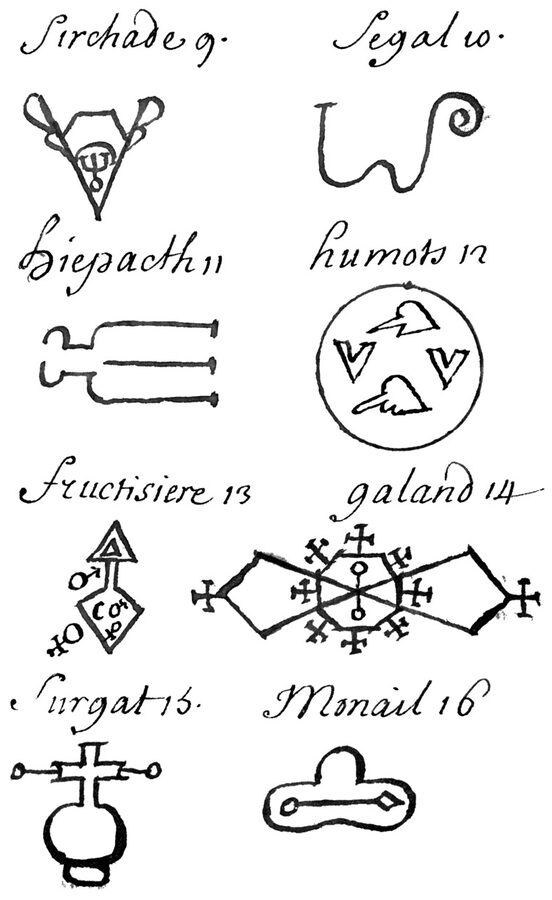
The book describes no body for him. It says instead that spirits have no matter of their own, so they must borrow a body to appear and can take any form they like. Instead, it provides a “character”, a drawing of the spirit’s personal sigil. Morail’s mark appears in two distinct forms. The earliest surviving version comes from a French manuscript dated to around 1709, now in London’s Wellcome Collection.
In that manuscript, the name reads “Monail”. The copyist drew the seal in green ink as a closed loop with a rounded hump. Inside sits a bar tipped with a ring on one side and a diamond on the other. The printed book of 1817 shows a completely different symbol: an oval ringed with crosses, bearing little resemblance to the older drawing.
Function
His whole office fits in one sentence of the printed book’s French: “Morail a la puissance de rendre toutes sortes de monde invisible.” The 1709 manuscript says the same with a small change of words, “rend toutes sorte de personnes invisibles”, he makes all sorts of persons invisible. The two spirits listed just before him among the eighteen have equally narrow jobs. Surgat, the fifteenth, opens every kind of lock, and Guland, the fourteenth, causes every kind of illness.
In the printed edition the plate with the signs of Guland, Surgat and Morail is followed at once by a spell headed “Pour se rendre invisible”, to make oneself invisible. The operation begins on a Wednesday before sunrise. The magician places seven black beans inside a dead man’s skull: one in the mouth, two in the nostrils, two in the eyes, and two in the ears. Next, he inks a magic sign onto the bone. The text points to a diagram on the page, but the printer forgot to include it. He buries the skull face up and is to water it every morning before sunrise for nine days with good brandy. On the eighth morning, a spirit appears at the grave and asks what the magician is doing. “I am watering my plant,” the worker must reply.
The spirit then asks for the flask. The magician must refuse until the apparition holds up its fingers, showing the same figure drawn on the skull. This sign proves it is the genuine guardian of the head. Without it, an impostor spirit could strike the operator and ruin the rite. On the ninth day, the beans ripen. The magician tests them one by one in front of a mirror. If his reflection vanishes when he places a bean in his mouth, the charm works. He can also test them in a child’s mouth. Any bean that fails is buried back in the skull’s grave.
The spell never names its spirit, and the figure it asks for is missing from the printed book. Peterson locates the missing drawing in a 1670 edition of the Grimoire of Pope Honorius, where it depicts a hand resting on a face. The link between Morail and this graveyard spirit rests on layout and office. The spell stands directly below his seal, and making people invisible is his only stated talent. The wording of the charm itself never names him.
Cross-Cultural Connections
Morail had other names before the printer gave him this one. The Grimorium Verum grew out of an older Latin handbook, the Clavicula Salomonis de secretis (“The Secrets of Solomon”), which Peterson takes to be its ancestor. One Latin copy survived in the Venetian State Archive among records of the Inquisition. Church courts seized it during magic trials in the 1630s.
In that older Latin text, eighteen spirits also serve duke Syrach. The sixteenth spirit is named Menail, described simply with the Latin words “Inuisibilem redit”: he makes one invisible. Variant spellings include Manail and Menael. The 1709 French manuscript writes Monail. Only the printed booklet of 1817 spells it Morail. One reading is that copyists misread a few letters, an e as an o and then an n as an r, until a new name stood in print.
The Latin handbook also gives Menail his own spell, and it has no skull in it. Under the heading “That we may be invisible, a most pleasant secret”, the magician makes a pouch from the skin of a chameleon. Inside go three characters written in blood: Menail’s on a triangle of paper, the sign of Syrach on a square, and the sign of Lucifer on parchment cut into five sides. The text then tells the magician to sacrifice the three signs together with the chameleon and eleven candles made of resin and pitch. From then on, whenever the magician carries them and says the words “harith, Menail, Bathalam”, he becomes invisible.
The bean spell has a relative in England. The English antiquarian John Aubrey noted a related charm in the 1680s. He recorded folklore about planting an “invisible bean”.
In his account, someone plants a bean inside a dead man’s eye socket. A fence keeps onlookers away while other beans grow outside. Once the outer crop ripens, the hidden bean is ready. A child shells the pods while held tightly by the hand, since carrying the magic bean makes a person vanish instantly. Aubrey was skeptical of the claim, quoting Horace: “Let Apella the Jew believe it, not I.” Yet he shared a London story he considered trustworthy.
Around 1680, merchants tried the experiment in a garden at Mile End. They placed a bean inside the skull of a black cat and buried it under specific astrological signs. Two days later, a rooster scratched the head up and ruined the trial. Aubrey’s tale and the Grimorium Verum clearly draw on a shared folk tradition of skulls and beans.
Within the grimoires, Morail’s power is shared. The Grand Grimoire, another popular French magic text, assigns invisibility to a demon named Sargatanas. That demon also opens locks, combining the roles that Morail and Surgat share in the Grimorium Verum.
The English Ars Goetia also features invisibility spirits. Its first demon king, Bael, turns the magician unseen. Later, the president Foras teaches invisibility alongside ethics and herbal lore. Morail, by contrast, receives no other powers.
Modern Survival
Morail lives on almost entirely through editions. Idries Shah printed parts of the Grimorium Verum in English in 1957. Peterson posted a digital edition in 1999, comparing manuscript variants alongside the French text. In 2007, he issued a critical print edition with an English translation. Both publications brought Morail back into view. The online version notes the printer’s missing skull emblem with dry precision: “Figure not included in Alibeck.”
The manuscript of 1709 is now digitised in full and open to anyone. One folio shows eight spirit seals arranged in two neat columns. At the bottom right, under the header “Monail 16”, sits the green loop with its diamond bar, resting beside the lock-opener Surgat.