Marnas was the chief god of Roman Gaza, worshipped as a rain-giver and called the Cretan Zeus. According to an ancient Christian biography, his great round temple was burned down in 402 after a seven-year-old boy ordered its bronze doors smeared with pitch, sulphur, and pig fat. The surprise is that this famous destruction story may be fiction, written long after the events. Gaza’s ancient coins remain the only firm evidence of what the god and his shrine looked like.
The burning is told in the Life of Porphyry, a biography of the city’s bishop around the year 400. While it offers the fullest surviving account of Marnas, modern historians treat much of it as legend.
Appearance
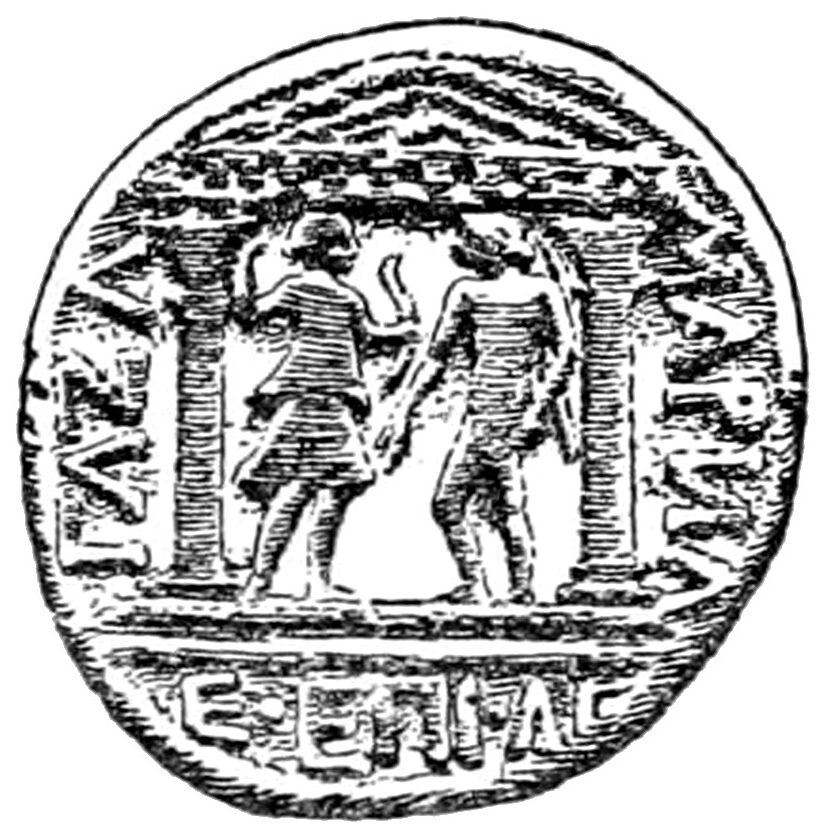
The safest picture of Marnas comes from Gaza’s own money. The Roman emperor Hadrian visited the city in 129 or 130, and soon afterwards Gaza struck bronze coins showing a small temple with two columns and a pointed roof. Two figures stand inside, facing each other. On the left is Artemis, the Greek goddess of the hunt, in a short dress with bow and quiver. Facing her stands a naked man who may also hold a bow, and around them runs the Greek legend ΓΑΖΑ ΜΑΡΝΑϹ, “Gaza, Marnas”. Stefan Krmnicek, a coin historian in Tübingen, described one coin struck in 131/132. He reads the naked man as the statue of Marnas that stood inside the temple.
George Francis Hill, the British Museum’s coin expert, translated the Life of Porphyry into English in 1913. He admitted that the coins were crude work, but to him the god looked young, more like Apollo than like the bearded Zeus of Greek art. Hill printed a drawing of one of the coins on the title page of his book, and the engraving for this entry is made from that drawing.
The temple itself is known only from the Life. After the fire, the biography says, the Christians argued about how to build their church, and some wanted to copy the temple’s shape. It had been round, ringed by two colonnades, one inside the other, with a dome rising high in the middle. Krmnicek notes that no remains of it are known today.
Function
The people of Gaza turned to Marnas for rain. In the autumn of 395 the winter rains failed. The city blamed its new bishop, saying Marnas revealed that Porphyry brought bad luck. When no rain fell for two months, worshippers gathered in the Marneion to sacrifice, calling Marnas the lord of the rains and Zeus.
For seven days they sang hymns outside the city, but no rain came. Then, the biography claims, Christian prayers brought a sudden downpour. The British coin scholar George Francis Hill argued that “lord of the rains” simply meant a local sky god of fertility, much like Baal in older Canaanite cities.
People also came to Marnas with questions, because his temple was an oracle, a place where the god was believed to answer them. When the emperor first ordered the temples of Gaza closed, the Life says, the official sent to enforce the order took a large bribe and let the Marneion go on answering questions in secret.
His name even came up at the races. Jerome, the Latin scholar living in Bethlehem, recorded a chariot race in Gaza in his life of the hermit Hilarion. A Christian named Italicus raced against a magistrate who worshipped Marnas. The magistrate hired a sorcerer to bind the Christian’s horses with spells. Hilarion sprinkled water from his cup on the horses and chariot, and Italicus won easily. According to Jerome, even the pagans in the stands shouted that Marnas had been conquered by Christ.
Cross-Cultural Connections
The Life of Porphyry calls the Marneion the temple “of the Cretan-born Zeus, which they accounted to be more famous than all the temples in the world.” Greek myth says the infant Zeus was born and hidden on the island of Crete, so the title made the god of a Near Eastern port into a Cretan.
His name points elsewhere. In Aramaic, the language spoken across Syria and Palestine at the time, marna means “lord” or “our lord”, and in Hill’s day most scholars took the god’s name from that word. Hill doubted it. He pointed to an old Cretan word marna, recorded as meaning “maiden”. The Cretans worshipped the young Zeus as Kouros, “the young man”, and the Greeks called their maiden goddess Kore, “the maiden”. Hill argued that Marnas mirrored a maiden partner, just as the young Zeus mirrored Kore. On this reading, the goddess beside him on the coins was his Cretan companion.
Hill found support in Gaza’s own stories about itself. Late antique geography notes that Gaza was once called Minoa, after King Minos of Crete, and the city put Minos on its coins. Hill linked this to the Philistines, the seafaring people who held Gaza centuries earlier and whom the Bible links to Crete. Hill admitted that such word links are precarious, and most Near Eastern language scholars rejected his theory.
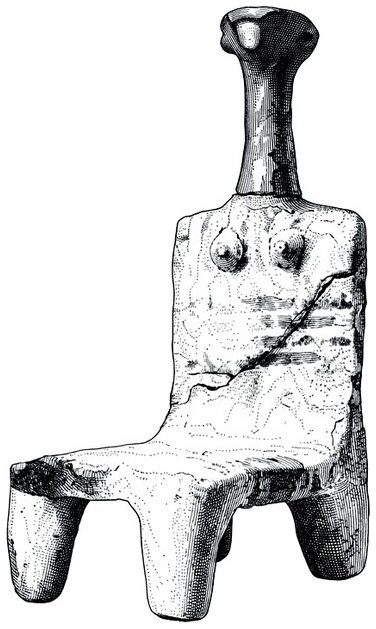
The Bible gives Gaza a different god. In the Book of Judges, the Philistines capture Samson, blind him, and bring him into the temple of Dagon in Gaza. Samson pulls down the central pillars, collapsing the building. Whether Marnas grew out of Dagon remains unknown. Other coastal cities worshipped their own deities, such as the enthroned figurine Ashdoda at Ashdod and the fish goddess Atargatis at Ascalon.
Modern Survival
The end of the Marneion was told as a Christian victory. While the temple was shut but still standing, Jerome wrote from Bethlehem to a Roman lady named Laeta that “Marnas at Gaza mourns in prison, and expects in dread the instant destruction of his temple.” According to the Life, Porphyry then travelled to Constantinople, the capital of the eastern Roman Empire, and won the support of the empress Eudoxia. Soldiers arrived in Gaza in 402 and spent ten days pulling down the city’s other temples. Meanwhile, the priests barred the inner doors with stones and hid their cult statues in the sanctuary. They reportedly escaped through secret tunnels leading under the city. Then soldiers and locals set the doors alight.
Eudoxia sent the plan for a church in the shape of a cross. It was built on the site of the temple and consecrated at Easter 407 under the name Eudoxiana, after the empress. In 411 Jerome wrote that the temple of Marnas at Gaza had “risen up again” as a church, and Krmnicek adds that a mosque, the forerunner of today’s Great Mosque of Gaza, was probably later built where that church stood.
The weak point of the whole story is the book that tells it. The Life claims to be the memoir of Mark, a deacon who served Porphyry and saw everything, yet no other ancient text mentions Porphyry at all. In 2010 the historian Timothy Barnes argued that the book was written “no earlier than the middle of the sixth century”, at least a hundred and fifty years after the fire. A 2025 translation shows that the author borrowed from texts written long after Porphyry died. Historian Michael Whitby dates the book a century or more after the events. The miraculous boy, the pitch, and the pig fat are likely pious fiction.
What remains certain are the coins, which Krmnicek calls the only reliable source for the temple, and one stone. At Portus, the harbour of ancient Rome, a man named Tiberius Claudius Papirius dedicated a monument “to Marnas” at his own expense sometime between 231 and 270; it is now in the Torlonia collection in Rome. From the same harbour came a dedication, since lost, in which the city of Gaza honoured the emperor Gordian III and spoke of its “ancestral god”.
The Life also says what became of the temple’s last stones. Porphyry had the marble of the sanctuary, which women had never been allowed to enter, laid as paving in the street outside the new church, so that it would be walked on by men, women, dogs and pigs. “And this grieved the idolaters more than the burning of the temple,” the biography says, “wherefore the more part of them, especially the women, walk not upon the marbles even unto this day.”