In Paris in 1826, a popular song warned King Charles X that his palace held an omen. Written by Pierre-Jean de Béranger, the song spoke through an old palace sweeper. She claimed she had watched a little red man haunt the Tuileries Palace before every disaster.
He had appeared in 1792 when King Louis XVI fell. He returned in 1814 right before Napoleon lost his crown. Now, the song warned, the red omen was back. Four years later, street revolts drove Charles X into exile.
Appearance
The Tuileries Palace once stood beside the Louvre. Queen Catherine de’ Medici began building it in 1564. French rulers lived there until May 1871, when the revolutionary Paris Commune burned it down. The ruins were cleared in 1883, leaving only the public gardens. The red man had no home outside this lost palace, and witnesses never agreed on his face.
Béranger described a hunchbacked, red-haired devil dressed in scarlet. The spirit wore a snake for a necktie and limped on a forked foot. His hoarse singing warned of political ruin. In the song, he also changed clothes with each regime. He wore wooden clogs in 1792, enemy feathers in 1814, and a priest’s hat under Charles X. Only his red hue stayed constant.
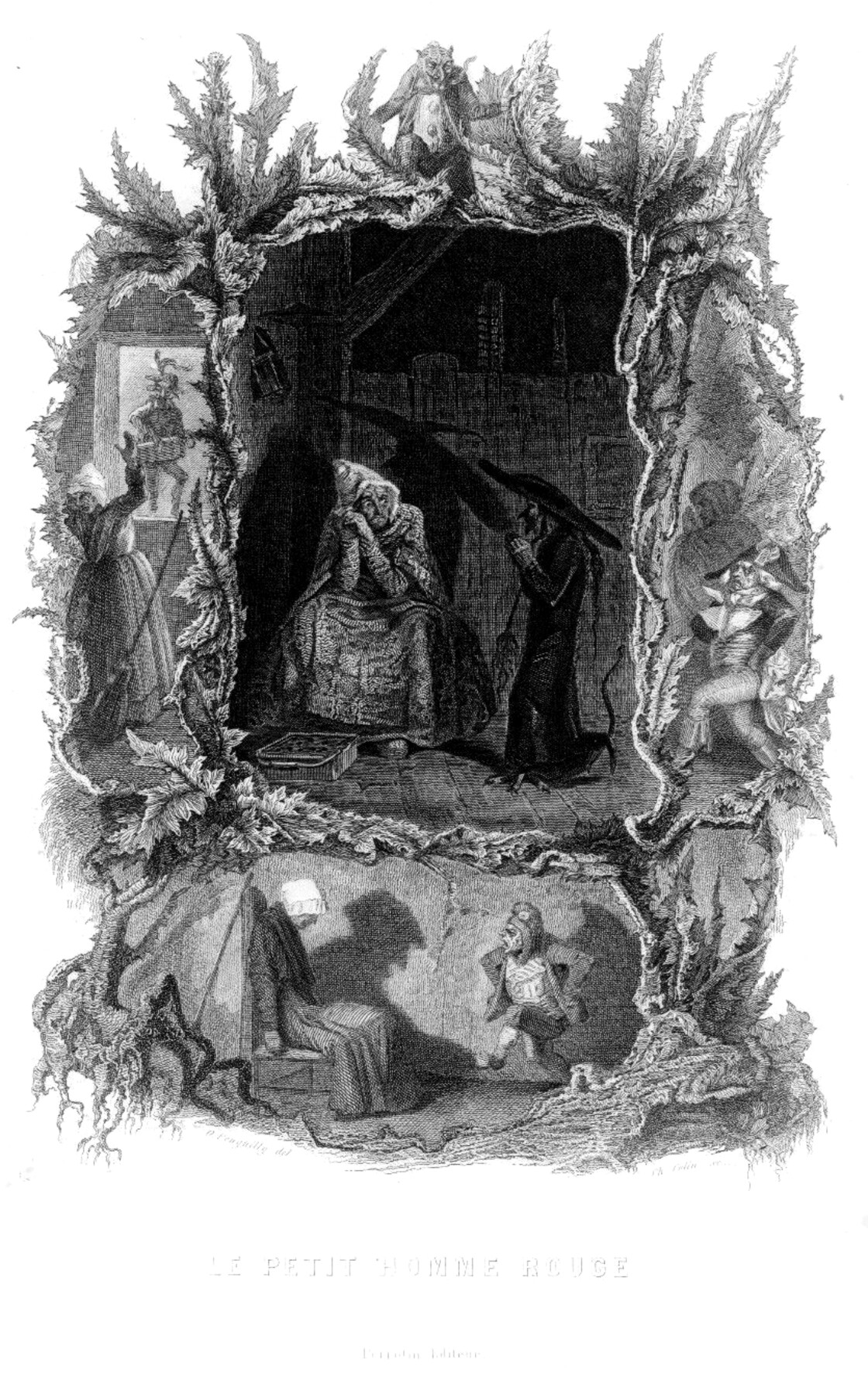
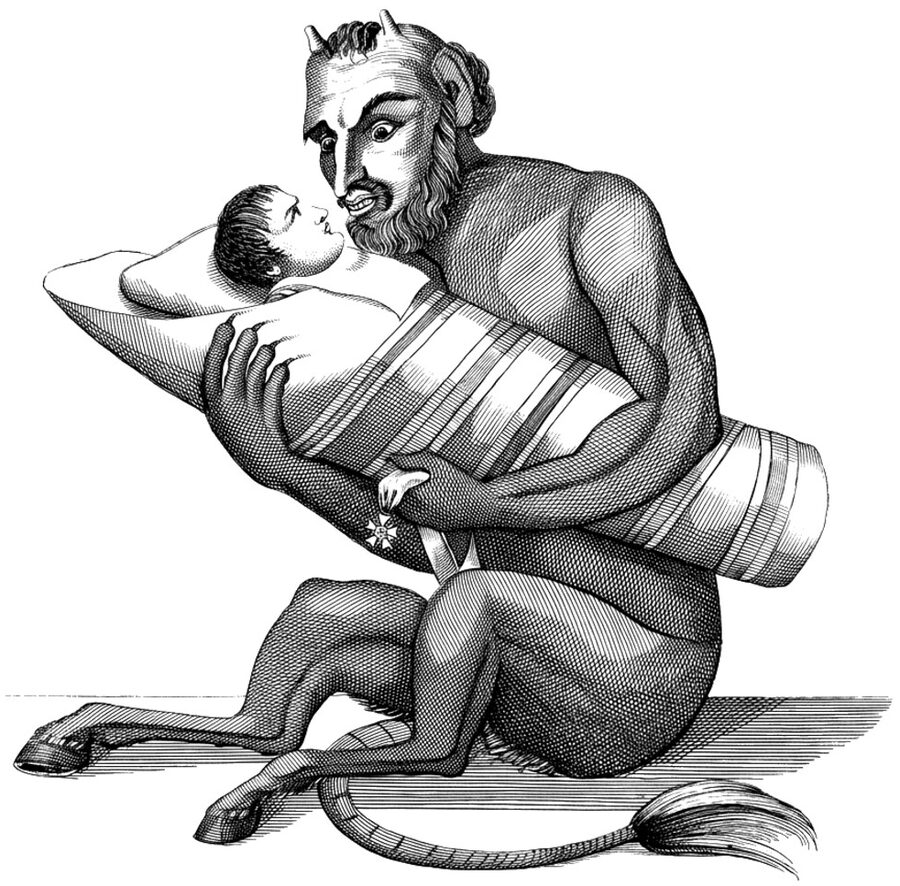
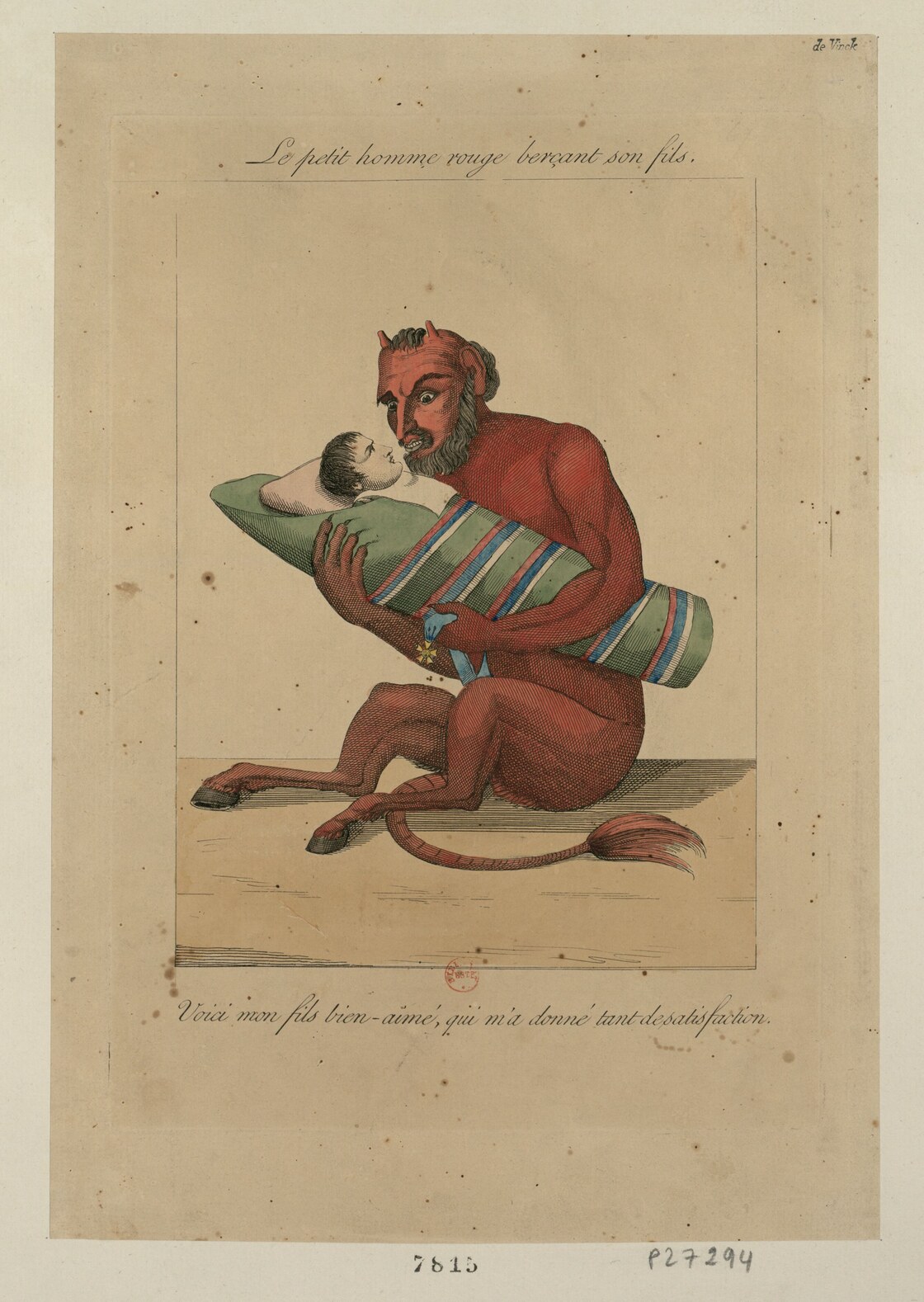
Older pictures made him plainly demonic. A hand-coloured print from 1814, Le petit homme rouge berçant son fils, shows a horned devil with goat legs and a tail. He cradles a swaddled baby with Napoleon’s face. The caption calls the child his beloved son who gave him great joy. The line parodies God’s words at Christ’s baptism. The engraving at the head of this guide is a modern redraw of that satirical print.
The famous fortune-teller Marie-Anne Lenormand offered a calmer view. In an 1831 pamphlet, she described a vision of the red man. Her version wore a neat red cloak and a plumed cocked hat. His face was dignified, and he spoke in political prophecies about the new French king.
Function
Béranger explained his song in a note. “An old popular tradition,” he wrote, “supposed the existence of a red man who appeared in the Tuileries at every unhappy event that threatened the masters of this palace.” The tradition, he added, came back into circulation under Napoleon, and people even claimed that this house demon had appeared to Napoleon in Egypt. Béranger did not believe the Egyptian part. He called it “a theft from the Tuileries in favour of the Pyramids,” meaning that the Egypt story had borrowed the palace’s own spirit.
Historian G. Lenotre gathered the Napoleonic tales in his 1933 book Les Tuileries. The earliest printed account he found appeared in a Paris journal in April 1814. In that story, the red man met young Bonaparte during his campaign in Egypt. He offered the general ten years of power before the Battle of the Pyramids in 1798.
After taking power, Napoleon moved into the Tuileries. Legend claimed a mysterious note left on his desk promised he would become king. The spirit reportedly returned in 1809 in Vienna to renew the pact for five years. His final visit came in June 1815, right before Napoleon’s defeat at Waterloo. That night, his face was grave and sullen.
The red man thus filled two roles. In palace lore, he was an omen of disaster who warned rulers of imminent downfall. In Napoleonic myth, he acted as a devilish patron who leased power for a fixed term. Lenotre thought the public simply could not believe Napoleon’s sudden rise without invoking black magic.
Cross-Cultural Connections
Lenotre argued that the palace phantom began as a rural house spirit. He compared him to the sotret of eastern France, a household sprite (lutin) who wears a red jacket and cap. Such sprites slipped through keyholes, tended stable horses, and watched over hearth fires. Villages and country inns in the region often took the name “The Little Red Man” from these tales.
Folklorist Rudolf Kleinpaul linked the red colour to the hearth fire in an 1898 study. He believed house spirits traced back to ancestors buried near family hearths. Pointed red caps recalled the chimney flames. Kleinpaul counted Béranger’s Tuileries sprite among these hearth beings. He compared him to Germany’s Petermännchen of Schwerin, a castle spirit who wore red before wars and black before deaths in the ruling family.
Lenotre wondered how a humble country sprite reached a royal court. Perhaps Paris sought its own palace ghost to rival Berlin’s famous White Lady, an apparition tied to royal deaths (see Woman in White and The White Lady of Berlin Palace and Luise Henriette). Lenotre admitted that despite many theories, the origin remained unsolved.
Modern Survival
The version told most often today gives the red man a human past. Popular websites such as Paris Zigzag and Sortiraparis tell it this way: a butcher called Jean l’Écorcheur, Jean the Skinner, worked a slaughterhouse on the land where Catherine de’ Medici built her palace. He knew too many royal secrets, so Catherine had him killed, and as he died he swore he would come back. His bloodied ghost became the little red man.
The oldest printed record of this murder appears in an 1880 popular history by Jules Beaujoint. The book reads like a sensational novel with invented dialogue. In it, Jean is a red-haired butcher who knows court secrets. Catherine orders an assassin to run him through with a sword in a cellar. Dying, Jean promises to return.
When the killer turns around, the blood-soaked ghost is already watching him, while the physical body has vanished. Earlier writers such as Béranger and Lenormand never mentioned a butcher. Beaujoint cited no source, suggesting he likely invented the murder himself.
Modern accounts claim the red man appeared one final time in May 1871 while the Tuileries burned. Lenotre recorded a stranger tradition from eastern France. Notes sent to him claimed local folk believed the red man had died, his spirit sealed under the waterlogged foundations of Strasbourg Cathedral.