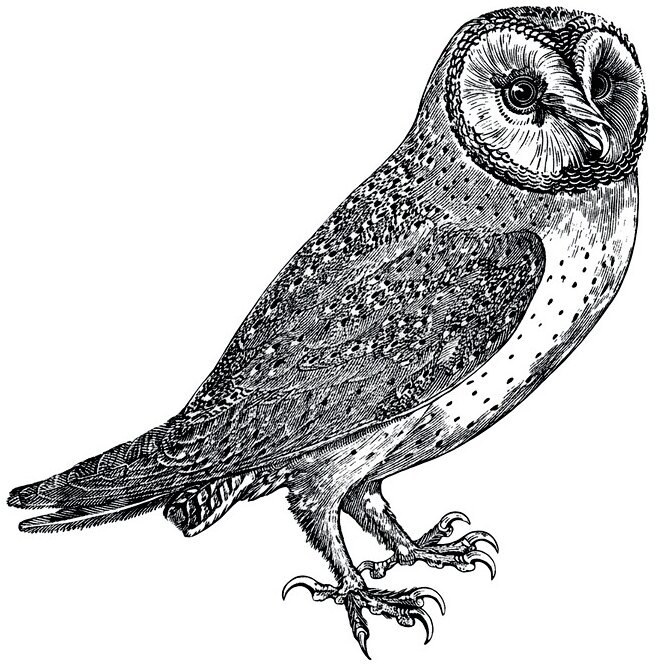
A sick person lies in a room where a small light burns through the night. Late at night, an owl settles on the window frame and wails. In German folk belief, its cry carries words: Komm mit, komm mit, komm mit auf den Kirchhof!, “Come along to the churchyard!” The owl is summoning the sick person to the grave.
In 1898, folklorist Rudolf Kleinpaul recorded the name Kommmitchen, meaning “little come-with-me”. Its appearance carried a grim certainty: once the bird cried at the window, death was sure to follow.
Appearance
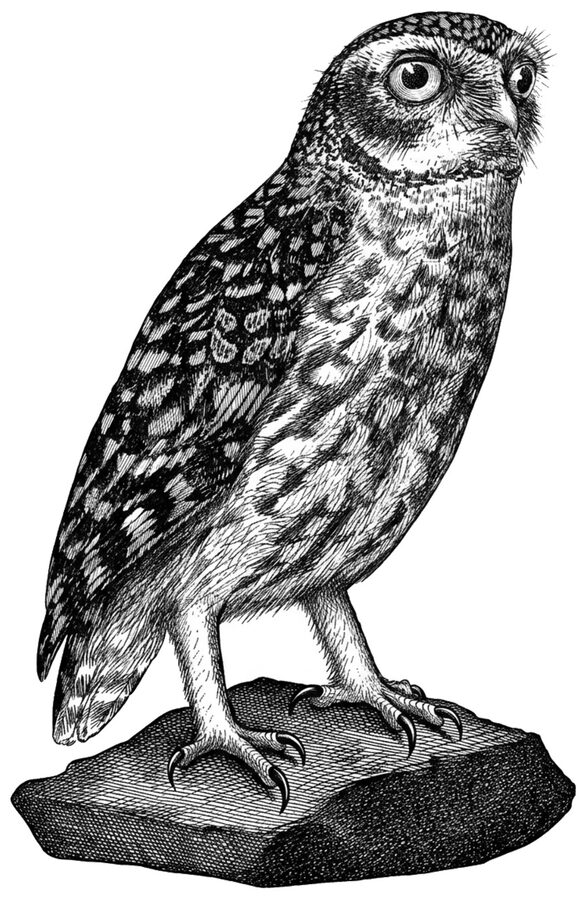
The Kommmitchen is a real bird: the little owl, Athene noctua to zoologists. German has two everyday names for this one species, Steinkauz (stone owlet) and Käuzchen (little owlet). Kleinpaul does not name a species, but in the sentences that follow he writes about the Käuzchen. The ornithologist Johann Friedrich Naumann traced these words to the little owl in 1820. His own engraving of the bird appears at the top of this page. The little owl is compact and round-headed, with bright yellow eyes and white spots across a grey-brown back.
Its voice matters more to the belief than its looks. Among the calls Naumann heard were a loud, ringing quew and a pleasant kuwitt. To anxious ears, its call sounded like “Komm mit, komm mit, auf den Kirchhof!”, with the final syllable echoing into the night. The bird’s two-beat cry, kuwitt, closely matches the rhythm of komm mit. In a dark house, a frightened family easily heard words in the sound.
Kleinpaul draws the owl family as a whole in darker strokes: “pallid, goggle-eyed, ghostly birds” that sleep through the day in a churchyard wall, glide off at sunset on silent wings and roam all night, “searching the ground for mice as for souls”.
Function
The Kommmitchen does one thing: it announces a death in the house it visits, and in the words people heard, it calls the sick person away to the churchyard. Naumann collected the names that went with this role. Country folk called it the Totenvogel (death bird) or Leichenhuhn (corpse hen). To Kleinpaul, its flight was “as good as if Death himself came flying.”
Naumann, writing as a naturalist, offered a cause. Unlike other owls, the little owl is drawn toward artificial light. In a rural village, the only candle burning all night was in a sickroom. The bird flew straight to the illuminated pane, alarming the family keeping vigil.
Naumann noted that such visits were common occurrences rather than folklore inventions. Country people spoke of these nocturnal visits with genuine dread, convinced that the bird could smell fever.
In 1880, sixty years after Naumann, Karl Bartsch, who collected the folk customs of Mecklenburg on the Baltic coast, found the same call in northern Germany. His folklore collection notes that whenever the owl cried at night, death followed soon after. In the northern Low German dialect, people heard the call as “Kumm mit, kumm mit”.
Cross-Cultural Connections
Kleinpaul places the German owl beside an Italian one. The owl, he writes, cries like Death himself, to whom all things are forfeit, and in Italian its cry is Tutto è mio, tutto è mio!, “Everything is mine!” Kleinpaul names no place or collector for the Italian words, and none of the other sources cited here has them, so they rest on his word alone.
The same chapter of Kleinpaul’s book follows the owl back to the ancient world. He notes that the Greeks and Romans feared a night owl that stole into cradles and killed small children. The Romans called it the strix. Over time, folk belief transferred the owl’s hunting habits to nocturnal witches. The Italian word for witch, strega, still derives from strix.
The same bird held an opposite reputation in ancient Greece, where it served as the sacred bird of Athena. Its scientific name, Athene noctua, means “Athena of the night”. Kleinpaul suggested that the bird’s night vision led to two opposing symbols: the wisdom of the goddess and the dark foreknowledge of death.
The belief was not limited to a few villages. The standard German encyclopedia of folklore, published around 1930, confirmed how widespread this omen remained. Its entry records that hearing words in the bird’s shriek was common across central Europe, always interpreting the call as a summons to the grave.
Other European death messengers also come to the house itself. In Ireland the banshee, a supernatural woman, is heard keening, a high funeral wail, outside the door before someone in the family dies. In Bartsch’s own Mecklenburg, the castle spirit Petermännchen of Schwerin foretold war and death in the ducal house by the colour of the clothes he wore. The Kommmitchen differs from both because it is an ordinary bird that any farmhouse could hear on any night.
Modern Survival
The little owl still breeds in Germany, and the German conservation society NABU writes its call today as a sharp, reproachful kwiew, close to the quew Naumann spelled in 1820. The name Kommmitchen survives in Kleinpaul’s book, while the bird’s scientific name keeps the other half of his story, the goddess Athena.
Naumann’s explanation, that a bird drawn to light finds the one window lit through the night, is the earliest attempt in these sources to account for the belief. It explains why the owl came to that window, and it leaves open what the people inside heard. On Naumann’s page the bird’s call and the people’s words stand side by side: kuwitt, and komm mit, auf den Kirchhof.