In ancient Egypt’s underworld, hundreds of gods and hybrid monsters carry drawn knives to guard the sun god through the night. They butcher hostile serpents and protect sacred tombs. The surprise is where their blades ended up centuries later: on pocket-sized healing stones made for ordinary people stung by scorpions. One such black stone in Cambridge shows two falcon-headed beings squatting with curved knives, standing guard just as their ancestors did on royal tomb walls.
Appearance
The Amduat is a royal picture book of the night. The title means “what is in the underworld.” Its oldest complete copy lines the tomb of Pharaoh Thutmose III in the Valley of the Kings. Later rulers had the same scenes painted in their tombs. The text divides the night into twelve hours. During each hour, the ram-headed sun god Ra sails his boat through the underworld. Rows of painted beings line his route to guide and protect him on this dangerous voyage.
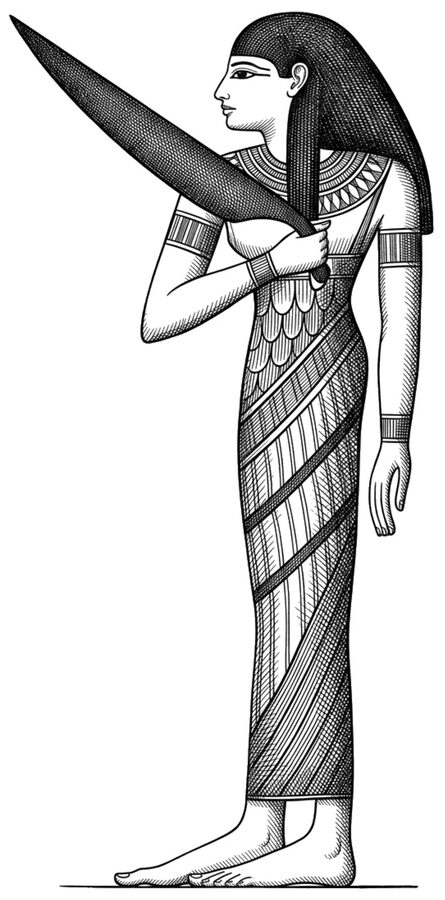
Many of these beings hold knives. In the third hour, five figures with goose heads grip blades in their right hands. In the sixth hour, nine fire-breathing serpents appear, each armed with a large knife. In the seventh hour, four goddesses stand in long dresses and wigs. Each woman holds a curved blade upright before her face. In the eleventh hour, a lion-headed goddess guards a fire pit with another heavy blade. The knife is their shared badge of office, whether their heads are human, reptile, bird, or beast.
The Egyptologist Rita Lucarelli identified this same pattern across Egyptian funerary spells. Underworld gatekeepers often have animal heads, human bodies, and knives in their grip. The two figures on the Cambridge healing stone belong to this exact tradition. They squat with falcon heads and sharp blades, though no carved name reveals their individual identities.
Function
The knife guardians keep the sun god’s waterway clear. The clearest battle happens in the seventh hour. There, the giant serpent Apep lies across the sandbar to halt the sun. In the painting, Apep is pinned down by six deep knives. The scorpion goddess Serqet binds his neck while another god fetters his tail.
Beside the crushed snake, four goddesses stand over four buried chests. Each chest shelters a form of Osiris, ruler of the dead. An inscription explains their duty simply: these knife-bearing women hack Apep to pieces every single night.
The blade serves a double purpose. It shelters the resting bodies of holy beings, and it dismembers their foes. In the sixth hour, serpents guard the hidden flesh of the god. The sun god commands them to burn his enemies and slice up their ghost shades.
The Amduat offered a vital guarantee to the dead pharaoh. Whoever recited the book’s spells would join the crew in the sun boat. But whoever failed to recognize these blade-wielding guardians would have no way to fend off the serpent.
Scholars classify these beings as underworld demons. In ancient Egypt, that meant task-focused spirits serving the higher gods rather than purely evil monsters. Hieroglyphic texts often wrote their names using the same signs as gods.
Over time, their status grew. On a temple slab from Heliopolis, King Nectanebo I kneels before knife-bearing guardians with crocodile and snake heads, offering them linen and gold in exchange for military victory. In later centuries, scribes drew knife-bearers directly around the embalmed mummy to shield the corpse itself.
Cross-Cultural Connections
Inside Egypt the knife guardians belong to the nightly fight against Apophis and to the boat of the sun god Ra that they protect. In the seventh hour it is the words of power of Isis that open the way, and the coffers the goddesses guard hold forms of Osiris. The tombs that carry the book lie in the Valley of the Kings, under the peak where the Thebans worshipped the cobra goddess Meretseger as another guardian of the royal dead. Gatekeepers armed with blades also occur in Mesopotamian and early Asian traditions. Yet the Egyptian tradition was unusual because the dead spoke directly to their guardians to demand safe passage.
Healing stones brought these underworld blades into everyday medicine. Known as cippi, these portable slabs depict the child Horus trampling crocodiles and gripping venomous snakes, shielded by the grotesque mask of Bes.
Priests poured water over the carved reliefs, allowing the liquid to absorb the stone’s magic. The patient then drank the runoff or washed a bite with it. On the Cambridge slab, the falcon knife-bearers march alongside a ram-headed sun god. This design transferred the elite mythological battle against underworld serpents straight to a peasant suffering from a scorpion sting.
Modern Survival
The knife guardians have no cult today and almost no names that people know. They survive on tomb walls in the Valley of the Kings, on papyri and coffins, and on objects like the Cambridge stone, which a collector of Egyptian amulets named L. Mackintosh bought in Guildford, in Surrey, England, in 1943, and which entered the museum’s catalogue in 1992. Its history before that is unknown, and so is the place where it was found.
The Cambridge stone holds a final puzzle. The hieroglyphs on its back display recognizable symbols for eternity and the name Isis, but they form gibberish instead of sentences. The craftsman likely carved pseudo-writing for buyers who could not read, trusting the sacred signs themselves to channel healing power.
An illiterate carver may not have known the royal Amduat text at all. Instead, he drew from a folk memory of knife-wielding protectors. What remains is a pair of miniature falcon guardians, gripping knives on a palm-sized pebble, ready to cut down poisons.
