In Danish tradition, an elder tree belonged to a spirit called Hyldemoer, or the Elder Mother. Anyone who took its branches had to ask her leave three times, promising something in return. If a woodcutter cut without asking, the stories warned that she would punish him. The folklorist Thomas Keightley brought this Danish formula to English readers in the nineteenth century, drawing from the Copenhagen legend collector Just Mathias Thiele.
Collectors recorded the request in more than one form. Another nineteenth-century translator, Benjamin Thorpe, gave a shorter plea: “Hyldemoer, Hyldemoer, allow me to cut thy branches.” Keightley’s version sounded more like a trade, offering something unnamed in return. Remarkably, an English woodman in Lincolnshire was recorded around 1900 using the same bargain with the “Old Gal” of the bush, promising his own wood once he died and grew into a tree.
Appearance
The Danish legends say much more about what the Elder Mother does than about how she looks. Danish accounts call her either Hyldemoer or Hyldeqvinde, meaning Elder-wife. In these notes, she dwells within or beneath the bush alongside lesser spirits who attend her.
The nearest thing to a picture in the folk material is a tree that moves. In Nyboder, the navy quarter of Copenhagen, one elder bush grew in a courtyard. Local lore claimed that this tree walked back and forth at dusk. Sometimes it peered through windows at children who had been left alone. In these oldest tales, no woman appeared. The plant itself moved, as though tree and spirit were one body.
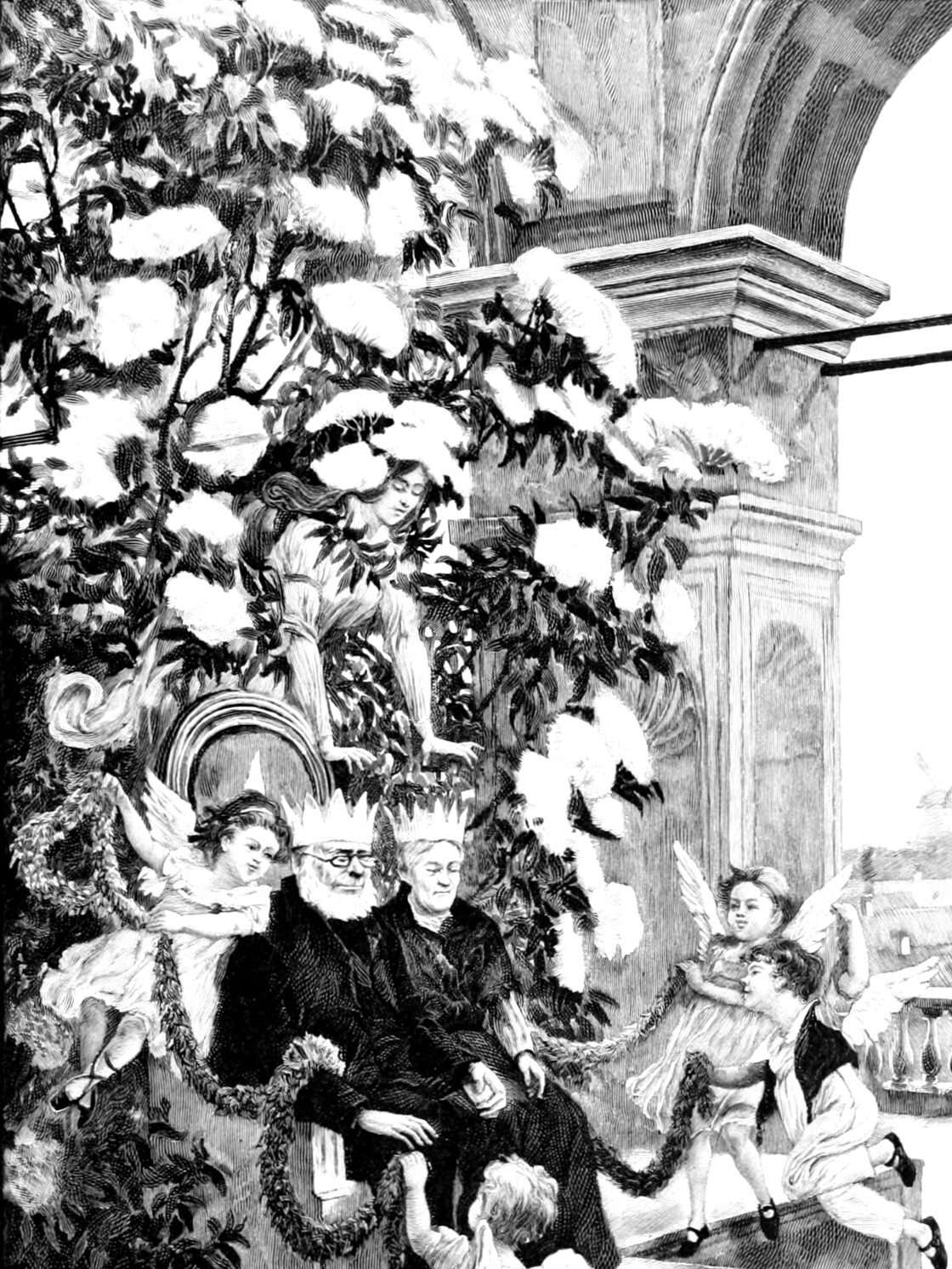
Hans Christian Andersen gave the spirit a human form in his 1844 tale “Hyldemoer”. He painted her as an old woman in a dress as green as elder leaves, trimmed with white blossoms. Later in his tale she turns into a girl with yellow hair and elderflowers. The engraving above, drawn by Hans Tegner in 1900, illustrates Andersen’s ending. The spirit leans from the branches over a couple celebrating fifty years of marriage, turning blossoms on their heads into golden crowns.
Function
The Elder Mother guarded her tree, and most of the Danish legends are about people who forgot that. Thorpe puts her rule in one sentence: “She avenges all injuries done to the tree.” Keightley tells of a man who cut down an elder and “soon after died suddenly”, and Thiele’s own Danish text, as Andersen later quoted it, places that man in Nyboder. Before cutting, Thorpe adds, Danish peasants also spat three times, a common way of warding off harm, to drive off the vætter, the land spirits of Danish folk belief, and other evil beings.
Her anger pursued the cut wood indoors. Folk tales strictly warned against elder furniture. When one family laid an infant in an elder-wood cradle, the spirit pulled the baby by its legs until parents moved it to another bed. Another tale tells of children tormented in a room whose floor was laid with elder boards. They found peace only after sleeping elsewhere.
Yet the shrub was also planted near doors for healing. For toothache, folk tradition advised holding a twig in the mouth before driving it into a wall with an spoken charm. Against a fever, one stuck an elder twig into the earth in complete silence, believing the illness would pass into the soil. Propitiating the Elder Mother kept this unpredictable power benevolent.
From Legend to Andersen’s Tale
Andersen drew the Elder Mother directly from Thiele, whom he had met as an impoverished youth in Copenhagen. Thiele’s legends provided the seed: the tale of an avenging tree spirit in Nyboder, and of a man who cut an elder down and died soon after.
The frame came from Andersen’s own bout with illness. After catching a chill in wet shoes on an estate, he spent days drinking elder tea. His fairy tale opens with that exact scene. A boy with soaked feet drinks hot elder tea while an old storyteller conjures an elder tree straight from the teapot. At its center perches the Elder Mother, framed by the familiar sailor courtyards of Nyboder.
Andersen kept the setting but discarded the dread. His Elder Mother harms no one. Instead, she carries the feverish child through the changing Danish seasons. At the climax, she announces her true name: “Some people call me Elder Tree Mother, but my real name is Memory.” The folklore menace who crippled infants was transformed into a guardian of recollection.
Cross-Cultural Connections
English marshland had an Elder Mother closer to Denmark’s vengeful spirit. A clergyman in Lincolnshire recorded a mother whose baby turned sickly after her husband crafted cradle rockers from elder. Believing the “Old Lady” was pinching the child, the mother swapped the wood for ash, and the infant recovered. A local woodcutter admitted he never cut green elder without saying: “Old Girl, give me of thy wood, and I will give some of mine when I grow into a tree.” The custom mirrors the Danish permission ritual almost word for word.
The collector argued that this shared formula arrived with Danish settlers during the Danelaw era. While this explains the similarity between the Danish and English charms, no written evidence proves how the custom crossed the North Sea.
Traditions in South Wales shared similar taboos. People considered it perilous to build on sites where an elder had once grown. Cut wood was left to rot rather than burned. Local lore claimed that the Elder Mother dwelt directly between bark and wood, making it dangerous to disturb or burn her dwelling.
Such tree-spirit traditions spanned northern and central Europe. In Lithuania, peasants offered food beneath elder bushes. In northern Germany, folk customs transferred fever chills directly to the tree. Some scholars connected the plant’s German names, Holler and Holunder, to the mythical Frau Holle. Across multiple cultures, from European woodland spirits to the Indian Yakshi, the elder exemplifies the belief in living spirits guarding sacred groves.
Modern Survival
Today the Elder Mother survives mostly through Andersen’s literary tale. There she endures not as an avenging tree spirit, but as Memory itself, watching over childhood and old age.
The folk belief also appears on this site in the calendar of tree lore, at the start of the elder month in the entry Ruis (Elder Moon Begins). Whether the Lincolnshire Old Gal came to England with Danish settlers, as Heanley believed, or grew up on her own wherever elders grew near houses, the records do not say. They do keep the mother in the marsh cottage who took the elder rocker off her baby’s cradle and put an ash one in its place.