For the Lakota, entering the afterlife requires a mark on the skin. In their sky teachings, the Milky Way is the spirit road of the dead. An old woman sits where this road forks, waiting to inspect every passing soul. In 1972, the Lakota holy man John Fire Lame Deer explained this guardian to the writer Richard Erdoes. Her name is hihan kara. “When we die we have to pass her on the way to the spirit land,” Lame Deer said. “If we have a tattoo on our wrists hihan kara lets us pass.” Without these marks, a soul cannot enter the spirit land and must walk the earth as a wandering ghost.
Appearance
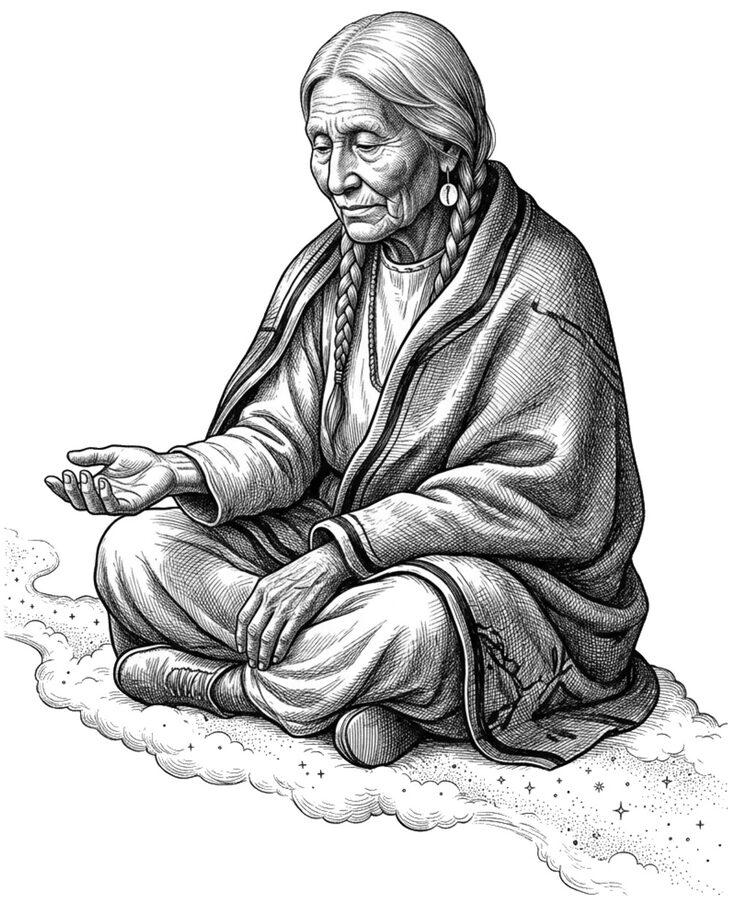
The sources give her very little body. She is old, she sits, and she looks. Lame Deer uses three names for her in the same book. Each name describes the same guardian. She is hihan kara at the fork of the Milky Way. She is the Owl Woman who guards the road to the spirit lodges, where the dead live. Finally, she is the Ghost Woman who throws unmarked souls over a cliff. Lame Deer wrote her name phonetically. In modern Lakota spelling it is Hiŋháŋ Káǧa, from hiŋháŋ (owl) and káǧa (to make). Translators render it as “Owl Maker”. None of the sources describe owl feathers or an owl face on her body. Why she bears the name of an owl remains unexplained.
Her seat is the road itself. To the Lakota, the Milky Way is the path of the dead. Lame Deer noted that “going south” means dying, because the soul travels southward along the star trail. A Lakota scholar, Craig Howe, described the same road in 2018. In this teaching, each child receives a spirit from a star at birth. At death, the spirit travels the Milky Way back to a fork, where it returns to the stars. The old woman waits at this fork.
We found no old drawing or carving of her. The picture at the top of this page is a modern drawing made for this entry: an old woman in a buffalo robe on a band of stars, holding out her hand for a traveller’s wrist.
Function
She checks the dead. What she looks for is a tattoo. Lame Deer described the marks as simple designs on the wrists, showing a name or a few letters. “The Owl Woman who guards the road to the spirit lodges looks at these tattoos and lets us pass,” he said. “They are like a passport.” He also called them “a kind of baptism.” An elder named Mrs. Elk Head, keeper of the sacred pipe, gave Lame Deer his own tattoo along with a secret name.
A soul without the marks does not go on. In Lame Deer’s words the Ghost Woman “will throw you over a cliff”, and the soul then has to roam the earth as a wanagi, a ghost. “All you can do then is frighten people and whistle.”
The oldest printed version is older by almost eighty years and gives her no name. The oldest printed account dates to 1894, recorded by the ethnologist James Owen Dorsey. He noted that every person needed a tattoo on the forehead or wrists during life. Without it, the spirit could not reach the Many Lodges, the village of the dead. Dorsey also mentioned a second, shorter road, warning that any spirit taking it would never arrive. “An old woman sits in the road and she examines each ghost that passes,” Dorsey wrote. If she found no marks on the forehead, wrists, or chin, she pushed the ghost from a cloud or cliff. The fallen soul could never return to the spirit road. Instead, it wandered the earth without a home, whistling in the dark. Dorsey added that families burned cedar near the sick to ward off these ghosts, and fired guns into the air if they heard one whistling.
The two accounts agree on the test, the fall and the whistling ghost, though the body parts differ: Dorsey has forehead, wrists and chin, Lame Deer only the wrists.
Cross-Cultural Connections
The closest comparison comes from Lakota tradition itself, and it tells the gate of the dead differently. Not every Lakota tradition placed an old woman at the gate. James R. Walker, an agency physician at Pine Ridge between 1896 and 1914, recorded a different version from local holy men. In his notes, the wind spirit Tate guards the spirit trail. Tate admits or turns away souls based on the judgment of Skan, the Sky. No sacrifice or ceremony alters this verdict. A rejected soul wanders the world until Tate relents. Walker’s record focuses on moral judgment rather than skin markings, and makes no mention of tattoos. An Oglala elder named Finger described the road to Walker as a white trail in the night sky. When asked if it was made of stars, Finger said it was like clouds, “so that nothing but wakan can travel on it.” In Lakota, wakan describes that which is sacred and spiritually charged.
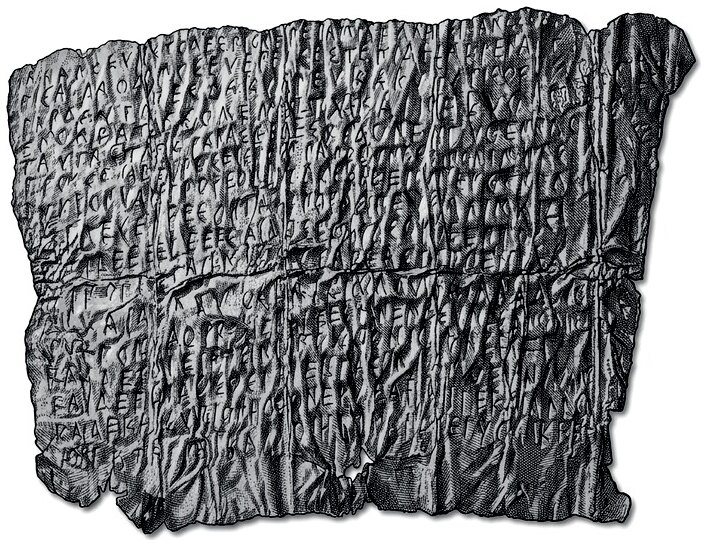
Further away, other peoples also put a test at the threshold of the dead. In Egypt, Anubis leads the dead to the scales where the heart is weighed, and Ammit waits to devour the hearts that fail. In ancient Greece, initiates of the Orphic mysteries were buried with thin gold tablets. These texts instructed the soul to approach a fork in the underworld road and recite secret phrases to guardian spirits. These parallels reflect similar human imaginations of the afterlife, not a shared history. The tests differ completely: the Egyptian dead are judged by the heart, the Greek initiate by memory, and the Lakota traveler by ink on the skin.
Modern Survival
The name now stands on a map. The highest peak of the Black Hills in South Dakota, 7,244 feet (about 2,200 metres) high, was called Harney Peak on American maps; its Lakota name is Hiŋháŋ Káǧa, Owl Maker. After Lakota requests, the U.S. Board on Geographic Names renamed it Black Elk Peak on 11 August 2016, after the Oglala holy man Black Elk.
In a 2024 broadcast, the Lakota and Dakota cultural leader Kevin Locke connected the mountain with the Milky Way journey. Calling the peak “Hinhan Kaga Apaha” (Owl Maker Hill), he described how the deceased begins traveling the Wanagi Chankoo, the Spirit Road. Locke referred to the Owl Maker as “he,” showing that the guardian is not remembered solely as an old woman.
The guardian also appears in modern online summaries, sometimes with distortions. Some articles claim that souls failing her test are “liberated from existence.” That claim has no basis in the historical records. Dorsey and Lame Deer both stated clearly that rejected souls fall back to earth as wandering ghosts.
The printed sources do not say whether the tattoo, the old woman and the owl were always one belief, or whether different Lakota bands and families told the gate of the dead in different ways. Lame Deer, at least, had settled it for himself. He ended his account of the Ghost Woman with his own body: “But, as you see, I have my arms tattooed.”