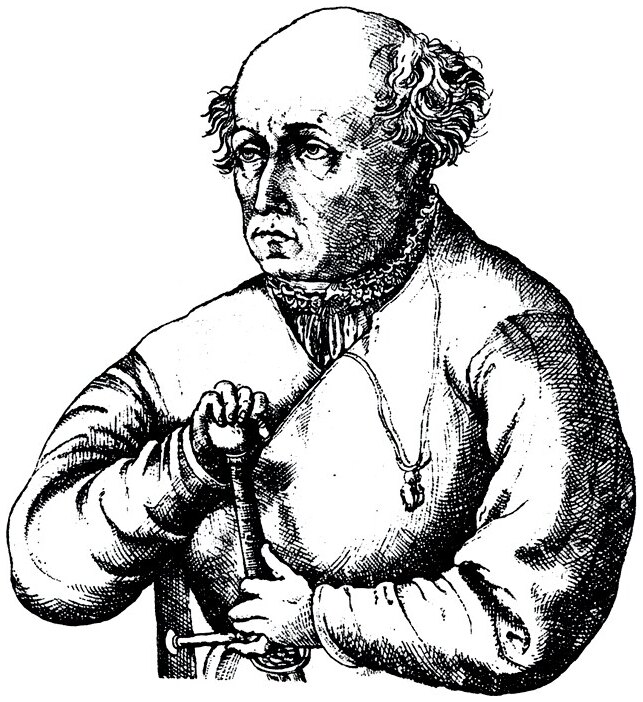
Around 1560, an unknown German writer compiled a list of gems for an alchemy book. One entry described the adamant, the ancestral name for diamond: it is a black crystal, “also called diamond and euax, because it gives joy.”
The text appeared in 1567 under the name of Paracelsus. Later English translations kept the odd phrasing: an adamant “or else Evax”. Today we expect a diamond to be clear, yet here it is black, iron-colored, and named after a legendary king.
Appearance
The book is called Liber vexationum, the Book of Vexations, and also Coelum philosophorum, the Heaven of the Philosophers. Its entry on the adamant is four sentences long. In Waite’s translation the stone “is of an obscure and transparent blackness, the colour of iron. It is the hardest of all; but is dissolved in the blood of a goat. Its size at the largest does not exceed that of a hazel nut.” Waite printed this list of stones on page 17 of the first volume of his Hermetic and Alchemical Writings of Paracelsus, between the emerald, which guards chastity, and the magnet.
Each of these traits can be followed back through older books. Pliny the Elder, the Roman writer whose Natural History appeared in AD 77, described the Indian adamant as transparent like crystal and “the size of a hazel kernel” at most. He knew six kinds of it, and one of them, which he called siderites, had “the lustre of iron” but could be broken with blows, so he counted it as a lesser stone. Centuries later, Isidore of Seville merged these details in his encyclopedia. He described the adamant as a small stone with the colour of rust, the shine of crystal, and the size of a hazelnut.
Medieval bestiaries copied his description almost word for word. The dark crystal in the Paracelsus book comes straight from this lineage, showing that ancient writers grouped several different minerals under the name adamas.
Function
Two things set the adamant apart in these books, its hardness and the one way to defeat it. Pliny wrote that the stone shatters hammers and resists fire. Yet it yields to fresh, warm goat’s blood after repeated blows on an anvil.
Pliny wondered what inspiration could have led anyone to test such a costly gem on a foul animal. He concluded that only the gods could have revealed it. Christian bestiaries later treated the unbreakable gem as a symbol of Christ.
The joy that gives the stone its second name also has an old root. Pliny says the adamant overcomes poisons, drives away fits of madness “and expels vain fears from the mind”. Isidore repeats that it expels vain fears and adds that it resists evil arts. Around 1100, Marbod of Rennes put stone lore into Latin verse. He wrote that the adamant grants victory, dispels night terrors, and baffles evil spells if bound to the left arm in gold or silver.
An alchemical dictionary printed in 1612 still claimed the stone makes its wearer lively and strong. At the end of that entry, it pointed readers back to Evax as the primary authority.
Cross-Cultural Connections
The second name of the stone belonged first to a king. Marbod opened his poem with an Arab king named Evax, said to have sent a lapidary guide to the emperor Tiberius. According to Marbod, this royal treatise recorded the varieties, colours, and powers of precious stones.
Marbod claimed he merely condensed the king’s vast work into a portable handbook. Two Latin letters between Evax and Tiberius circulated with the poem, urging secrecy. In 1799, their modern editor concluded that a medieval monk had fabricated the correspondence.
Medieval scribes cited the verse lapidary under the name of Evax because of that opening line. By 1574, a German press issued the poem outright as the king’s own work.
An earlier mention in early printings of Pliny credited Evax with writing to Nero on medicines. Later scholars discovered that copyists had inserted those words into the printed editions without manuscript authority.
In classical Latin, the exclamation euax signified a shout of joy. When the Book of Vexations explains that the stone is called Evax because it brings gladness, the author likely played on that Latin cry.
A printing error may have completed the shift. The Ortus sanitatis, a 1491 natural history compendium, opens its section on adamant with a citation: “Euax in lapidario suo. Adamas est lapis durissimus” (“Evax in his book on stones: the adamant is the hardest stone”). The text describes the dark crystal, its hazelnut size, and its softening in goat’s blood.
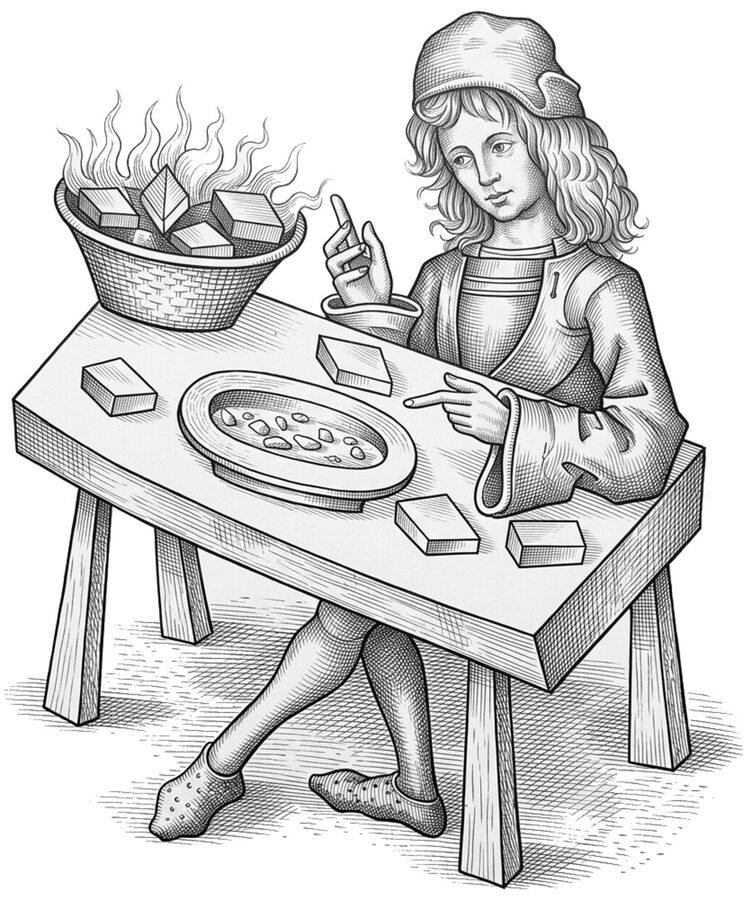
An accompanying woodcut depicts an artisan testing uncut gems in an open flame. A hasty reader scanning the page could easily mistake the name of the cited author, Evax, for another title of the adamant itself.
Modern Survival
The Book of Vexations kept its place among the works of Paracelsus for centuries. It appeared in Latin in 1568, Johann Huser printed the German text in the sixth volume of his collected Paracelsus in 1590, and Waite’s translation brought it to English readers in 1894. Huser already noted that no copy in Paracelsus’s own hand had been found. Karl Sudhoff, the editor of Paracelsus’s complete works, concluded in 1933 that an unknown author wrote the book around 1560, and he did not think much of that author’s skill.
The name Evax for the diamond therefore comes from a book that only borrowed Paracelsus’s name, and from a king whose letters a monk probably wrote. In modern collections, the entry remains preserved between the emerald and the lodestone. It survives as ancient authors left it: dark as iron, no larger than a hazelnut, and broken only by warm blood.